
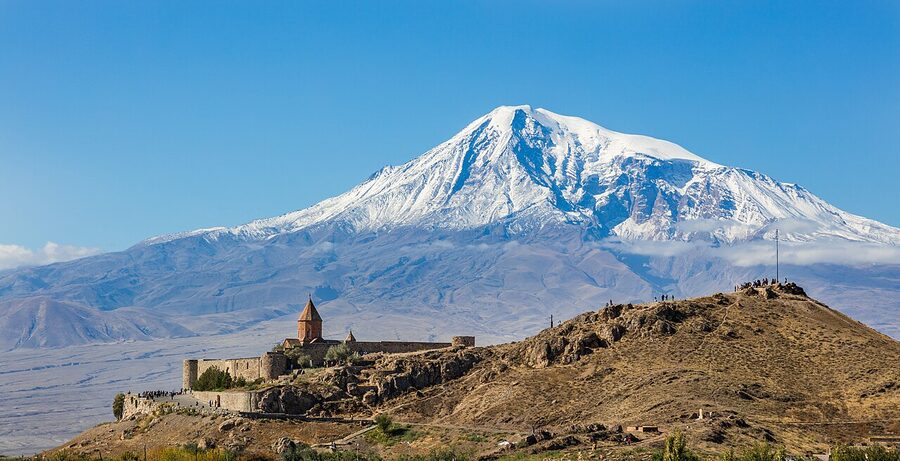
Khor Virap is the monastery you go to for the church. That sells it short. You go for the mountain.
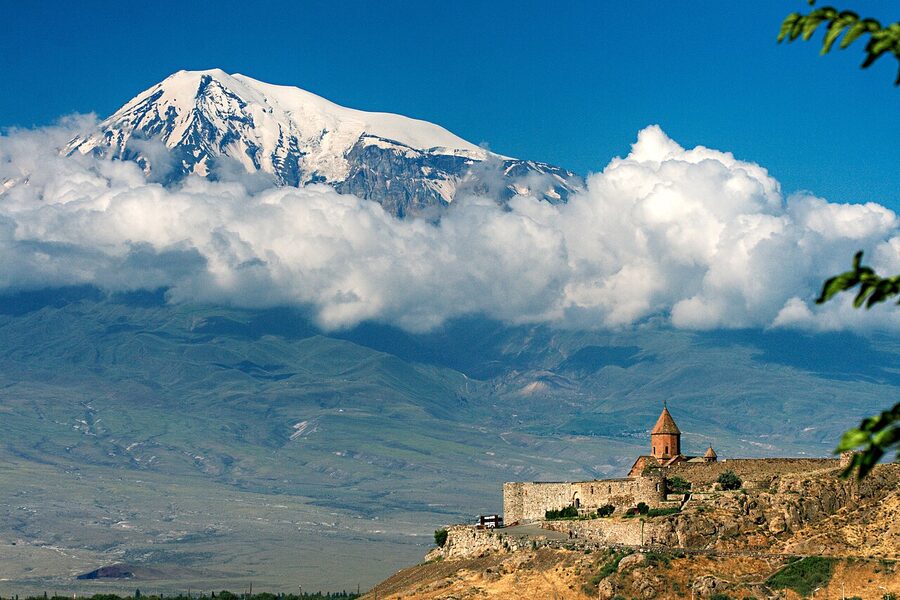
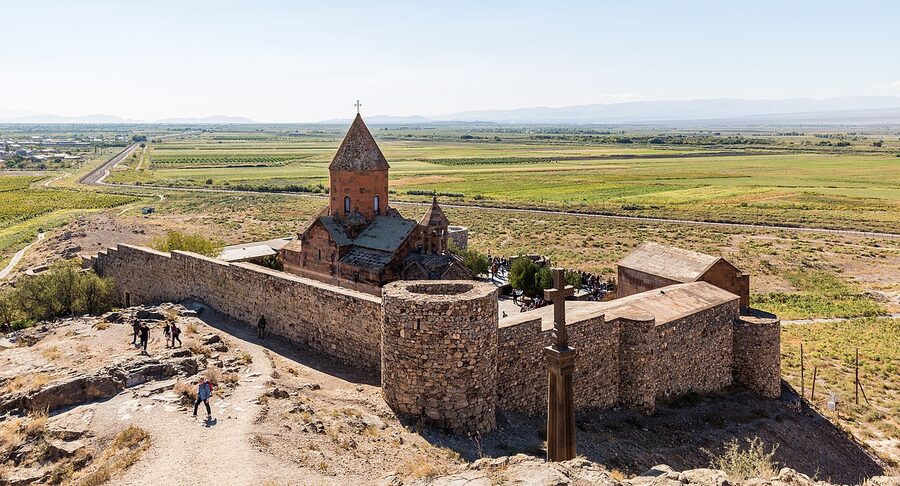
The 17th-century church is fine. It is small, plain, fortified, and there are several Armenian monasteries that beat it for architecture alone. Geghard is more dramatic. Echmiadzin Cathedral is bigger and the seat of the church. Garni is older and Greco-Roman and frankly more striking on its own merits.
What none of them have is Ararat directly behind them, almost close enough to touch, with nothing in between except a flat valley and a barbed-wire border.
That is the picture. That is why you go.
In This Article
- The view, and why it lands the way it does
- Get there at sunrise. Everything else flows from that.
- Hire a taxi for the morning run
- Drive yourself if you have the licence
- The bus, and why it kills the morning
- What the place actually is
- The royal prison, and the lost capital next door
- The legend that turned a pit into a pilgrimage
- From 7th-century chapel to 17th-century church
- Inside the chapel
- Two pits, two stories
- Climbing down, and when not to
- The hill above the monastery is the better viewpoint
- The other building, and the khachkars
- Skip the doves
- Practical bits
- Hours, fee, and the dress code
- Where it sits, and what’s behind the fence
- What to bring on the day
- Pair Khor Virap with the Areni-Noravank run
- Tour options if you don’t want to drive
- Combining Khor Virap with the other big monasteries
- The clean two-day plan
- Adding Echmiadzin and Zvartnots
- The light, the season, the photo
- Spring blossom in the Ararat Plain
- October vineyards and a winter cap
- Summer haze and winter ice
- The pit, the mountain, and the politics nobody mentions
- How the border ended up where it is
- Why the locals come too
- So, is it worth it?
The view, and why it lands the way it does
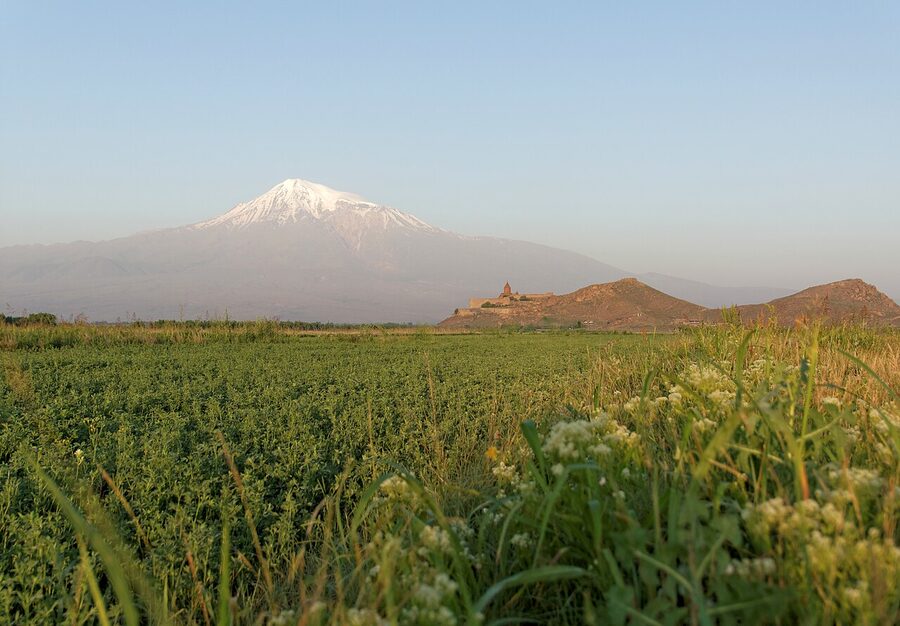
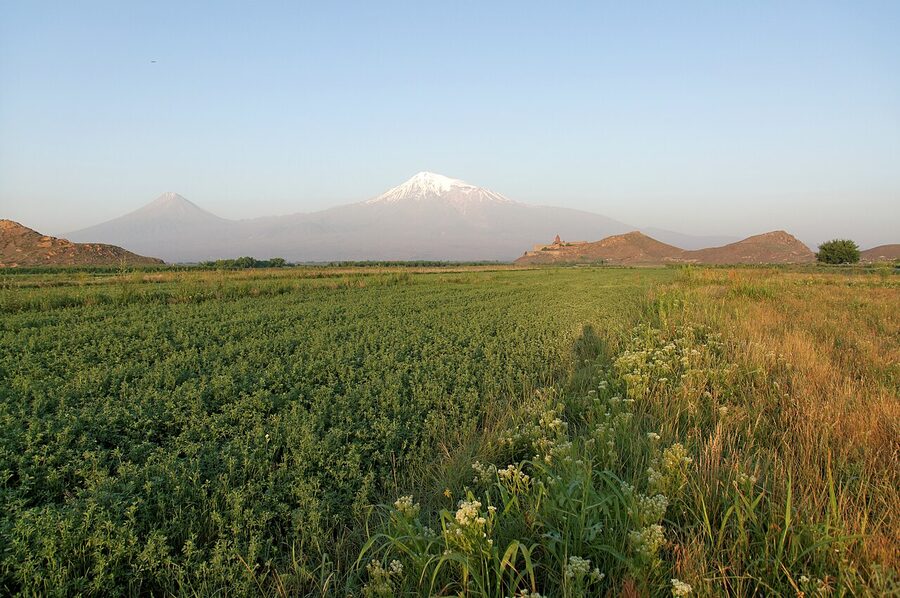
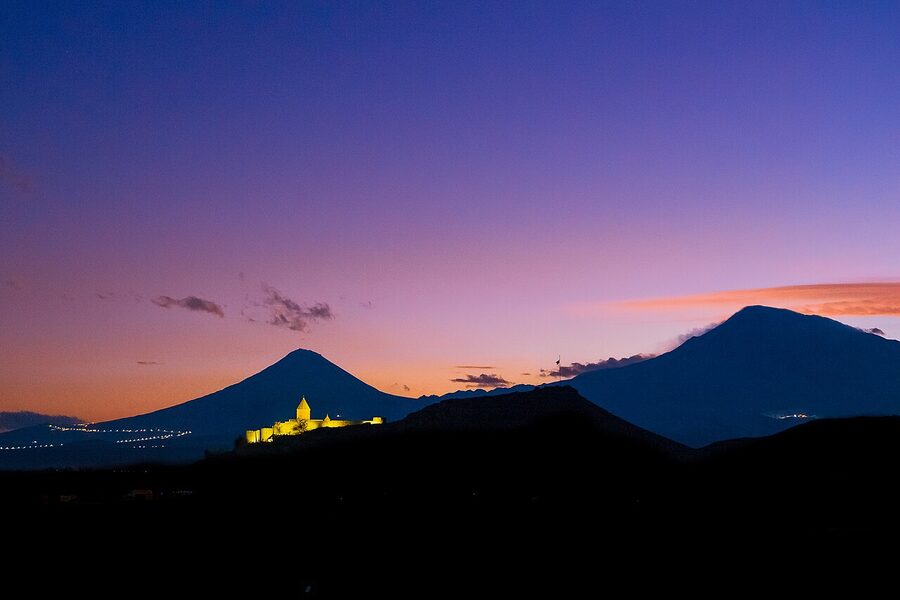
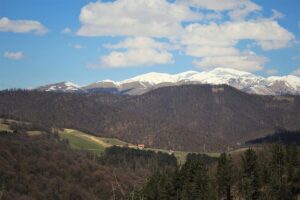
Ararat is 5,137 metres of stratovolcano sitting alone in a flat plain. There is no foothill clutter. There is no nearby second peak to pull the eye. From the hillock at Khor Virap you have a 100-metre rise, the closed Turkish border about a hundred metres further, and then nothing for forty-some kilometres until the snow line. Big Ararat on the left, Little Ararat trailing off to the right, and the silhouette of a monastery anchoring the foreground.
It is a postcard composition because the geography itself is composed.
The catch is that Ararat is famously shy. Cloud rolls in by mid-morning, sits on the summit, and what you came for is gone. Locals will tell you cheerfully they have lived in the valley a lifetime and seen it clean only a handful of times. That is not really a complaint. It just means the morning visit is the difference between a great trip and a fine one.
Get there at sunrise. Everything else flows from that.
The standard day-trip pattern is breakfast in Yerevan, leave around 9, arrive at Khor Virap around 10. By 10 the cloud is up and the bus tours are in. You will spend half an hour shuffling and you will not get the photo.
If you can be at the gate when it opens at 8 (it is sometimes already unlocked by 7:30, depending on the caretaker), you have something close to the place to yourself. The light is also better. Ararat catches early sun. By 9am the contrast collapses and the mountain reads as a flat grey wedge instead of the textured snow-capped thing you came for.
Hire a taxi for the morning run
A round-trip from Yerevan with about an hour at the monastery is around 12,000 to 15,000 dram (roughly $30 to $40). Use GG Taxi or Yandex Go to find one rather than negotiating from the curb. Tell the driver you want to be at Khor Virap by 7:45. A one-way fare runs around 5,000 to 6,000 dram (about $13 to $15) but you will then need a wait fee, or you take your chances trying to flag a return ride from the village. The round-trip is the cleaner deal.
One thing worth flagging: many Yerevan taxi drivers have limited English. If you are negotiating on time-of-arrival or wait minutes rather than just a destination, the apps make life easier because the route is set in advance and the price is on screen.
Drive yourself if you have the licence
The road is easy. South out of Yerevan, then a turn-off marked for Pokr Vedi, and you wind up the four kilometres to the hill. Discover Cars or any of the Yerevan-based rentals will set you up. Allow 50 to 60 minutes from the city.
The advantage of driving yourself is the photo stop a kilometre out. There is a stretch of the access road where the monastery and Ararat line up perfectly through the foreground vineyards, and the best shot every photographer wants is taken from there, not from the hilltop. Pull over. A bus tour cannot.
The bus, and why it kills the morning
The bus does work, technically. Number 467 leaves Sasuntsi Davit station and stops at Khor Virap on the way to Noyakert. It costs around 350 to 500 dram. The catch: the first departure is later than dawn, so the bus puts you onsite at exactly the time the magic ends. Schedules vary by season, but the standard departures are 9am, 11am, and the early afternoon, and the timetable is not always honoured to the minute. If your trip is purely budget-led the bus is fine. If you came for the picture, take the taxi.
One more wrinkle: some local marshrutkas labelled for “Ararat” town will drop you a kilometre and a half from the monastery rather than at the gate, and then you walk. Worth confirming with the driver before you board.
What the place actually is
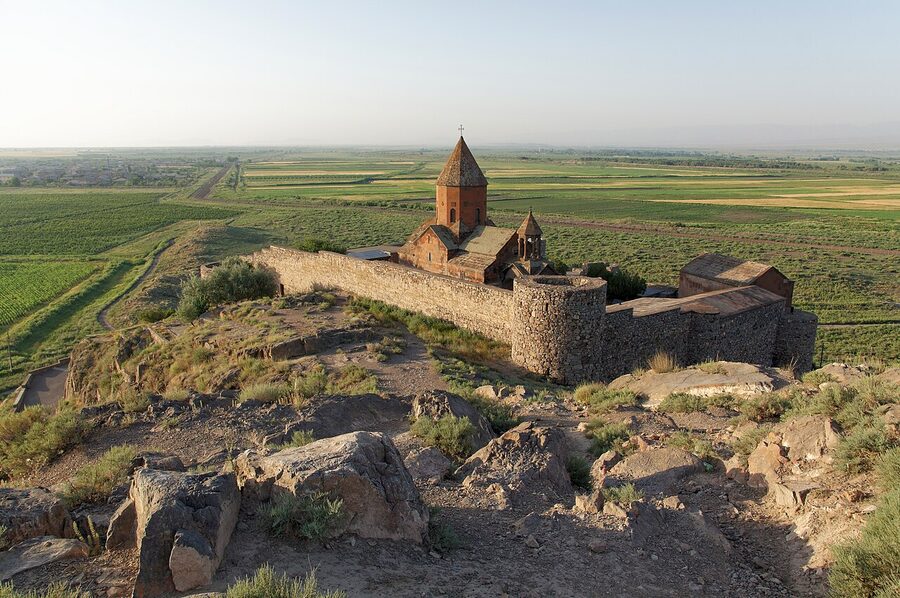
Khor Virap means “deep dungeon”. It is named for what was here long before the church.
The royal prison, and the lost capital next door
Around 180 BC, King Artashes I founded the Armenian capital of Artashat in this stretch of the plain (Hannibal of Carthage was reputedly involved in laying it out, which is one of those facts that sounds invented and is not). Artashat needed a royal prison. The deepest pit in the area got the job, and it kept the job through the next several centuries. People did not come back from it.
Artashat was the seat of the Artashesid dynasty for around five hundred years. It stayed the capital until King Khosrov III moved the court to Dvin in the 330s, and what was left of Artashat was destroyed by the Sasanian king Shapur II soon after. The ruins sit roughly eight kilometres north of the monastery hill. Excavations on the thirteen mounds around Khor Virap have been running since the 1970s and have turned up coins, mud-brick fortifications, and pottery, plus a few of the artefacts now in the British Museum that point to an earlier pagan temple on the monastery site itself, possibly dedicated to Anahit, the Armenian goddess of fertility, healing, and wisdom.
The legend that turned a pit into a pilgrimage
The story that turned the prison into a pilgrimage site is the one every Armenian school child can tell you in two minutes. The man who would become Saint Gregory the Illuminator preached Christianity to King Tiridates III at the wrong moment, the king did not appreciate it, Gregory ended up in the pit. He stayed thirteen years. A Christian widow in a nearby village dropped him bread. The king, meanwhile, descended into something the chronicles describe as madness, his sister had a vision, and Gregory was hauled out, cleaned up, and credited with curing the king. In 301 the king declared Christianity the state religion of Armenia, the first country to do so.
The longer version of the legend is darker than the school summary. The chronicler Agathangelos says Tiridates persecuted a Roman Christian named Rhipsime and her companions, refused to take a hint when she rejected him, and was struck by what the medieval texts describe as a lycanthropic madness, foraging like a boar in the fields. His sister Khosrovidukht had the vision repeatedly before anyone took it seriously. Most of the people sent to retrieve Gregory expected to find a body. He was alive.
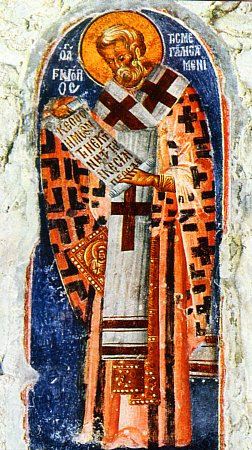
Whatever you make of the legend, the key dates check out. The conversion is real, the imprisonment is at least documented in early Armenian sources, and the cult of Gregory is the single most important thread running through Armenian religious history. There is also a colder political reading some historians prefer: the conversion was strategic, a way of carving out an Armenian identity between Zoroastrian Persia and pagan Rome. Both readings can be true at once.
From 7th-century chapel to 17th-century church
The chapel built on the pit in 642 by Catholicos Nerses III the Builder marked the spot. Nerses was a heavyweight: he ran the Armenian Apostolic Church just as Arab armies were arriving in the region, and the chapel at Khor Virap was one of a string of building projects designed to anchor the Church’s authority in stone. He also built Zvartnots, the great round cathedral whose ruins now sit between Yerevan and Echmiadzin, in the same period. The original 7th-century chapel at Khor Virap was made of white limestone. Most of it has been rebuilt or replaced after centuries of invasion and earthquake, including the catastrophic 1679 quake that flattened large parts of the Ararat Plain.
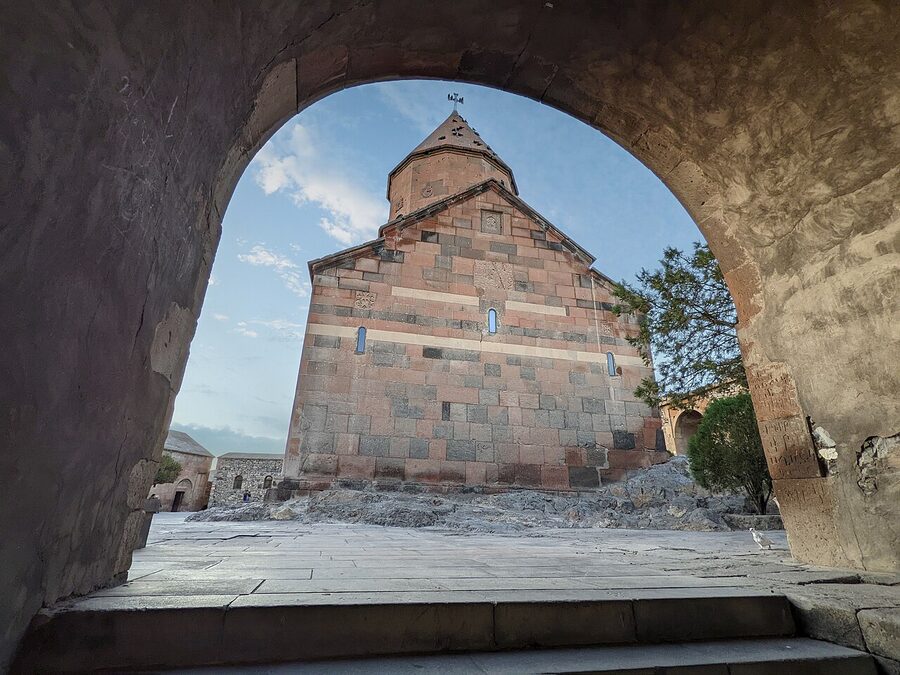
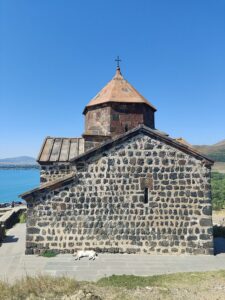
The current Surb Astvatsatsin (Holy Mother of God) church went up around the older structure in 1662, during the period when this part of Armenia was under Persian Safavid rule. It has been restored several times since (notably in 1939, 1949, 1957, and around the turn of this century), which is why the walls feel cleaner and tighter than the centuries on the plaque suggest. That is the building you walk through today.
Inside the chapel
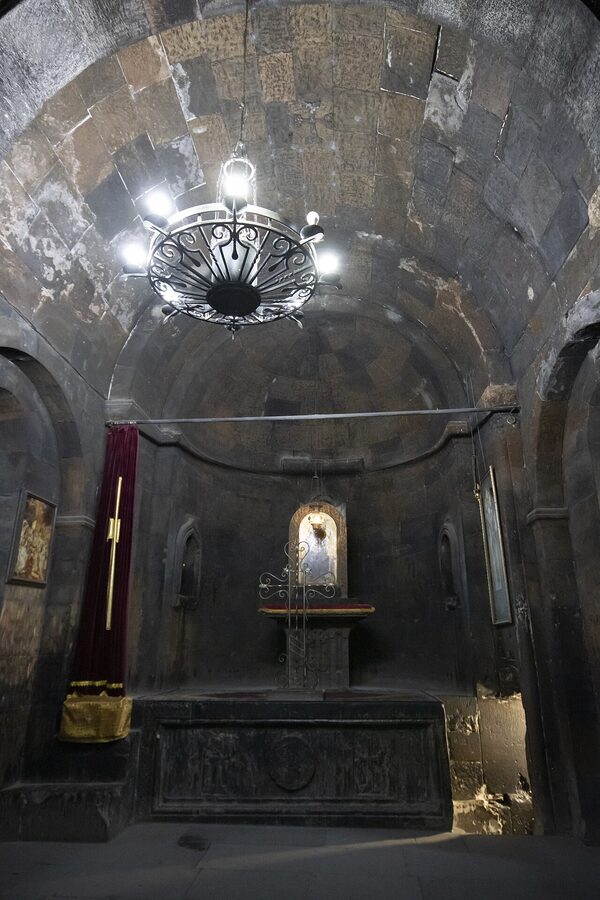
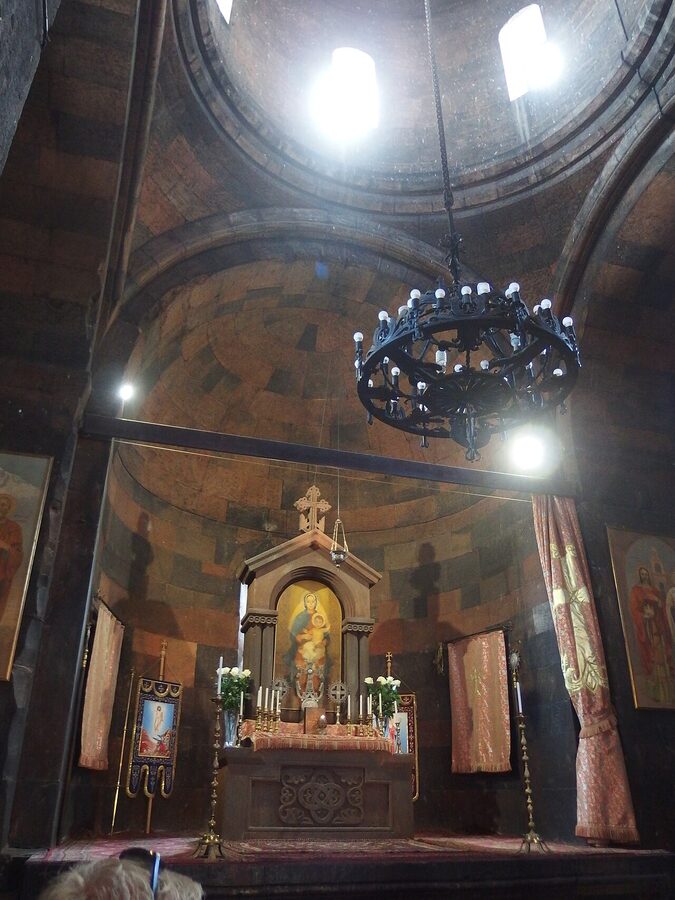
The interior is not what you came for. It is a working Armenian Apostolic church, candles for sale at the door, no frescoes worth describing, no famous icon. The pull is the stairways.
Two pits, two stories
Two pits sit beneath the chapel floor. The smaller hole in the south wall is the cell where Gregory was supposedly imprisoned. The deeper one in the southwest corner, accessed by a near-vertical iron ladder of about 27 rungs, is the dungeon proper. Six metres deep, four and a bit metres across. The two are unmarked from above, which is the kind of thing that catches you out: you can step almost directly onto the rim before you notice the drop.
Of the two pits, the deeper one is the famous one. The shallower may have been added later. Different sources will give you different answers about which is “really” Gregory’s, and the medieval chronicles do not draw a clean line between them. Nobody can tell you which one for certain, and that uncertainty is part of why the story works the way it does.
Climbing down, and when not to
You can climb down. Most people do.
It is uncomfortable in the way that small enclosed spaces are uncomfortable. In summer the air below ground is thick with humidity and the bodies of however many tourists came in before you. In winter it is dim and cold. Sturdy shoes are non-negotiable; the rungs are smooth metal, slightly polished by use, and the ladder runs at something steeper than 70 degrees. Don’t bring a candle down with you. The heat from a few of those in a small chamber is unpleasant.
If you have any history of claustrophobia, look in from the top and call it. The view of the pit is more interesting than the floor of it anyway. Pay attention also to the queue: on Armenian holidays and weekends, particularly around Easter and the New Year period when the church holds the candle ceremony, there can be a wait of fifteen or twenty minutes for the ladder, and the chamber below holds maybe five people without anyone touching anyone else. If the line is more than four deep when you arrive, walk the rest of the complex first and circle back.
The hill above the monastery is the better viewpoint
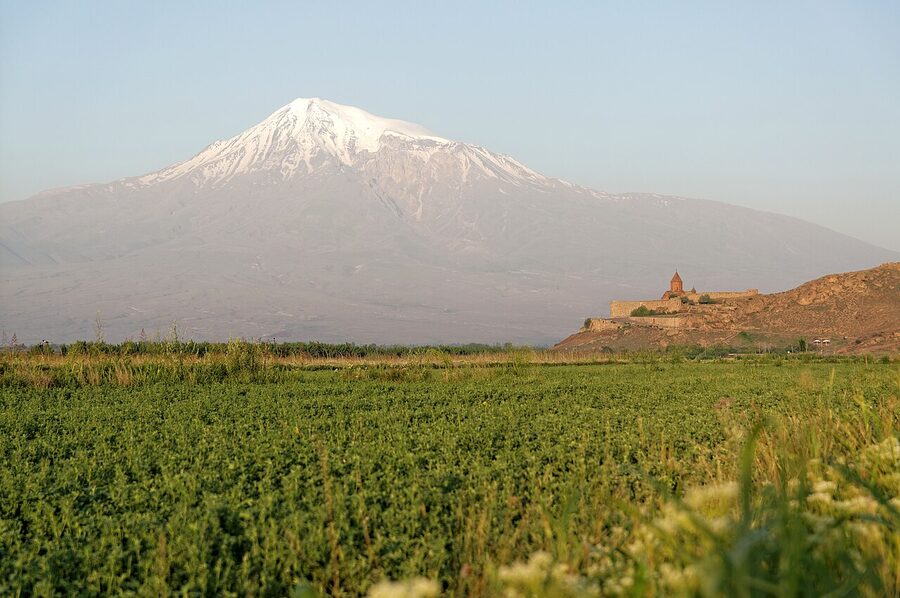
This is the part the standard half-day tour skips, and it is the best fifteen minutes you will spend on the site.
Walk out of the monastery’s main gate, turn left, and follow the rough path up the small hill. There is an Armenian flag at the top. Total time, about five minutes if you take it slowly. From there you have the monastery in the foreground, slightly below you, and the full sweep of Ararat behind it. This is the angle in most of the postcards. It is also the angle that makes you understand the geography of the whole valley: the line of the Aras River, the fence of the Turkish border, the snow on the volcano, the way Khor Virap sits exactly where the plain stops being plain.
From this hill, on a clear day, you can technically see four countries. Armenia, Turkey, Iran, and Azerbaijan all meet within sightlines of where you are standing. The four-country fact is one of those things that sounds like a guidebook trick and is true.
The other building, and the khachkars
The compound has two churches, not one. The big one, Surb Astvatsatsin, is what most visitors see. The smaller St Gevorg chapel sits on the same site as the original 7th-century building of Nerses III. It is plain inside, oriented oddly to the rest of the complex (Armenian churches almost all face east-west; St Gevorg points north-west to south-east, which is the same odd alignment as the pagan Temple of Garni and probably not a coincidence), and easy to miss in the rush to get down the ladder. Worth the two minutes.
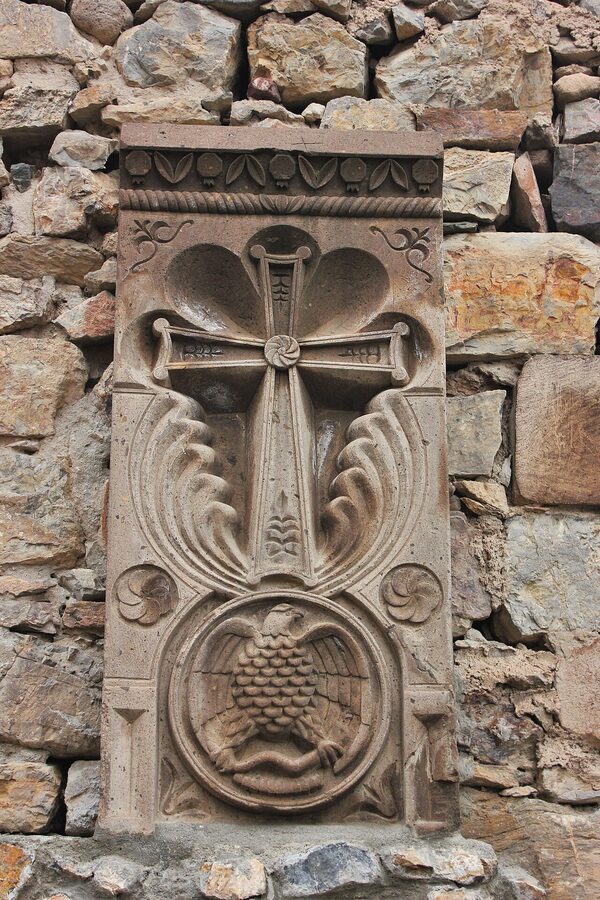
Worth a slow look, also, at the southern wall of the main church, where there is a sundial cut directly into the stone. The bell tower is built up against the western wall in dark basalt, which is the kind of detail you only notice once someone points it out and then can’t un-see. Around the courtyard you’ll see khachkars, the carved cross-stones that turn up at every monastery in Armenia. Khor Virap’s are not the most ornate in the country (Goshavank or Geghard outdo them on detail) but several are old, and a few are working memorials.
Skip the doves
You will be approached at the gate, and again on the way out, by people selling caged white doves. The pitch is that you release the dove and it flies toward Mount Ararat, carrying a wish or a prayer. It is photogenic. It is also a small animal-cruelty industry. The doves are bred in cages, released untrained into a landscape they cannot navigate, and the lucky ones are recaptured by the same operators within the hour for the next tourist. The unlucky ones do not make it back.
It is a no from me. There are better ways to mark a visit.
Practical bits
Hours, fee, and the dress code
Opening hours. Roughly 8am to 6pm in winter (November to March) and 8am to 8pm in summer (April to October). There is no central authority publishing the hours and visitors report some variation; arriving at 7:45 in any season usually finds the gate already open. The dungeon is accessible whenever the chapel is.
Entrance fee. Free. So is the pit. Tip the caretaker if you go down and back up; a few hundred dram is gracious.
Dress code. A working Armenian Apostolic church. Knees and shoulders covered for both men and women, and women are expected to cover their heads inside the chapel. A scarf is enough. They have loaner scarves at the door if you forgot.
Where it sits, and what’s behind the fence
Where it is. Pokr Vedi village, about 4 km from the main M2 highway and roughly 30 to 43 km south of Yerevan depending on which point in the city you measure from. Travel time is 40 to 60 minutes by car. The nearest town of any size is Ararat, about ten minutes further south by road, which is where you would change buses if you came on the cheap.
Where you cannot go. The barbed-wire fence behind the monastery is the closed Turkish-Armenian border. Russian guards keep a watch over it. You cannot get past the fence, and you should not be photographing the actual border infrastructure even though no one will object to your shooting Ararat above it. There are stories of lights on the mountain at night, Turkish bases, listening posts; whether any of that is true or just the kind of thing locals tell visitors to make the place sound dramatic, I will not pretend to know.
What to bring on the day
What to bring. Sun. The plain has no shade. In summer this corner of Armenia regularly hits 35 to 40 degrees C and there is no breeze on the hill. Bring a hat. Bring water; the kiosks at the bottom of the path overcharge for it. Bring cash for souvenirs and the candle stand. A power bank is worth tucking in if you are continuing south to Areni and Noravank afterwards, because there are not many places to charge between here and the wine valley.
Pair Khor Virap with the Areni-Noravank run
The standard day trip from Yerevan does Khor Virap, then Areni for lunch and wine, then Noravank, then back. If you only have a day to spend on the south, this is the route to do. It runs eight to nine hours, and the wine portion is genuinely good (Areni grapes have been pressed in this valley for over six thousand years, since some of the world’s earliest known winemaking at Areni-1 cave).
I’d flip the order if you can. Do Khor Virap first thing for the morning view of Ararat, then push south for an hour to Areni, eat there, taste the wine, then up to Noravank in the afternoon when the red rock of the gorge actually catches sun. Most tour operators run them in this sequence anyway. If yours wants to do Noravank first, push back; you will lose the Khor Virap view.
For more on the Areni grape, the food in this region, and what to order, the traditional Armenian food guide covers the lunch you’ll want at the wine stop.
Tour options if you don’t want to drive
Group day trips out of Yerevan covering Khor Virap with Noravank and Areni run roughly $40 per person and last about 9 hours. Private tours land in the $80 to $135 range for groups up to three or four people. The major aggregators all sell variations on the same itinerary; the differences are vehicle quality, English-speaking guide, and whether wine tasting is included.
Khor Virap day trip from Yerevan (GetYourGuide | Viator | Klook)
Whichever you book, ask the operator whether they leave Yerevan early enough to put you onsite by 8am. Many of them don’t. The standard 9am departure gets you there at the cloud hour. A 7am departure costs the same and changes the trip.
Combining Khor Virap with the other big monasteries
People sometimes ask if they can do Khor Virap, Garni, and Geghard in one day. The geographic answer is no, not well. Garni and Geghard are east of Yerevan in the Kotayk hills; Khor Virap is south on the Ararat Plain. The roads don’t connect cleanly, and squeezing all three into a single day means you have done none of them.
The clean two-day plan
One day south for Khor Virap, Areni, Noravank. Another day east for Garni Temple and Geghard Monastery, with lavash baking demonstrations slotted into the gap between them. Most operators sell exactly these two as a paired pair. Nine hours each, lunch built into both, and you finish the second evening having properly seen the four sites that are on every Armenia first-timer’s list.
Adding Echmiadzin and Zvartnots
If you also want Echmiadzin, the historical seat of the Armenian Apostolic Church, that is a half-day on its own (it sits west of Yerevan, towards the airport). Some private operators bundle Khor Virap with Echmiadzin and Zvartnots in a six-hour route, which works if you’re tight on time, but you sacrifice Areni and Noravank to do it. Zvartnots, by the way, is the round 7th-century cathedral built by the same Catholicos Nerses III who built the original chapel at Khor Virap. The two sites are linked by their builder, and seeing them on the same day, even via a slightly compromised itinerary, has its own logic.
The light, the season, the photo
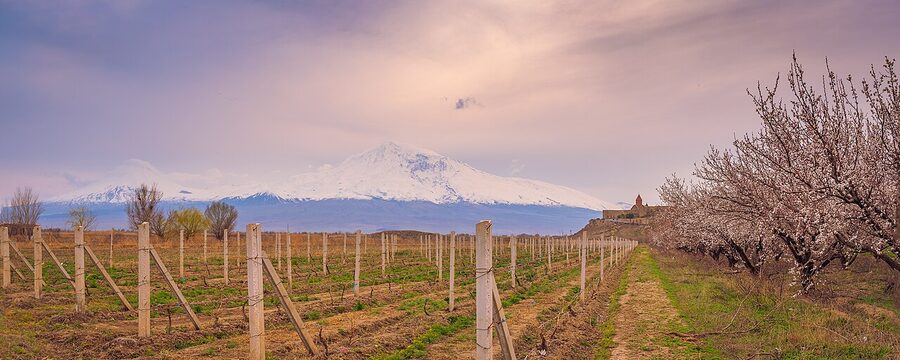
The two seasons that put Khor Virap at its best are spring and autumn, for opposite reasons.
Spring blossom in the Ararat Plain
April to mid-May is the bloom window. Orchards in the Ararat Plain are full of cherry, apricot, and plum blossom and the foreground of the postcard shot turns pink and white. Snow is still solid on the upper third of Ararat. Mornings are clear more often than not. Easter usually falls inside this window too, which is worth knowing if you would rather not be onsite for the holiday crowds; the days immediately after Easter weekend are quieter than the weekend itself.
October vineyards and a winter cap
October is the second best. The vineyards are deep red, the air is dry and cold, and Ararat will already have its winter cap. The contrast on a clear morning is sharper than at any other time of year. The Areni grape harvest runs through this period, so a Khor Virap morning followed by an Areni afternoon is unusually good in the first three weeks of the month, when the wineries are at their busiest in a way that does not feel touristy.
Summer haze and winter ice
Summer is hot and hazy and the mountain spends most of the day under cloud. Winter is clear but cold (-5 to 5 degrees C is normal), and the road in from the M2 can be icy. If your trip is fixed to August, get there at sunrise and accept that you may not see the summit at all. If you have flexibility, go in May.
The pit, the mountain, and the politics nobody mentions
You can’t write about Ararat from Khor Virap without naming the thing that is right in the frame.
Ararat is the symbol of Armenia. It appears on the national coat of arms. It dominates the Yerevan skyline. The country’s flagship cognac is named after it. There is no mountain in any country that pulls more cultural weight relative to its actual geography.
And it is in Turkey.
How the border ended up where it is
The mountain has not been on Armenian territory since 1921, when the Treaty of Kars formalised the post-Ottoman, post-Soviet border arrangement and put both Big Ararat and Little Ararat inside the new Republic of Turkey. Most Armenians do not have access to it for normal travel; the border is closed and has been since the 1990s. From Khor Virap you stand maybe a hundred metres from the fence with the mountain rising behind it. You cannot reach what you can see.
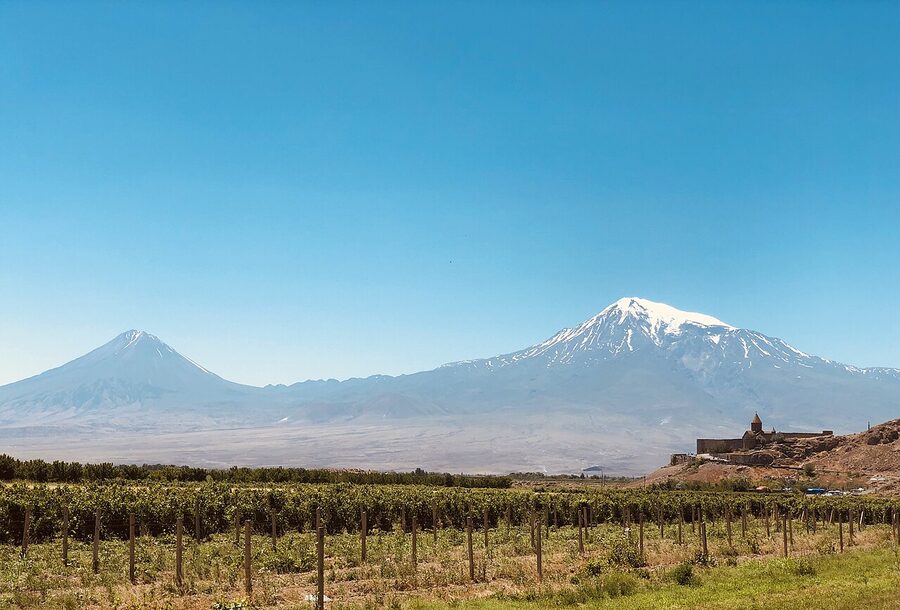
That tension is what makes the view at Khor Virap mean something more than a postcard. The monastery isn’t just a pretty foreground for a famous mountain. It is the closest most Armenians will ever get to a mountain that is, in every way that doesn’t involve a deed of title, theirs.
Why the locals come too
This goes some way to explaining why Khor Virap is on every domestic itinerary too, why it shows up on coins and stamps and brandy labels, and why nearly every Armenian wedding and baptism in the country pulls in here for photographs. The site is not crowded with foreign tourists. It is also crowded with locals.
The site keeps a working ceremonial calendar that civilians watch closely. On New Year’s Day, the Catholicos brings light up out of the pit, candle in hand, as a re-enactment of Gregory’s release. In 2016 Pope Francis visited; in 2021 Charles Michel, the president of the European Council at the time, came too. None of which makes the morning view any clearer; it just means the place is taken seriously by the Armenian state and the global church in a way the modest 17th-century walls might not suggest at first glance.
So, is it worth it?
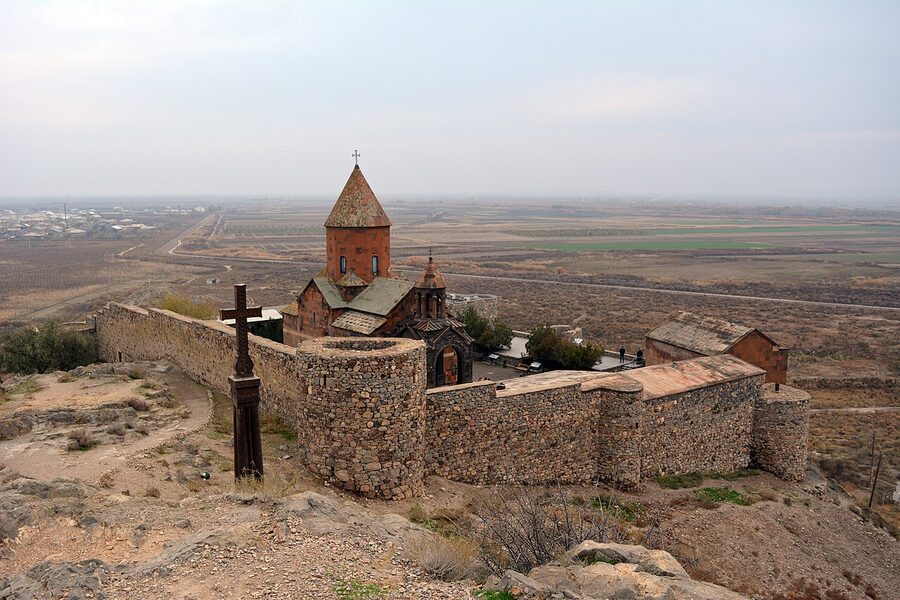
Yes, with the early start. No, without it.
If you can be on the hill before 9am with a clear sky behind Ararat, Khor Virap is one of the most affecting visual experiences anywhere in Armenia and on a short list across the entire South Caucasus. The combination of fortified small monastery, biblical mountain, closed border, and big sky is genuinely singular.
If you arrive at 11am with a tour group on a hazy August morning, you have queued for a small church that is fine but not extraordinary, you have looked at the cloud where Ararat is supposed to be, and you have had a perfectly nice forty minutes. You have also not seen the thing you came for.
Set your alarm. Hire the car the day before. Tell whoever’s driving that you want to be at the gate when it opens and not a minute later. The mountain is shy, and you only get the chance the morning gives you.


.jpg)


