Inside the Avazan, an a cappella voice catches the rock and comes back at you four or five times, slightly behind itself, slightly above. The room is colder than the air outside even in July. Smoke from beeswax candles climbs along the carved stalactites of the ceiling and disappears into the dark. Somewhere off in the gavit a tour group is photographing a dome, but in here it’s just the sharakan, the cold drip of a spring older than the church around it, and the smell of a place that has been used the same way for eight hundred years.
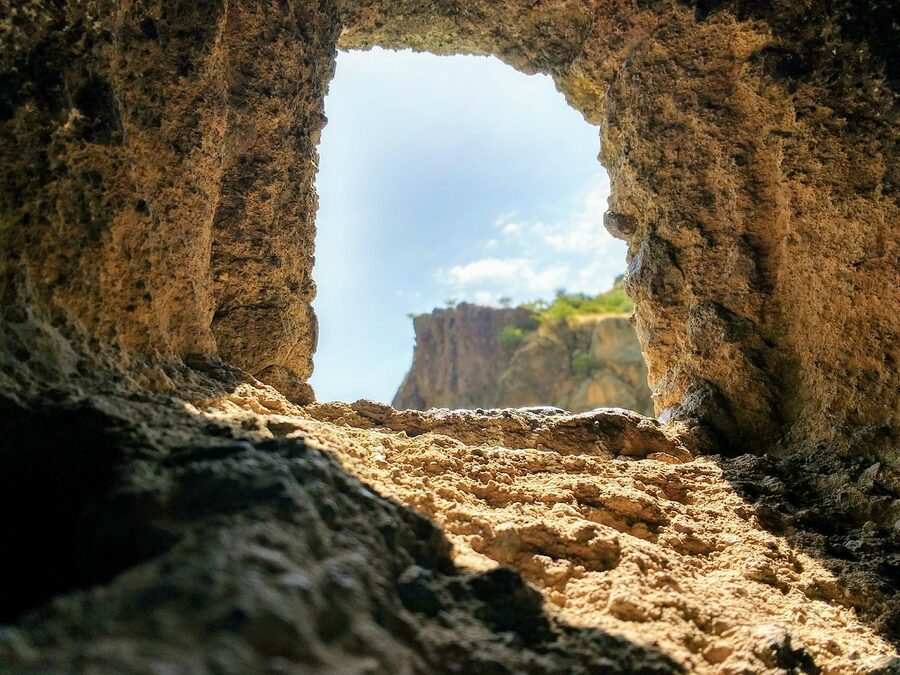
Geghard sells itself as a half-day stop on a Garni-Geghard package. That gets you there. It doesn’t get you the place. If you can give it a slow morning, do.
In This Article
- Why Geghard is different from every other monastery you’ll see in Armenia
- What you’re walking into: a quick history that earns its place
- The buildings, room by room
- Katoghike (1215): the main church
- The gavit (1215-1225)
- Avazan (1240s): the cave church with the spring
- Astvatsatsin (1283): the second cave church
- The upper zhamatun and Proshyan tomb (1283-1288)
- The chants, and why the acoustics matter
- Khachkars: the cross-stones that aren’t tombstones
- The wish-pebble shelves
- The practical bit
- Getting there from Yerevan
- By marshrutka and taxi
- By hire-taxi
- By organised tour
- Pairing with Garni: most people do, and they’re right
- What to eat at the gates
- When to go
- What you carry away
Why Geghard is different from every other monastery you’ll see in Armenia
Armenia has more monasteries than it has time for. After three or four you start clocking the same plan: cruciform church under a cone-on-drum dome, courtyard, a wall of khachkars, a view. The good ones earn the trip. The lesser ones blur. Geghard doesn’t blur, because half of it isn’t built. It’s cut.
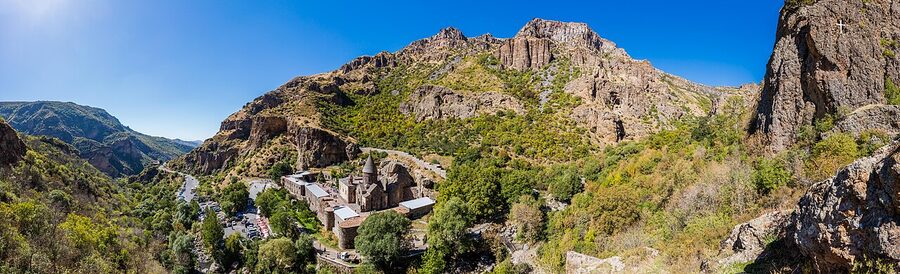
The cliffs at the head of the Azat valley are a soft volcanic stone, and from at least the 4th century, monks have been carving rooms straight into them. The free-standing main church, Katoghike, is from 1215 and looks like a normal Armenian medieval church. Behind it, the gavit is half built and half hewn out of the rock. Behind that, two more chapels, two tomb-chambers, and a hall for chants are entirely cave. There are no construction joints. You walk through a door that’s part wall, part mountain, and you can’t always tell where the wall ends and the cliff begins. This is the bit competitors describe as “carved into the cliff” without explaining what it actually feels like.
It’s also the only Armenian monastery whose name comes from a relic. Geghardavank means “Monastery of the Spear”, from the spear that pierced Christ at the Crucifixion, said to have been brought to Armenia by Apostle Thaddeus. The spear’s no longer here. It’s about an hour west, in the treasury at Echmiadzin Cathedral, and you can sometimes see it on display.
If you’d rather a Roman temple than a cave church, the standard pairing is Garni Temple, twenty minutes back down the gorge. If you want the Mount Ararat view that defines half the photos of Armenia, that’s Khor Virap, an hour south of Yerevan in the other direction. Most people do all three across two day trips, because Garni and Geghard share a road and Khor Virap doesn’t.
What you’re walking into: a quick history that earns its place
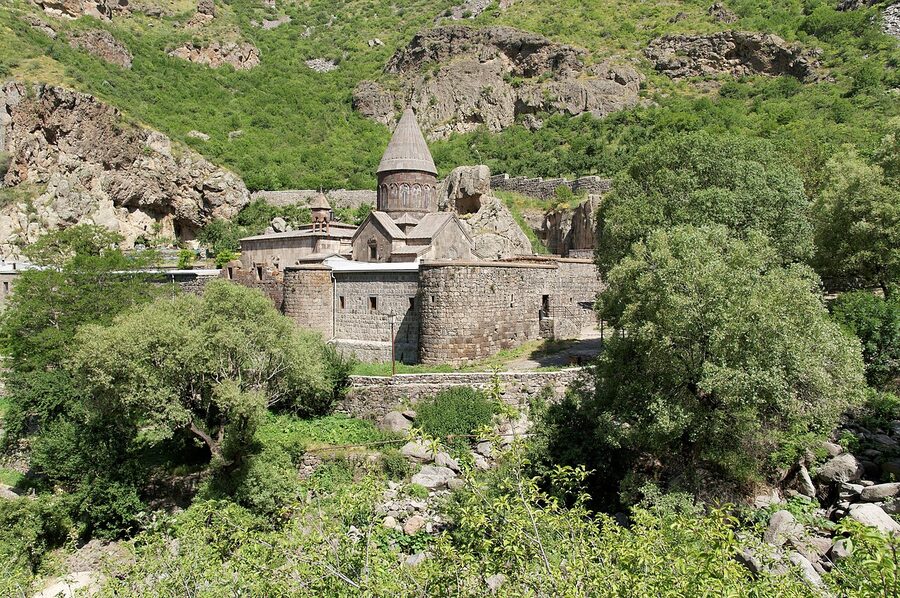
The cave at Geghard had a sacred spring before it had a church. People came here to drink the water before Armenia was Christian. Sometime in the 4th century, after Gregory the Illuminator converted King Tiridates III, the standing tradition was to put a small church wherever there’d been a pre-Christian holy site, and Gregory put one over this spring. The first foundation was called Ayrivank, “Monastery of the Cave”. It was destroyed in 923 by Nasr, an Arab vice-regent, who burned the buildings and walked off with the manuscripts. Earthquakes finished what was left.
What you see now is mostly 13th century. The Zakarid brothers, Zakare and Ivane, generals of Queen Tamar of Georgia, took most of Armenia back from the Seljuks around 1200 and started rebuilding the great Armenian monasteries. They built Katoghike at Geghard in 1215. The gavit went up between 1215 and 1225. Then in 1240 the Proshyan family bought the monastery and spent the next forty-odd years carving the rest, the part that makes Geghard Geghard. By 1283 the second cave church and the two zhamatun tomb-chambers were finished. The architect’s name was Galdzag. He’s named in an inscription on one of the church walls, “Remember Archimandrite Galdzag”, which is a strange thing to read on a wall in a country whose stonemasons usually go unnamed.
Pilgrims came for the relics. Apostles Andrew and John donated relics here in the 12th century. The Holy Lance arrived earlier, somewhere in the long story. The monastery was famous, and rich, and stayed lit for centuries. The spear was kept here, viewable to pilgrims, for 500 years. After the Russian conquest of the early 19th century the monastery emptied out, the main church wintered the flocks of Karapapakh nomads, and Geghard was barely a working religious site for a hundred years. UNESCO inscribed it in 2000 (criterion ii) along with the upper Azat valley around it, and a small monastic community lives there again today.
The buildings, room by room
This is the section nobody else writes properly. The complex has names; using them will make the visit a different experience. Bring this list, or screenshot it.
Katoghike (1215): the main church
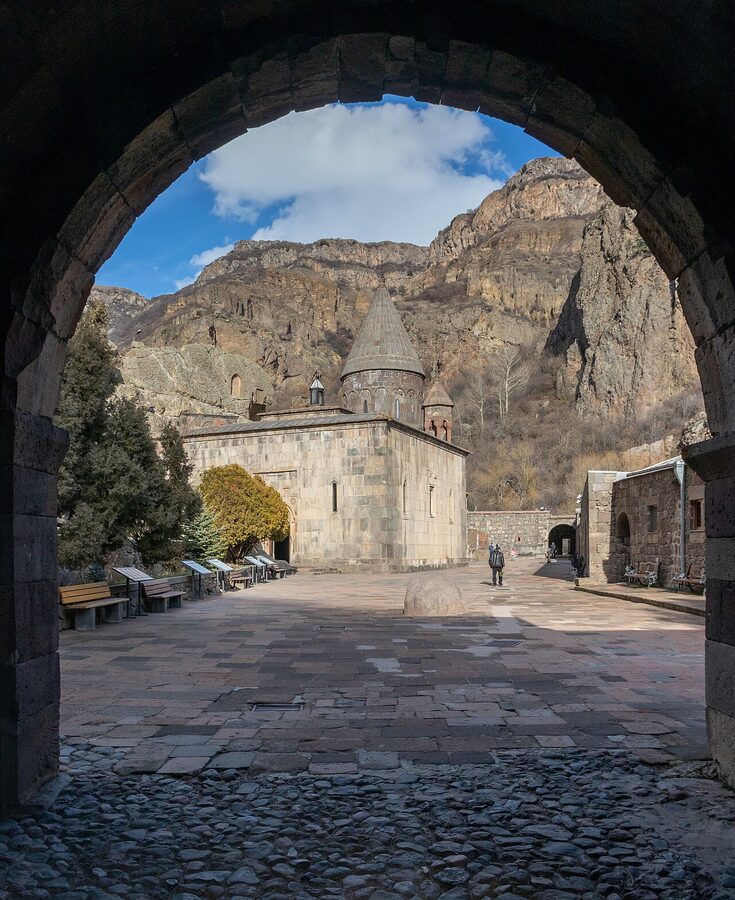
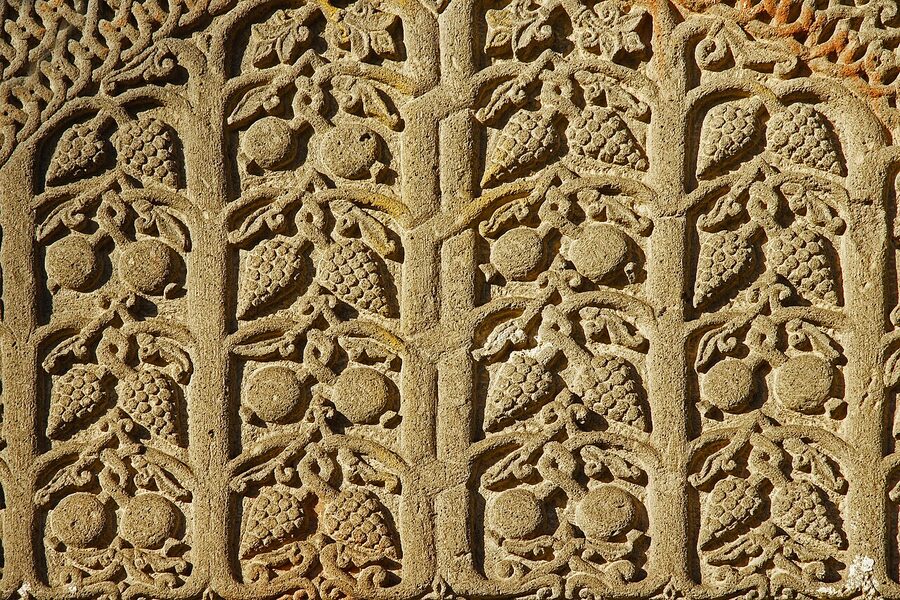
This is the only fully built church in the complex, and the easiest one to skim past, because architecturally it’s a textbook Armenian medieval cruciform plan under a cone dome. Look at the south portal before you go in. The tympanum has a tree with hanging pomegranates and intertwining grapes; doves face the central axis; above the arch a lion attacks an ox, which was a standard “this prince has power” motif of the period. Inside, the walls record donations in inscriptions that haven’t been cleaned off the stone. The drum of the dome has small reliefs of birds, masks, animals’ heads, and rosettes if you can crane your head back far enough to see them.
The gavit (1215-1225)
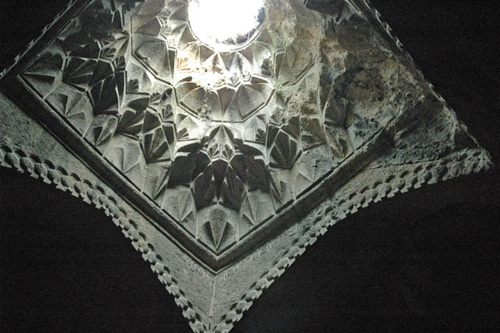
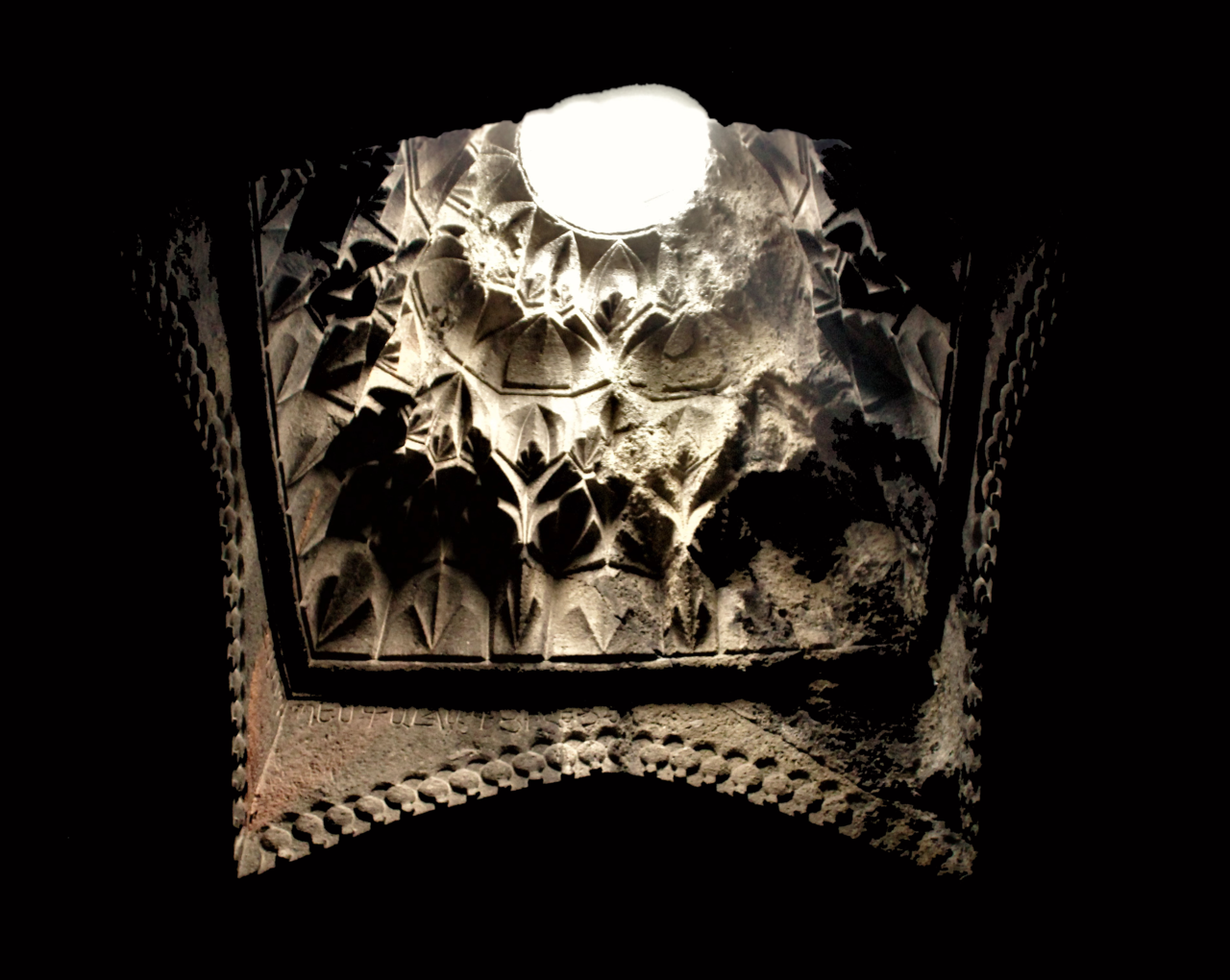
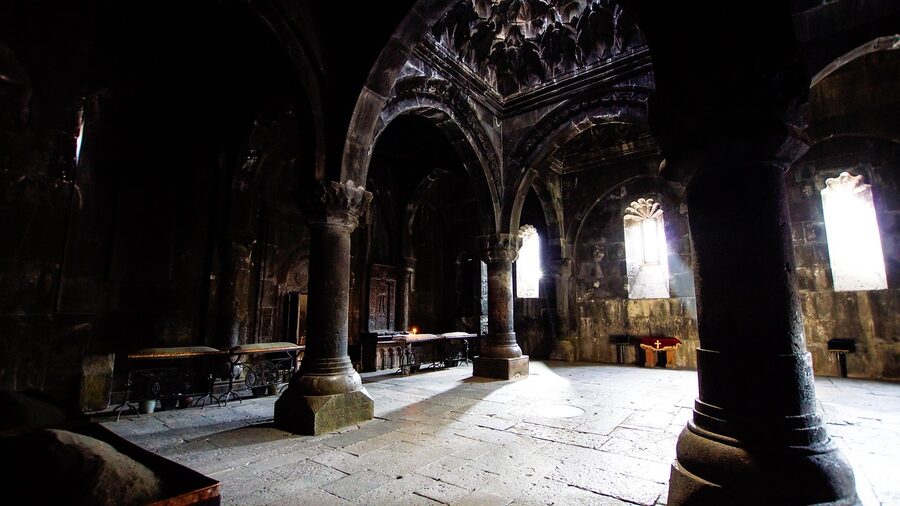
“Gavit” is the Armenian word for what Latin Christians call a narthex, the antechamber attached to the west of a church. At Geghard the gavit is the doorway to the cave system. It’s partly free-standing and partly cut from the cliff. Four heavy columns hold up a roof with a small central oculus, and that single shaft of daylight is the whole drama of the room. Look down: under your feet are gravestones, and the floor itself is the burial ground for the wealthy who paid to be entombed in the holy ground of Geghard. The acoustic in here is good. The acoustic next door is something else.
Avazan (1240s): the cave church with the spring
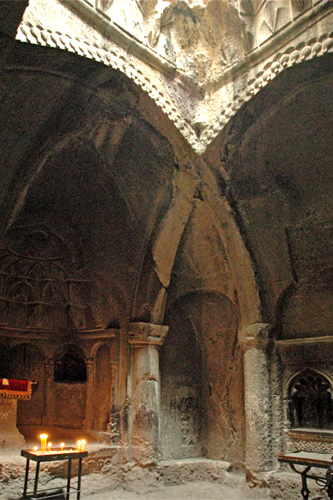
This is the room. The name means “basin”, because the spring still runs out at the base of the wall, and you can scoop water from it as pilgrims have for at least 1700 years. The whole church is hewn from one piece of cliff, dome and all. The dome is corbelled inward in concentric layers carved to look like stalactites, the central one shaped like a tent. Two crossed arches rise to that central point. There’s a single inscription that reads, more or less, “Remember Archimandrite Galdzag”, recording the architect who carved the place. He carved the second cave church next door. He probably also carved the two zhamatuns. Forty-odd years of one man’s work, all of it underground.
The spring is the reason the place is here. People drank from this water before there was a Christian church on top. People drink from it now. The water is cold, mineral, and not sterile; locals fill bottles, tourists usually just dip a hand. There’s no fence. There’s no instruction.
Astvatsatsin (1283): the second cave church
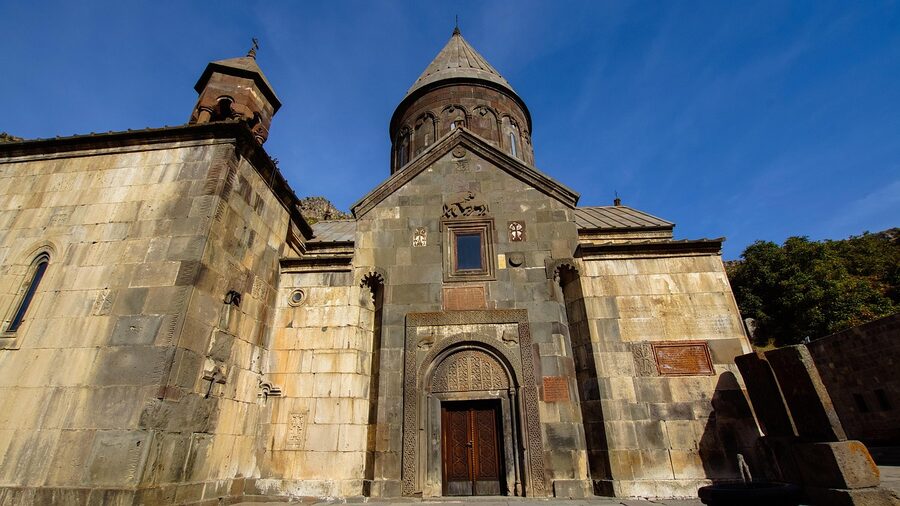
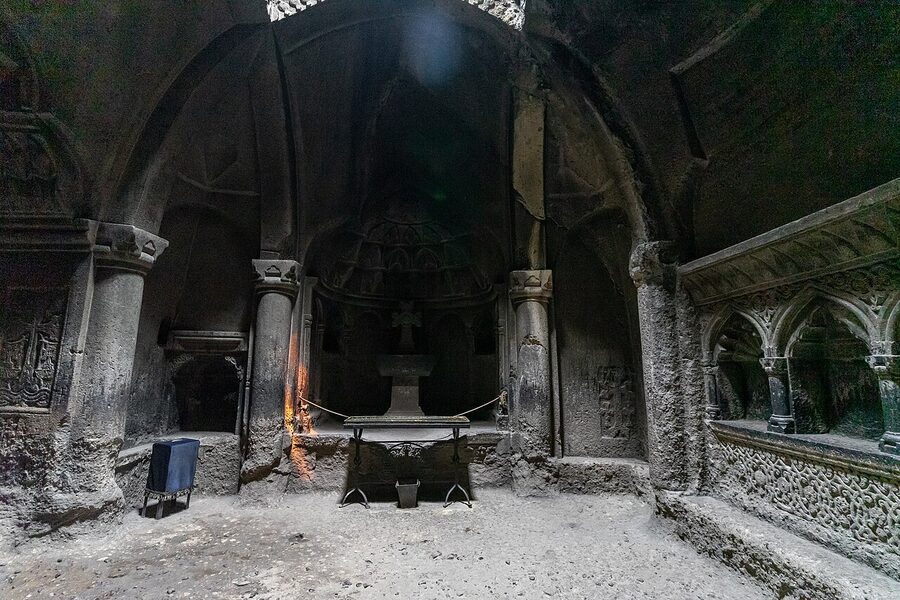
The Astvatsatsin (Holy Mother of God) chapel is the second cave church, also accessed through the gavit. It’s smaller, simpler, and has the same cruciform plan in a single block of stone. The carving is tighter; the acoustic is closer. If you’ve come on a tour, this is where the group is most likely to sing.
The upper zhamatun and Proshyan tomb (1283-1288)
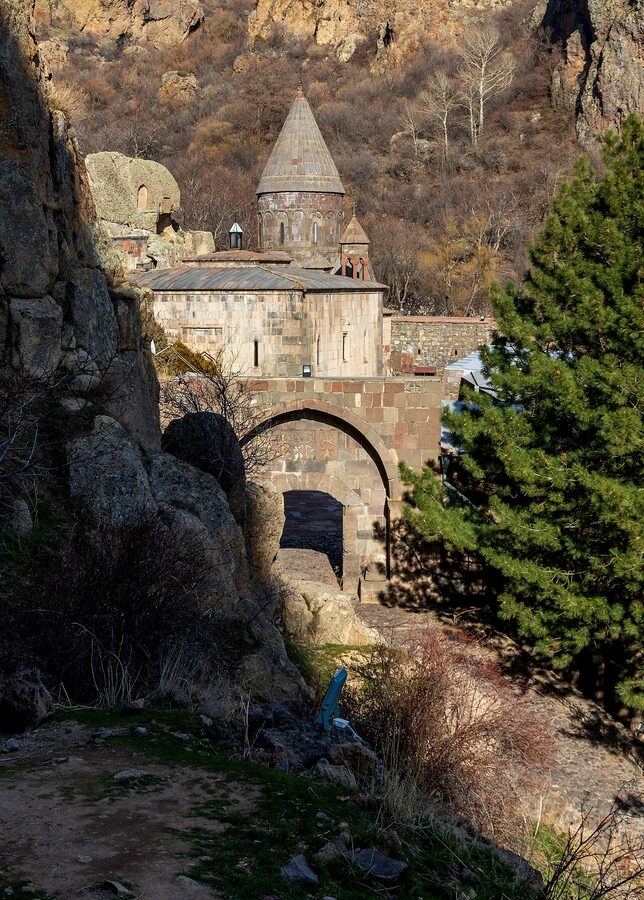
Take the stairs west of the gavit and you reach the funerary chamber the Proshyans cut for Papak Proshian and his wife Ruzukan in 1288. Next to it, in 1283, they cut a tomb for Prince Prosh Khaghbakian himself, the man who’d bought the monastery. The reliefs in the main zhamatun are unusual: a ram’s head with a chain in its jaws, two lions whose tails end in upward-looking dragons’ heads, an eagle with a lamb in its claws. The eagle-and-lamb is the Proshyan family coat of arms. The dragons are older than that. Pagan motifs the Christian masons kept and rewrote. You won’t get a guide explaining this unless you’ve paid for one. The relief is on the northern wall above the archways. Look for the chain.
The chants, and why the acoustics matter
Armenian liturgical chant, sharakan, predates Gregorian. It’s monodic, modal, and intended for unaccompanied voice. Geghard’s interior is roughly the best place to hear it. The Avazan and the Astvatsatsin are stone domes carved as one piece. Reverberation tails out for several seconds. A single voice in there sounds like four. A trio sounds like a stadium.
You’ll often catch a small ensemble singing for tips. Sometimes it’s a tour group’s local guide. Sometimes it’s two or three women in a cappella, who’ll sing one piece for whoever’s listening, and pause for a small donation if you’d like to keep going. There’s no advertised schedule. If you’re standing in the gavit and you hear voices coming from the rock, it’s the Avazan, and you should walk towards them. If a tour bus has just emptied and the place is loud, give it ten minutes; the buses leave in waves and the rooms quiet down between them.
Two practical points. The chants don’t always happen; some mornings nobody’s there. And recording, if a singer is paid, is generally fine; ask first with a gesture. The donation is what they came for, not the audio rights.
Khachkars: the cross-stones that aren’t tombstones
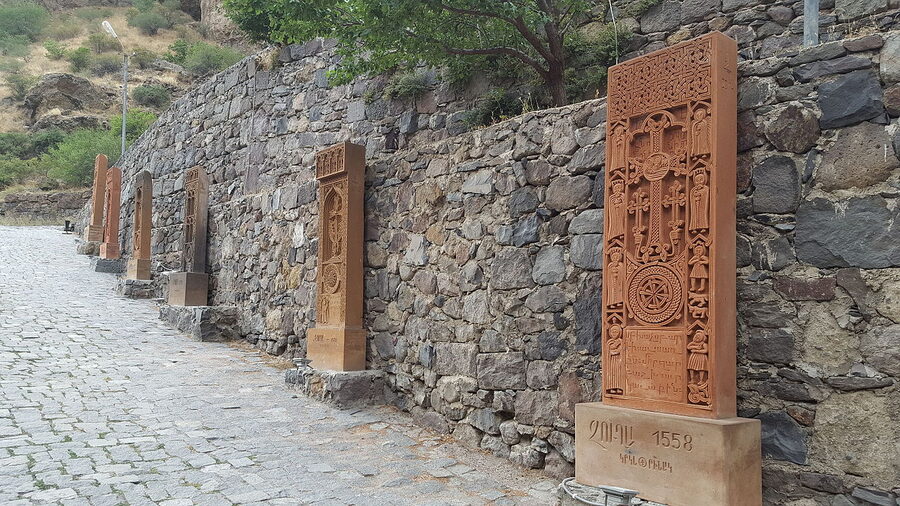
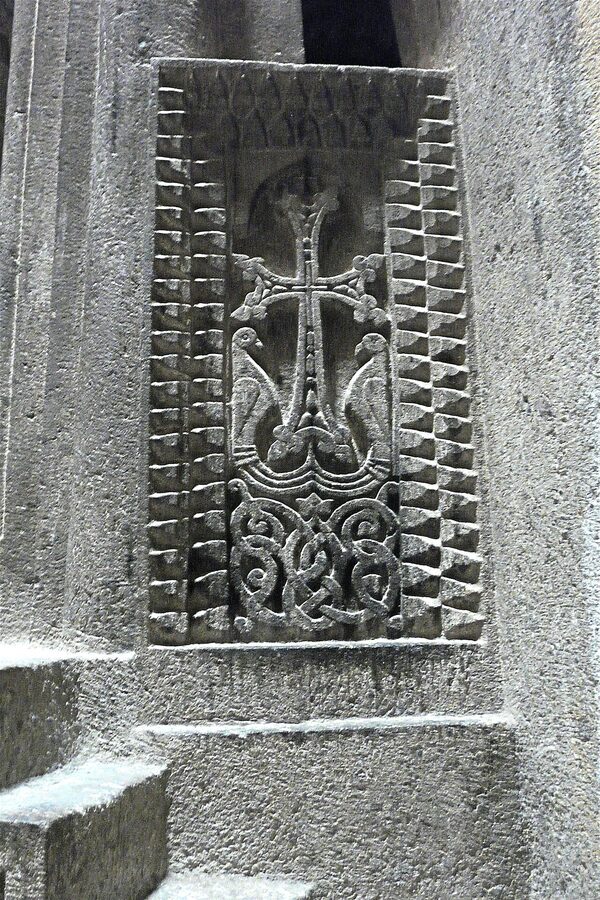
A khachkar is a slab of stone, usually around 1.5 metres tall, carved with a cross at the centre over a sun-or-eternity wheel, then covered in interlace, plant scroll, and figurative work. They’re not gravestones. They’re memorial stones, votive donations, sometimes just commemorations of an event. UNESCO put khachkar carving on the Intangible Cultural Heritage list in 2010. There are over 50,000 documented in Armenia. No two are the same.
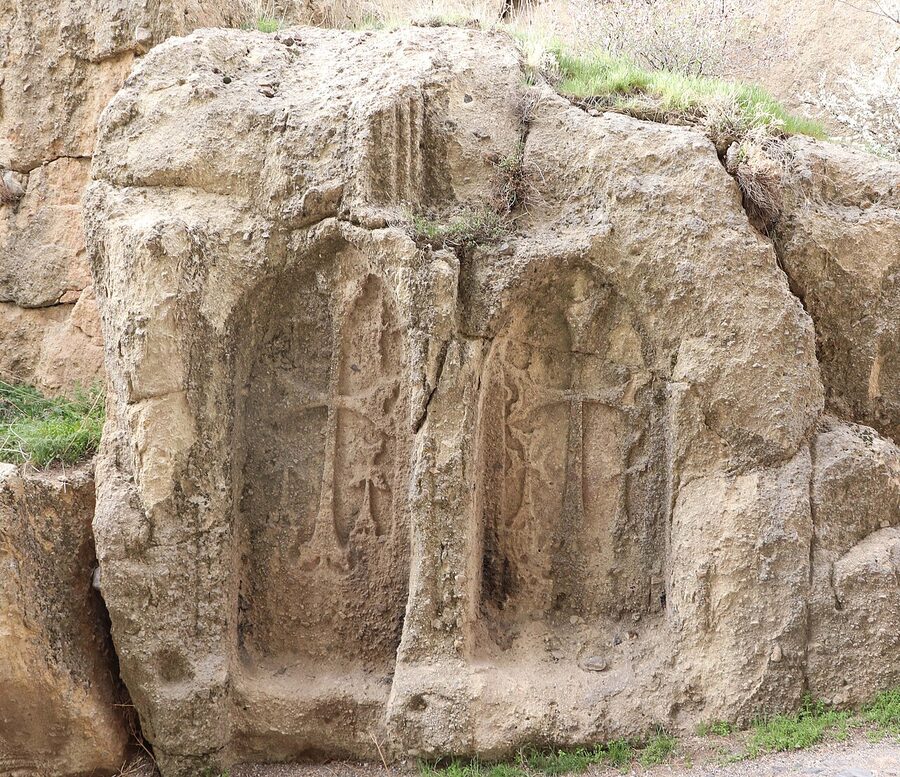
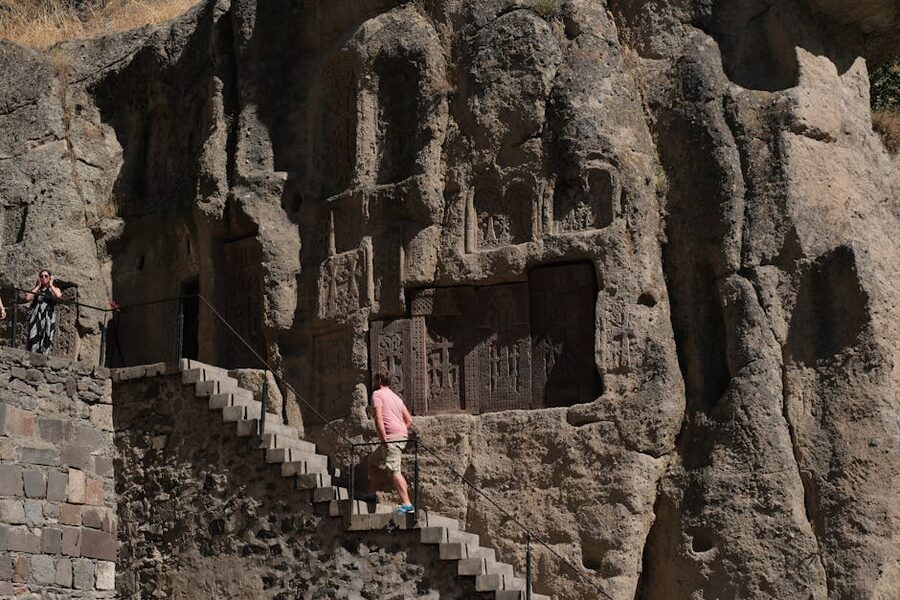
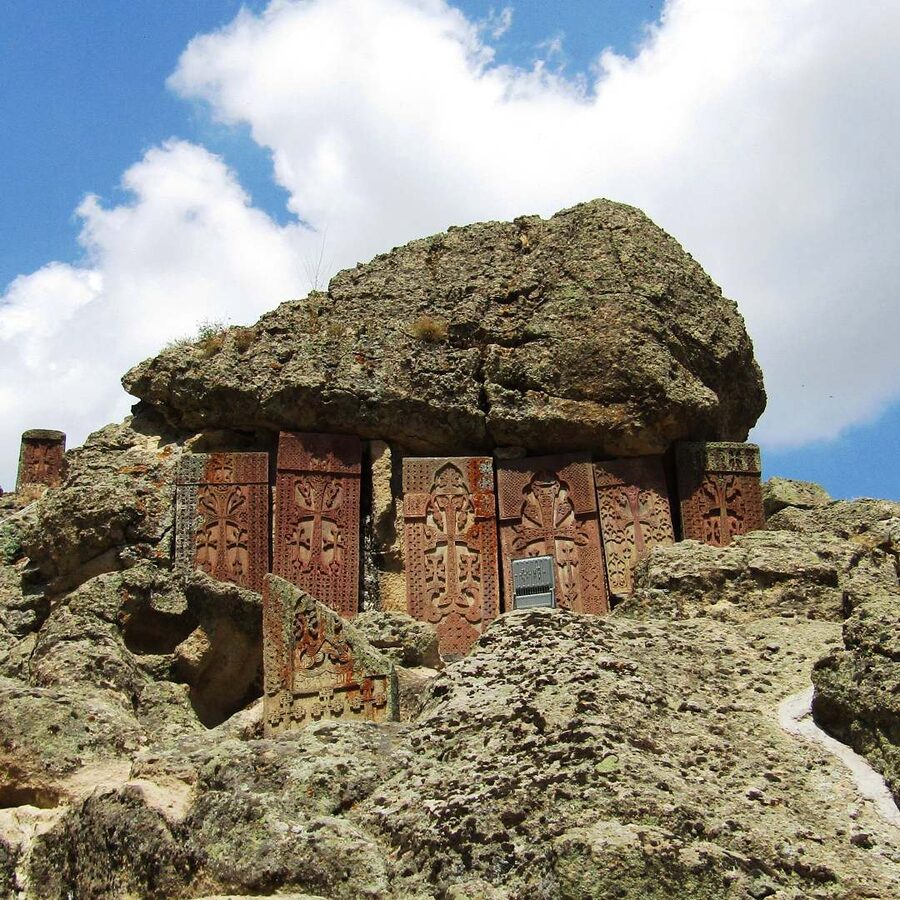
Geghard has them everywhere. Free-standing along the path up from the parking, mounted into the outer walls of the monastery, carved directly into the cliffs above and beside the buildings, set into the floor underfoot in the gavit, and integrated into the walls of the cave churches. The 13th-century clusters around the Proshian church are some of the finest in Armenia. The ones along the path in are easier to read, because they’re at eye level and you have time. Slow down on the way up, not on the way down.
Behind the church there are bushes tied with coloured ribbons. Visitors leave them as wish-offerings. The custom is older than the monastery, older than Christianity in Armenia, and it survived the conversion in 301 AD by being absorbed rather than suppressed. You’ll see the same thing in Central Asia among Muslim populations. Make of that what you’ll make of it.
The wish-pebble shelves
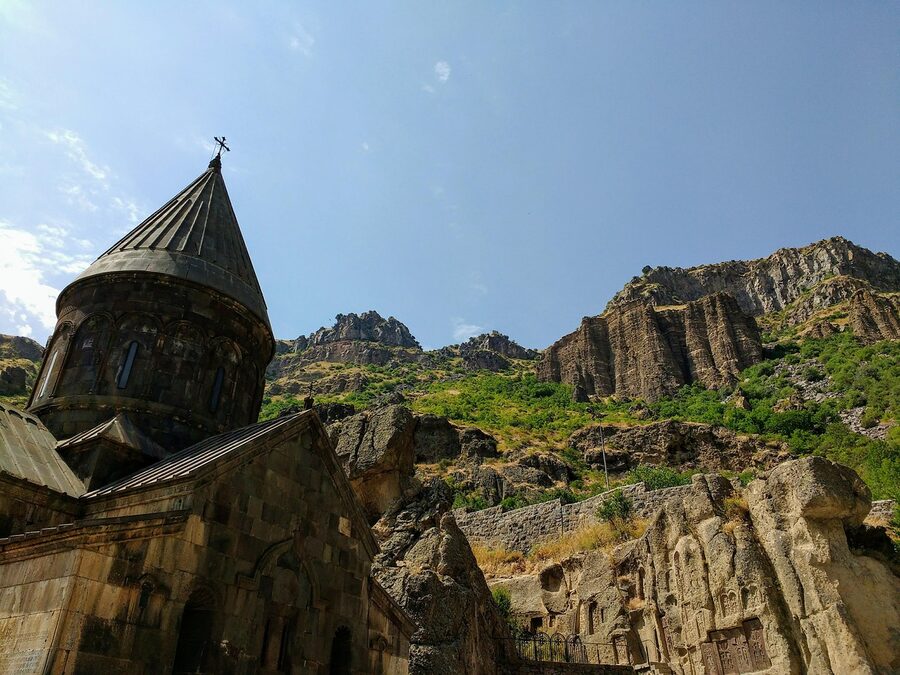
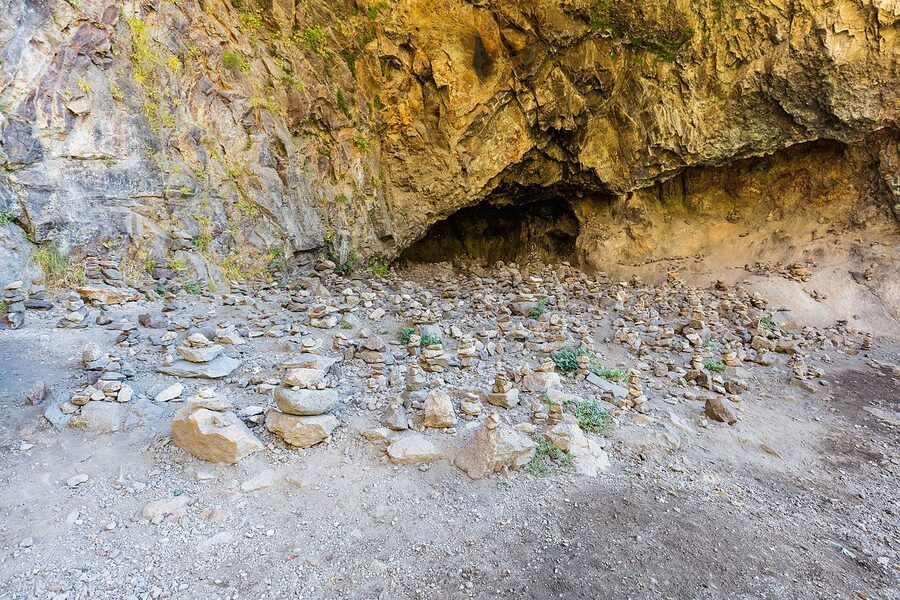
Just before the main entrance there are shallow ledges cut into the cliff. People throw small pebbles up at them, and a pebble that catches and stays is a wish that comes true. There’s a small pile underfoot of the misses. Locals do this. Tourists copy. It’s a quiet, mostly silly, completely benign tradition, and it adds about three minutes to your visit if you indulge it.
The practical bit
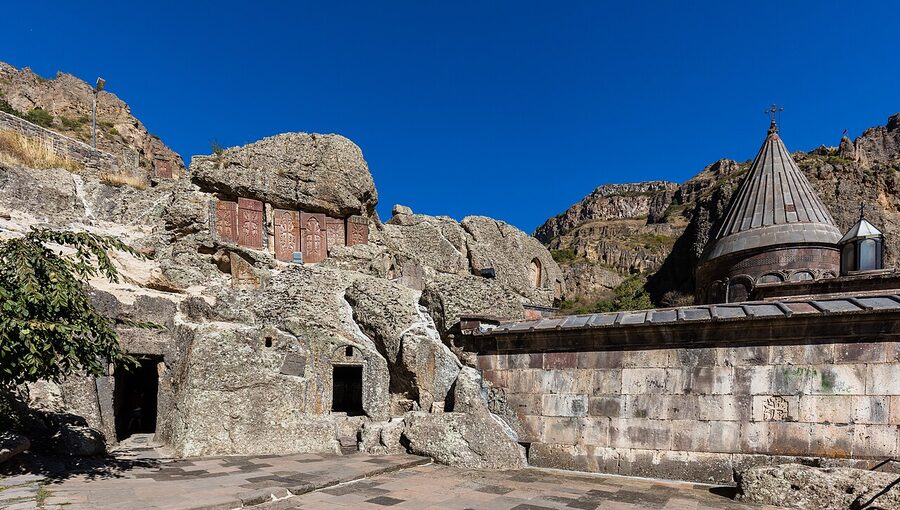
Hours. The monastery is open every day, with daylight as the de-facto bracket. Practically, plan to be there between 09:00 and 18:00 in summer; in winter the road in can be closed by snow and the gates can shut earlier. The complex sometimes posts notices in Armenian only, so if a side chapel is roped off, it’s roped off.
Entry. Free. There’s no ticket, no booth, no fee. Donations to the church are appreciated; candles cost a couple of hundred dram each at the table inside the gavit.
Dress code. A working monastery. Shoulders covered, no shorts above the knee, headscarves provided at the entrance for women if you’d rather have one (not strictly required, but expected). Hats off inside for men.
Photography. Generally fine in the courtyard, the gavit, and inside the cave churches. No flash. If a service is happening, put the camera down. If a singer’s performing, ask before recording.
How long. Bus-tour standard is 45 minutes. That’s enough to walk through, take twelve photos, and leave. Two hours is the right amount if you want to actually slow down in the cave churches and read the khachkars on the way up.
The path up. A short, mostly paved walk from the parking area through a row of vendors. There’s a slight incline. Wheelchair access into the gavit is reasonable. The cave churches all have raised stone thresholds, so getting into the Avazan and the Astvatsatsin in a wheelchair is a stretch.
Getting there from Yerevan
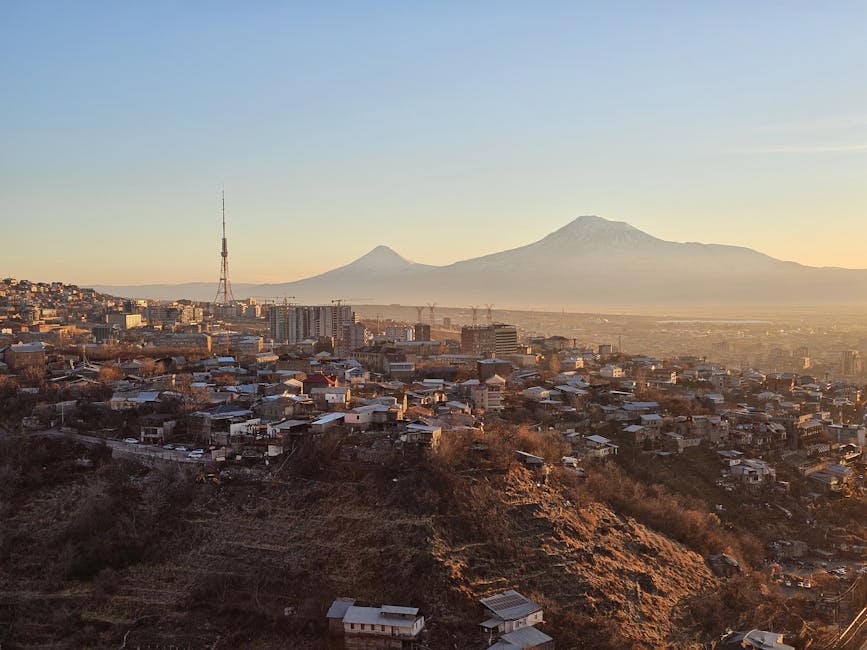
Geghard is about 40 km east of Yerevan in Kotayk Province, near the village of Goght. There’s no direct public bus to the monastery itself. There are four ways in, in roughly increasing order of cost.
Comparison at a glance:
| Option | Cost (round trip) | Time door-to-door | Best for |
|---|---|---|---|
| Marshrutka + taxi | ≈ 3,000-4,000 AMD (US$8-10) | 3-4 hours each way | Cheapest, slowest, most flexible |
| Hire-a-taxi for the day | ≈ 12,000-18,000 AMD (US$30-45) | ~30 minutes each way | Two or more travellers, no group |
| Group tour (Garni + Geghard) | US$15-30 per person | Half day | One person, no Armenian, no fuss |
| Private tour | US$60-150 per car | Half day | Custom timing, sunrise or after-dark, photos |
By marshrutka and taxi
Marshrutka 284 leaves from the Gai bus station in Yerevan to Garni village every 30-40 minutes through the day. Fare is around 300 AMD (about 75 cents). It drops you on the main road in Garni near the temple, not at Geghard. From Garni there’s no scheduled bus the rest of the way; you negotiate a taxi or shared car at the village corner for around 2,000-3,000 AMD return, including a half-hour wait at the monastery. A few of the drivers will also offer to wait at Garni Temple if you want to do both sites in one move. Reasonable Armenian or Russian helps; you can manage with English and gestures.
The walk back from Geghard to Goght village is about 4km and downhill, through small farmsteads and recreational gardens advertised in Armenian as հանգստի գոտի (hangsti goti). From Goght there’s a marshrutka back to Yerevan. This is what we’d recommend if you have the time, because the descent on foot is half the experience of being out of the city, and not many tour buses ever pass you.
By hire-taxi
Standard for travellers who want to do Garni and Geghard properly without spending six hours on minibus logistics. Pickup from your hotel in Yerevan, both sites, lunch in Garni village, back by mid-afternoon. Negotiate before getting in. Taxi-Bao and gg.am (the local app) both quote round-trip rates that are reliable. Cash is normal. Drivers usually wait at each stop and don’t charge by the minute; clarify the wait time at the start.
By organised tour
Group tours run daily and stop at both Garni and Geghard, usually with the Symphony of Stones in the gorge thrown in if the road is open. They cluster around 09:00 and 13:00 departures, half day, lunch optional. The cheapest tickets are around US$15-20 for a small-group seat; private cars run US$60-150 depending on the operator and the route. Worth checking listings on multiple platforms; they sell the same cars at different prices.
For half-day Garni-Geghard combos, the platforms with the most current inventory are Viator, GetYourGuide, and Klook. Pick by the language guide and group size. The Klook listing skews towards English-only and smaller groups; the GetYourGuide listings include some private-car options at the higher end.
Pairing with Garni: most people do, and they’re right
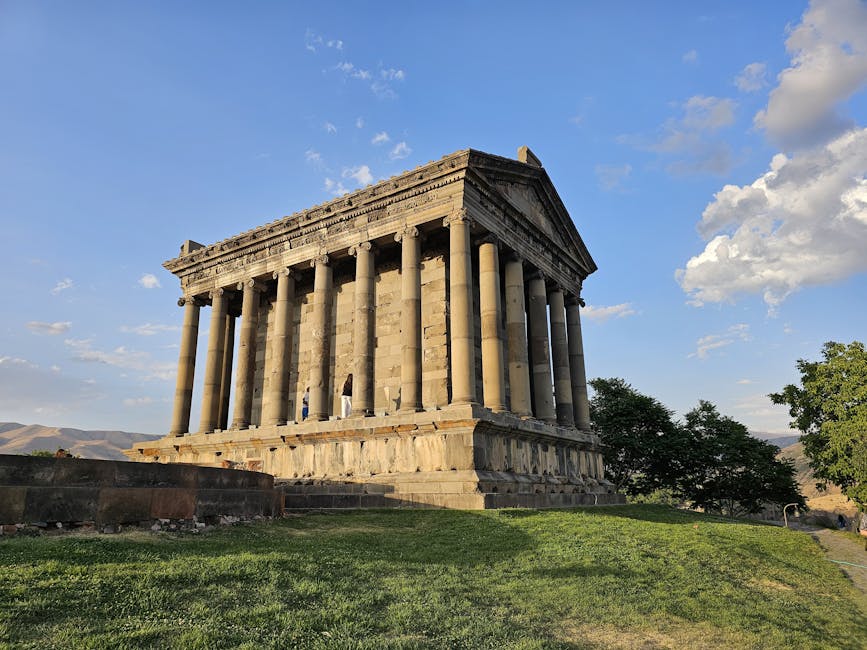
Garni and Geghard share a road, and pairing them is the most common Armenia day trip. The two sites are 25 minutes apart by car, and you can also walk a section between them down through the Azat gorge if the path is open. Garni is a 1st-century Greco-Roman temple to Mithras, the only standing Hellenistic-style structure in Armenia, rebuilt in the 1970s using mostly the original stones after the 1679 earthquake brought it down. The pairing makes architectural sense: pre-Christian to Christian, free-standing to rock-cut, sun god to Holy Spirit. Read the full Garni Temple guide for the temple half of the day.
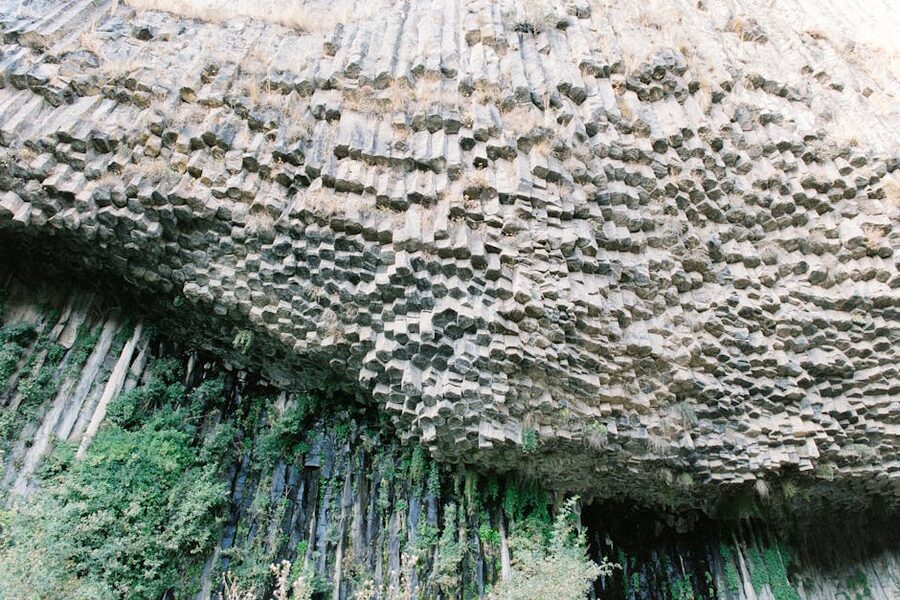
Two add-ons worth considering. The Symphony of Stones is a wall of hexagonal basalt columns in the Garni gorge below the temple, formed by the same volcanic geology that gave the monks something soft enough at Geghard to carve through. It’s a 25-minute walk down on a path that gets slippery after rain. The Havuts Tar monastery ruins, on the opposite side of the gorge, are a longer hike and largely unrestored, which is the appeal. Look at how Armenia’s older bridges were placed and you’ll spot the same pattern around the Azat. The road system here was laid out to follow the gorge bottom.
What to eat at the gates
The vendors line the path between the parking and the entrance. They sell three things you’ll see across Armenia, but the Garni-Geghard versions have a national reputation worth eating.
Gata. A round, sweet yeasted bread layered with a mildly sweet butter-and-flour filling, baked in a wood-fired oven. Roughly 30 cm across at the small end, sometimes much larger. Garni and Geghard gata are the famous ones in the country, and the version at the gates is good. You eat it warm. Around 1,500-2,500 AMD a piece depending on size, and it’ll feed two people lazily through the rest of the morning.
Lavash. The thin sheet bread baked in a tonir clay oven by a woman bent into the oven’s mouth. Sometimes you see the baking happening at the stalls along the road. The fresh lavash on its own is a meal; with cheese and herbs it’s the standard Armenian breakfast, and it travels well. Maybe 500 AMD a sheet.
Sujukh. Strings of walnuts dipped repeatedly in thickened grape molasses, then hung to set. Looks like a candle, eats like a fudge with crunch. Around 1,500-3,000 AMD per stick. Keeps for weeks if you don’t eat it before you get home, which you will.
If you want a sit-down meal, Garni village has half a dozen restaurants with wood-fired tonir kitchens visible from the dining room. Lunch on the way back from Geghard, not on the way out, because Geghard is the destination and you don’t want to feel the full khorovats afterwards.
When to go
Spring and autumn are the best months. April-June and September-October give you mid-teens to mid-20s Celsius temperatures, and the gorge is green or turning. July-August is hot and dry, and the cave churches are colder than the air outside, which can either be a relief or a shock. December-March the road in can be snowed, the cave water is liquid ice, and the visit is shorter because you can’t comfortably loiter.
Time of day. Aim for either 9:00-10:30 or after 15:00. Tour buses cluster around mid-morning and the gavit fills up fast. There’s a lull in the early afternoon when the day-trip groups are eating in Garni. Late-afternoon light hits the cliff faces above the monastery in a way that the morning doesn’t.
Sunday morning. If you happen to be in Yerevan on a Sunday and you want to see the place actually used as a church, the morning Divine Liturgy is at 11:00. Stand at the back, don’t photograph anything, leave when the congregants line up to receive. It is a different experience to a tour visit. If you’ve already seen Geghard once as a sightseeing destination, this is the version that recasts it.
What you carry away
Most of Armenia’s medieval architecture is, at root, the same plan in different settings. Cone on drum, cruciform inside, four corners with a chapel, khachkars in the wall. Geghard is the place where someone took that vocabulary and decided to invert it. Instead of putting buildings on top of the rock, they put them inside it. Forty years of one architect’s life, mostly underground, mostly in light bounced off three corners of stone. There’s nothing else in the country quite like it.
You can do it in 45 minutes. You can do it in three hours. Do the longer version if you possibly can, ideally with a thermos and the willingness to sit on the stone bench outside Katoghike for a while, listening to whether anyone happens to start singing in the room behind you.
And on the way back to the city, if the painter Martiros Saryan’s name comes up (he painted Geghard) and you have an afternoon to spare, the Saryan House Museum in Yerevan is small and worth it.