Skip the half-day bus tour. Garni gets sold as a stop. It’s a day.
The temple itself takes about twenty minutes if you only want the photo. The hour you save with a quick visit is the hour you’d otherwise spend in the gorge below, where 50-metre basalt columns hang against gravity in shapes that look hand-built. That’s the part most people never see, because the bus is leaving at noon and Geghard is next on the list. Pair Garni with Geghard Monastery if you want, but make it a full day. Pack water, wear something with grip on the soles, and walk down into the canyon.
In This Article
- The quick answer
- Why Garni doesn’t fit anywhere else in Armenia
- Why what you’re standing in front of is essentially original
- Walking the temple
- The exterior, slowly
- Inside the cella
- The Greek inscription you’ll miss if you don’t know to look
- The Roman bath nobody talks about
- The mosaic and its grumpy little inscription
- The fortress, the cyclopean wall, and what was here before Rome
- Down into the gorge: the Symphony of Stones
- How the columns formed
- Walking the canyon floor
- Havuts Tar: the side trip almost nobody does
- Getting there from Yerevan
- By marshrutka
- By taxi or hire car
- By organised tour
- Practicalities
- Hours, fees, what’s included
- Best time of day
- Best time of year
- Eating in Garni village
- Pairing Garni with Geghard, or going on alone
- The other things at Garni you’ll see in the brochure
- The St Sion church
- The royal palace remains
- The medieval khachkars
- One more take, before you book
The quick answer
If you’re in a hurry and just want the numbers, here’s what you need before the bus leaves Yerevan.
| Detail | Specifics |
|---|---|
| Where | Garni village, Kotayk province, 28 km east of Yerevan |
| What it is | 1st-century Greco-Roman colonnaded temple, the only Hellenistic building left standing in the former USSR. Plus a working Roman bath, fortress remains, an Urartian inscription from the 8th century BC, and a basalt-column gorge. |
| Entry fee | 1,500 dram (about USD 3.80) for the temple complex; 1,000 dram for the bath only. Children under 7 free. |
| Hours | 9:00 to 22:00 daily in summer; 10:00 to 17:30 winter. The temple is illuminated after dark. |
| How to get there | Marshrutka 266 from GAI Poghots, 500 dram. Taxi from central Yerevan, 5,000-7,000 dram. Hire car for the day with Geghard, 12,000-18,000 dram. |
| How long you need | Forty minutes for the temple alone. Three to four hours including the gorge. A full day if you also do Geghard. |
| When to go | May, June, September. Avoid July-August midday heat. The 6pm light is the best of the day. |
Why Garni doesn’t fit anywhere else in Armenia
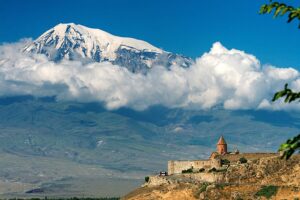
Armenia has roughly nine hundred surviving monasteries and churches. They are all of a piece. Tufa stone, conical drum-and-dome roofs, narrow windows, the same handful of architectural moves repeated for a thousand years and getting better every century. You’ll see this clearly at Geghard, half cut into the rock, and at Echmiadzin Cathedral, the seat of the Armenian Apostolic Church. Even Khor Virap, where Gregory the Illuminator was held in a pit for thirteen years before he converted King Tiridates III, follows the rules.
Garni breaks every one of them.
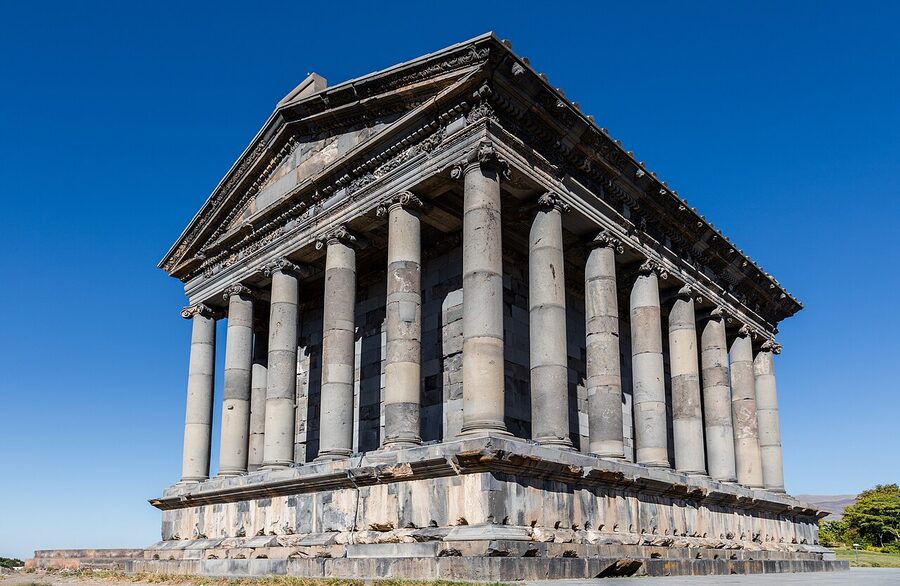
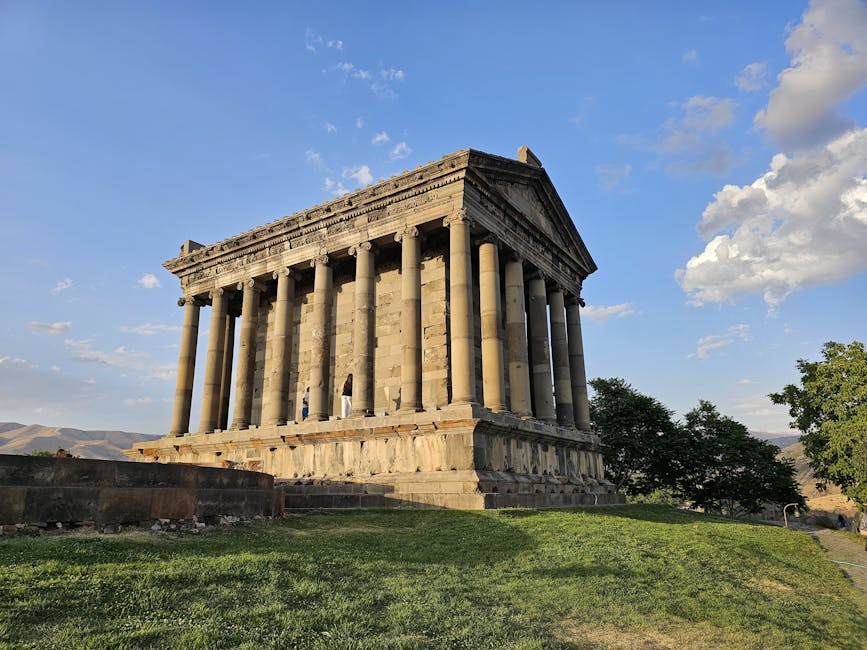
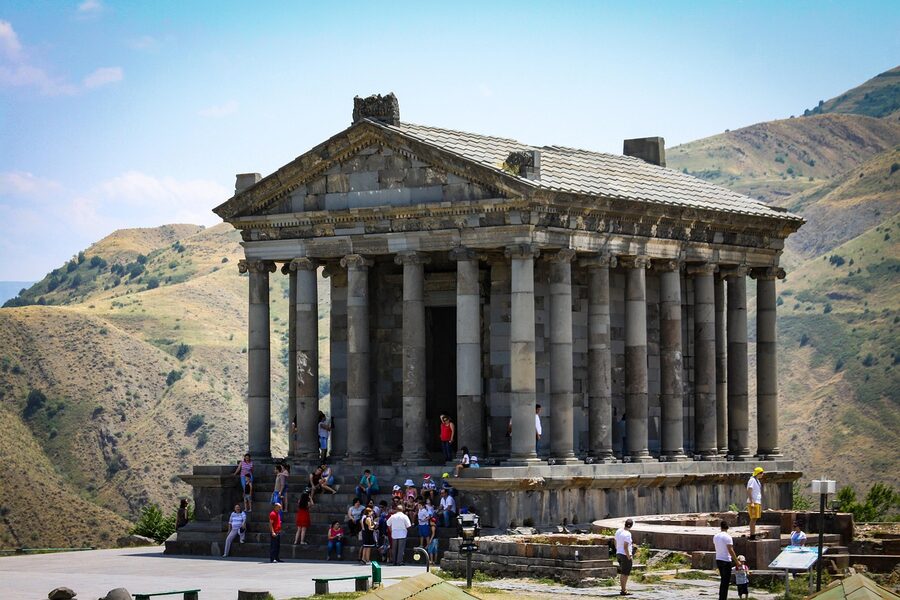
It’s a colonnade. Twenty-four Ionic columns, basalt cut to the dimensions of a Roman pattern-book, with a gabled roof and a stepped krepidoma you climb to enter. If you didn’t know where you were standing you could be in Sicily, or the Bay of Naples, or the Levant. The dating is mid-first century AD, traditionally placed around 77 by King Tiridates I, who had been crowned by Emperor Nero in Rome in 66 and travelled home with fifty million drachmas in Roman silver and a working set of Roman architects. The temple sits on a triangular promontory above the Azat River at 1,400 metres, on top of an older Urartian sanctuary, inside what was already an ancient fortress when the Romans arrived.
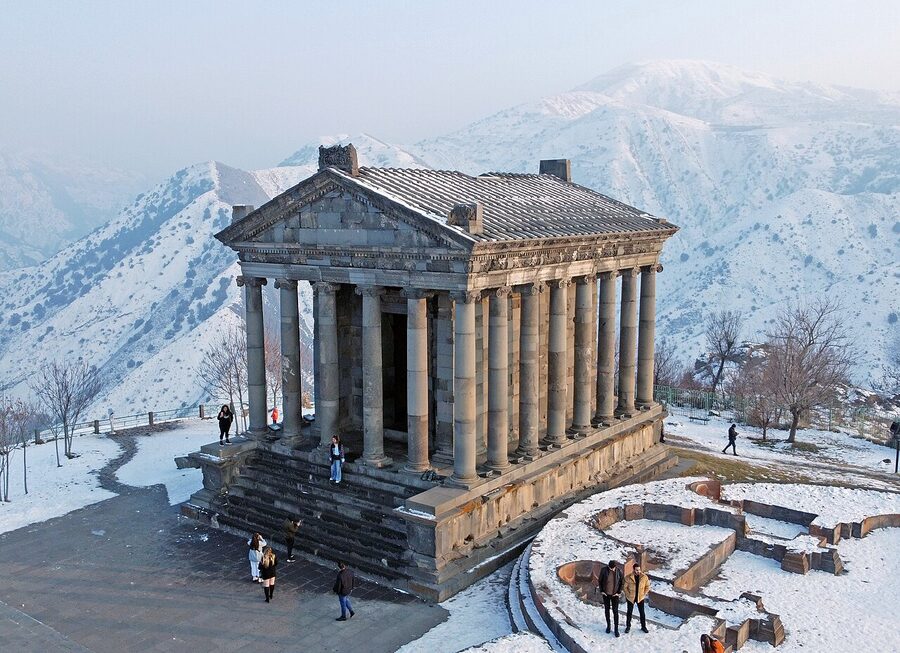
Then it gets stranger. Armenia became the world’s first Christian state in 301, and Tiridates III (a different Tiridates, three centuries later) sent Gregory the Illuminator out to destroy every pagan structure in the country. Every other temple of Mihr was levelled. This one survived, by an accident of family politics: it was kept as a cooling-house for Khosrovidukht, the king’s sister, who wanted somewhere to spend the summer. So a Roman pagan colonnade became a royal villa, and that’s how the only Hellenistic building in the former Soviet Union slipped through the wreckage of late antiquity.
Then in 1679 a 6.4-magnitude earthquake on the Garni fault flattened it. The roof collapsed, the columns toppled, the krepidoma cracked. The pieces fell where they fell, and they sat there for nearly three hundred years, half in the cliff edge and half on the slope below, while the village around them shrunk to a few hundred people and a vineyard.
Why what you’re standing in front of is essentially original
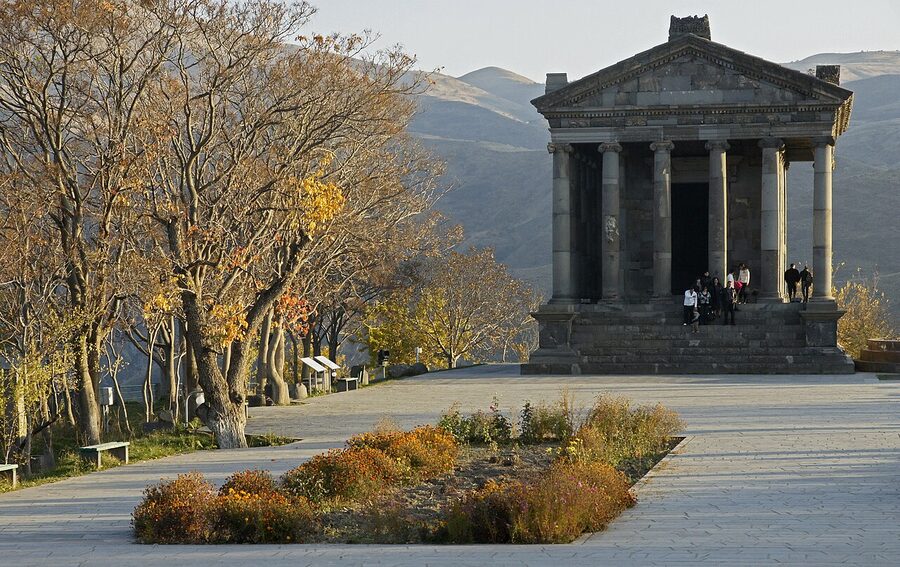
The reconstruction matters because Armenian guides will tell you the temple was rebuilt and a lot of foreign visitors hear that as “fake.” It isn’t. Between 1969 and 1975, the architect Alexander Sahinyan ran an anastylosis: every fallen block that could be identified was lifted, mapped, catalogued, and put back in its original position. Where blocks had shattered or been carted off as building stone after the quake, modern basalt was cut to match and slotted in, but conservatively. The estimate is that around 80 percent of what you’re looking at is the original first-century stone. The rest is replacement, and you can pick it out if you stand close on a sunny day, because the new basalt is a slightly paler grey.
Anastylosis is the same technique used at Knossos and the Stoa of Attalos in Athens. It’s a serious method with international rules. The reconstruction at Garni is well-regarded by the conservation field; UNESCO has Garni on its tentative list as part of a wider archaeological complex.
What this means as a visitor: when you climb the nine steps and stand at the base of the columns, you’re touching stone that was cut by Roman or local craftsmen during the reign of Vespasian, sat in a field for three hundred years after the earthquake, and was put back where it belonged in the 1970s. That’s worth twenty minutes more than the bus tour gives you.
Walking the temple
The site is small. From the ticket booth you walk a tarmac path of about 200 metres, past a stretch of original fortress wall on your left and the bath complex below it on your right. The temple appears at the end, sitting on its krepidoma right at the edge of the cliff. There’s a flag, sometimes a wedding party, and a couple of stray cats who live there full-time.
The exterior, slowly
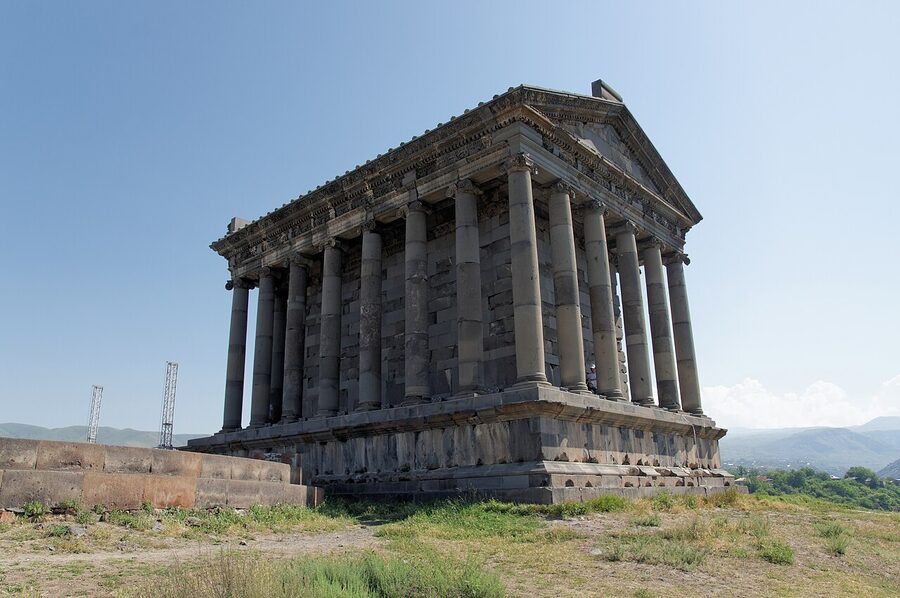
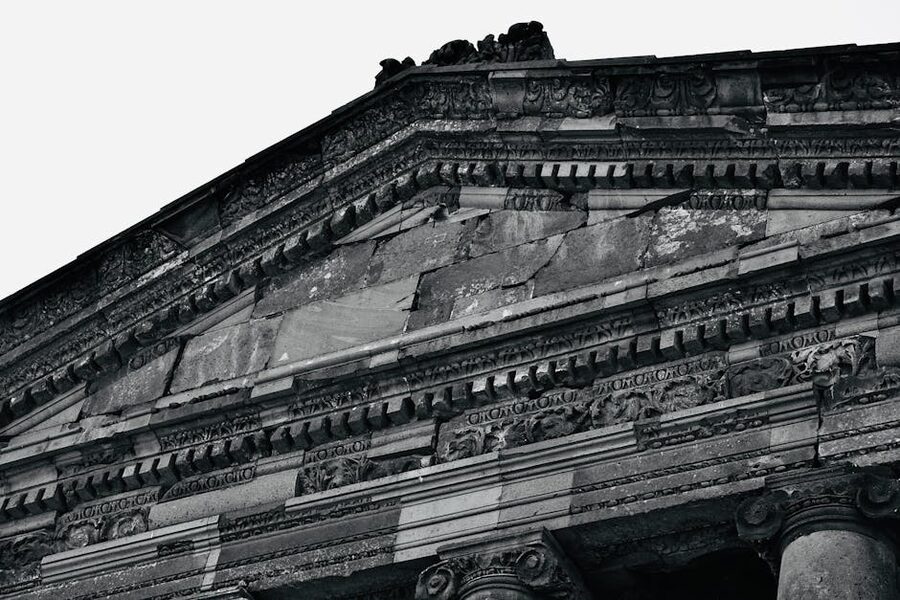
The dimensions are 15.7 by 11.5 metres at the krepidoma, with the columns rising about 6.5 metres above that. Six columns across the front, eight down the sides, peripteral, with corner volutes carved in the proper Ionic pattern. The capitals are the bit worth lingering on. They’re not slick. The volutes are slightly asymmetric, the egg-and-dart on the abacus is a bit chunky, and a couple of the column drums are out of true. This is what local craftsmen working in basalt with a Roman blueprint produced. Roman it is, but local hands clearly cut it.
The pediment is plain. There’s no relief carving on the metopes (it’s an Ionic frieze rather than Doric anyway, but no decoration). The roof is reconstructed in the same basalt, with terracotta-coloured tile underneath. The stone is the dark grey volcanic basalt that the whole region sits on; you’ll see it as cobbles in Yerevan side streets and as building blocks in every village wall from here to Lake Sevan.
Inside the cella
Step inside and the room is much smaller than you expect. About 5 by 7 metres of usable floor, dim, and almost entirely empty. There would have been a cult statue of Mihr, the sun god, somewhere on the back wall; nothing of it remains. There’s a small stone block where flowers and the occasional bunch of pomegranates appear in summer, left by the modern Hetanist (Armenian neopagan) movement, which uses Garni as its central shrine.
The acoustics are weird. The ceiling is high, the walls are thick, and any sound you make has a long, dry tail to it. People sing here when nobody’s around. So do the Hetanist priests during Vardavar, the summer water festival, and during the spring equinox when they celebrate the birth of Vahagn, the dragon-slaying fire god whose name shows up across Armenian folk songs about thunder and storms. The Hetanists are a small but serious community; they’re not a tourist re-enactment.
The Greek inscription you’ll miss if you don’t know to look
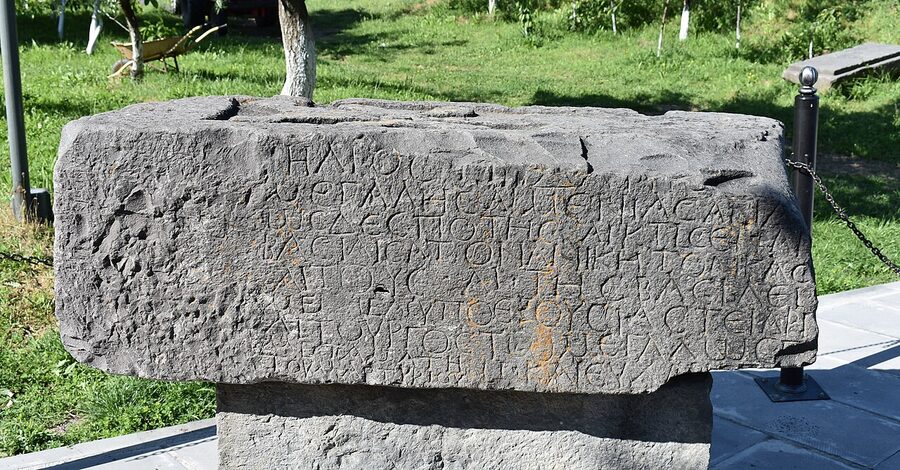
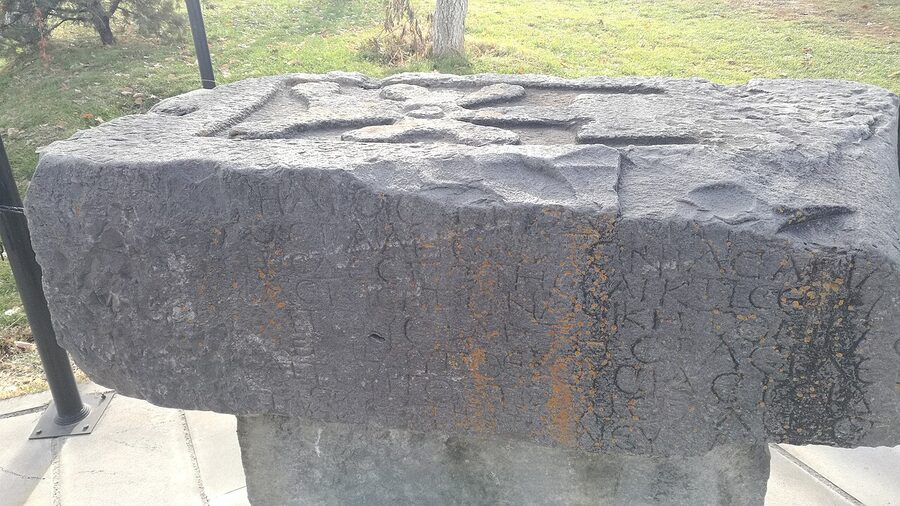
Above the entrance, on a re-set lintel block, there is a Greek inscription discovered by archaeologist Babken Arakelyan in 1945. It reads, roughly: “The Sun Tiridatēs, Great King of Greater Armenia, lord and despot, built the temple in the eleventh year of his reign.” That single line is what fixes the date and the founder. Without it, the building could be a tomb (which is a serious minority hypothesis among Western scholars; the case is decent and worth knowing about, even if most Armenian archaeology comes down on the temple side). Look for it on the way in. It’s at eye level, weathered, and easy to walk past.
The Roman bath nobody talks about
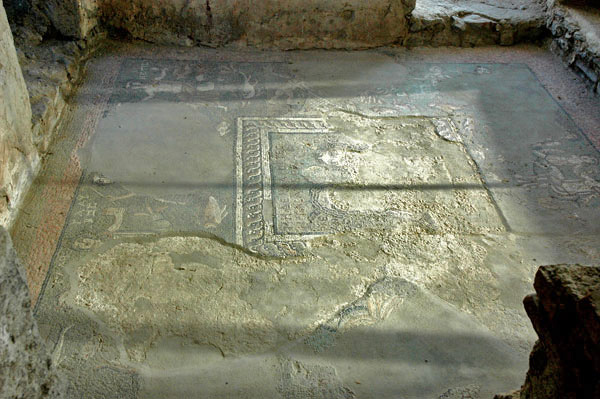
About fifty metres back from the temple, under a corrugated roof that does the building no favours visually, there’s a third-century Roman bath house with a hypocaust system and four rooms: apodyterium (changing), tepidarium (warm), caldarium (hot), and frigidarium (cold). It’s small, maybe ten metres on the long axis, and worth ducking into.
The bath is older than people expect for this region: about a hundred years older than the conversion to Christianity. The hypocaust pillars are intact: short fired-clay columns that held up the floor while hot air from a furnace circulated underneath. Roman bathhouses worked the same way from Britain to the edge of Persia, and seeing the system this far east is the actual rarity at Garni. Forget the temple for a moment; this bath is more practical evidence of Roman material culture in Armenia than the colonnade is.
The mosaic and its grumpy little inscription
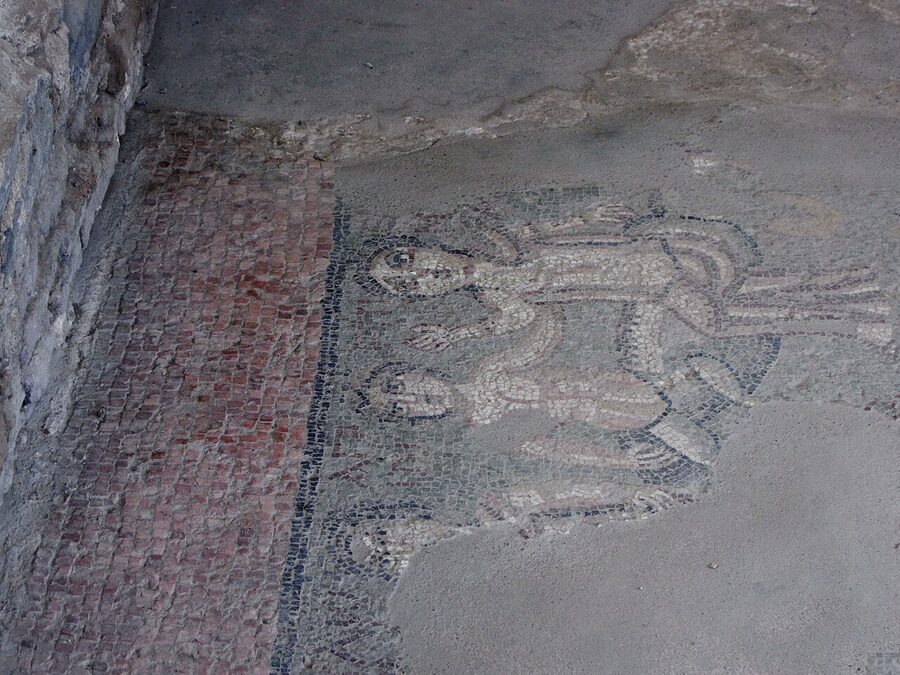
In the changing room, what’s left of the floor is a mosaic of marine deities (Glaukos, the Nereids, Thalassa as a personification of the sea) done in pale and dark stones cut to small cubes. It’s not the finest provincial mosaic you’ll see (Antioch has better, Sicily has better) but it’s the only one of its kind in Armenia, and the date is the second to third century. The work is provincial, with stylized fish and what appears to be an octopus that the artist clearly didn’t have great reference for.
And in one corner, in Greek, the artist or the workshop owner left a complaint. Translations vary: “We worked, and received nothing,” or sometimes given as “Worker, work without reward.” Either way, the same wry exhausted complaint craftspeople have made about clients since the trade began. Crouch down to read it. It is, to my mind, the best fifteen seconds at the entire complex. Two thousand years on, and the bath-fitter is still annoyed about it.
The fortress, the cyclopean wall, and what was here before Rome
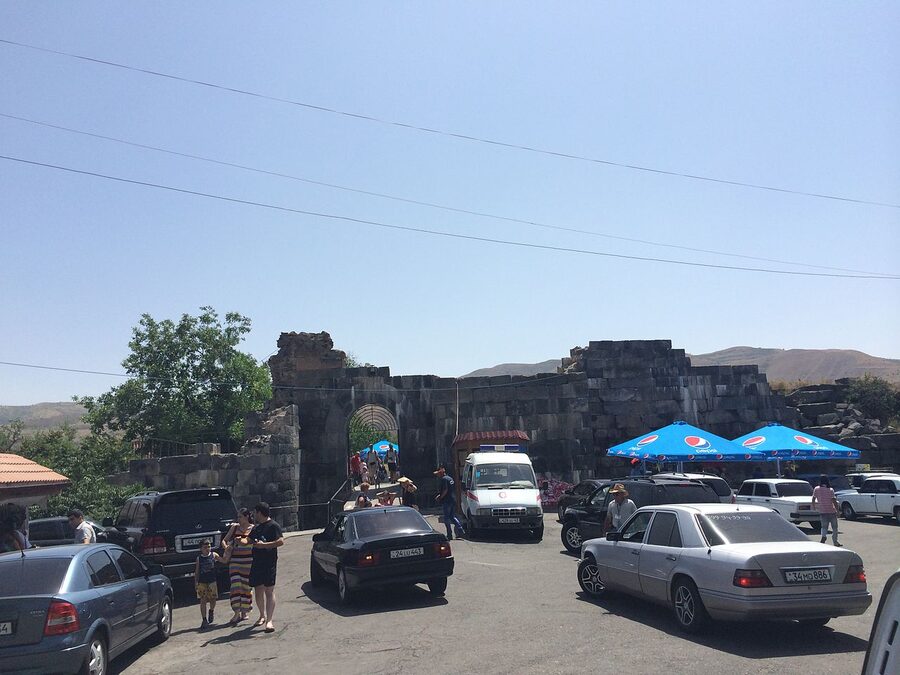
Walk along the wall on your way back from the bath. The lower courses, with the huge undressed basalt blocks fitted together without mortar, are cyclopean masonry from the Bronze Age, putting parts of this site into the second millennium BC. The Romans built on top of what was already an old fortress, and the Urartians (the kingdom that ran the Armenian highlands from about the 9th to the 6th centuries BC) had built on it before that.
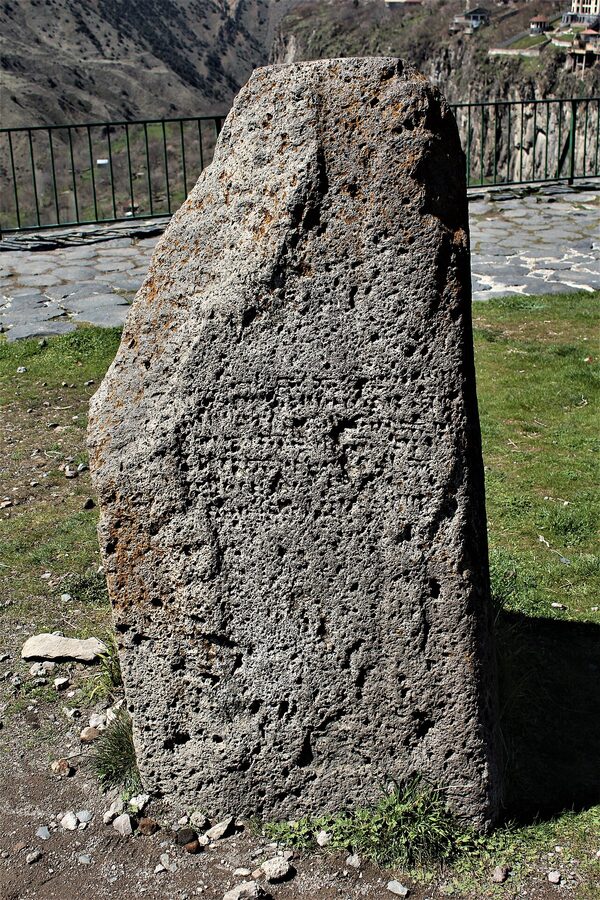
Near the fortress wall there’s a small upright stone block carved in cuneiform. The inscription is by King Argishti I (or II, the dating varies) of Urartu, dated to the 8th century BC. It calls the place “Giarniani,” the earliest written name for the site, which then became Greek “Gornai” in Tacitus, then medieval Armenian “Garni,” then today’s spelling. So you have, in a circle of about thirty metres, three thousand years of continuously occupied stone. That’s an unusual density even by Caucasian standards.
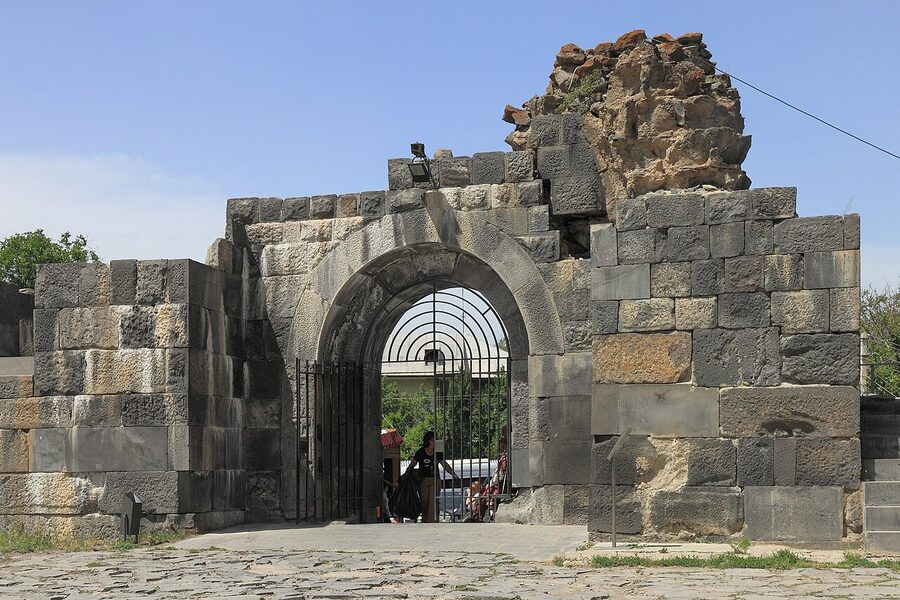
Tacitus, writing about Roman frontier campaigns, mentions Castellum Gorneas in the Annals as the easternmost Roman fortified position; that’s Garni. Pliny the Elder records King Tiridates’ visit to Naples. So the place is in the Roman literary record more than once, even if briefly.
Down into the gorge: the Symphony of Stones
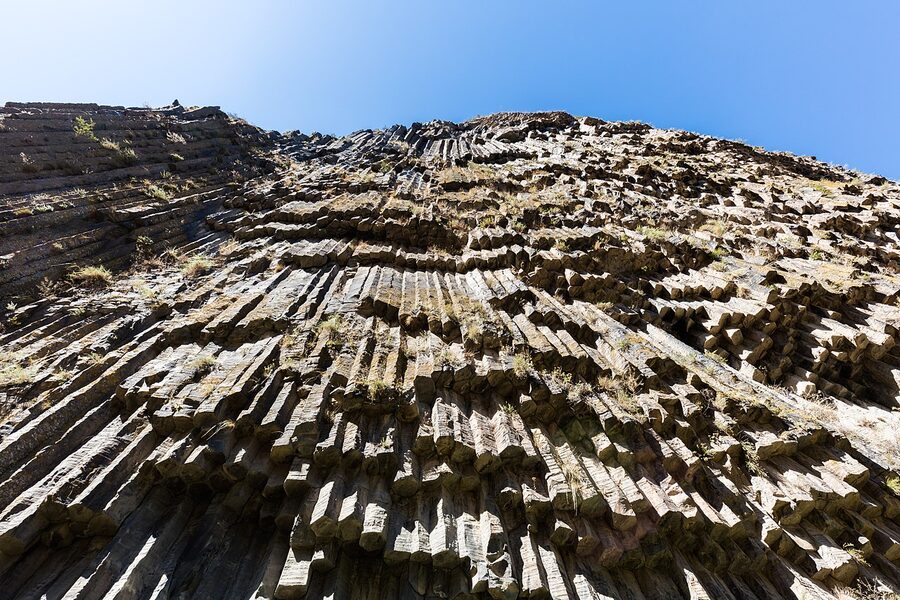
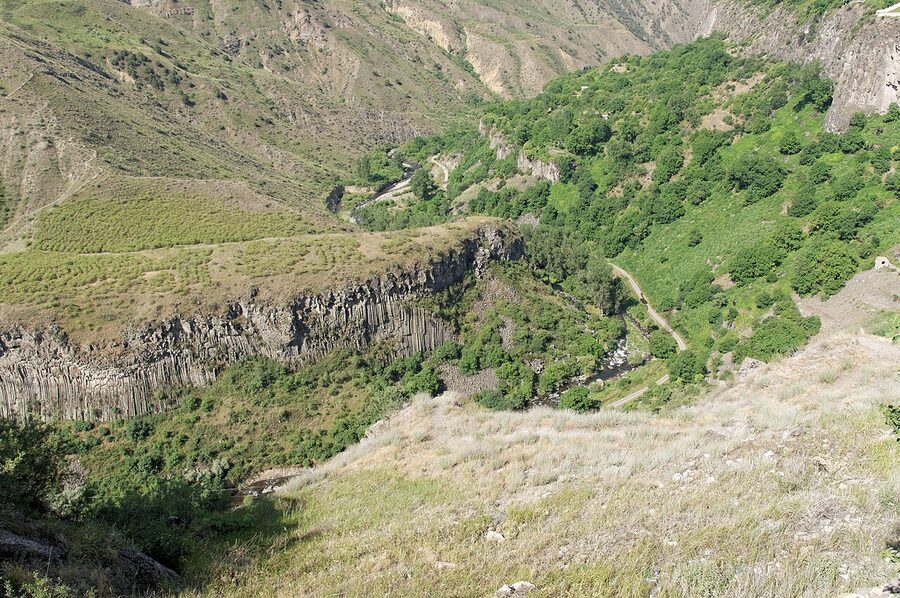
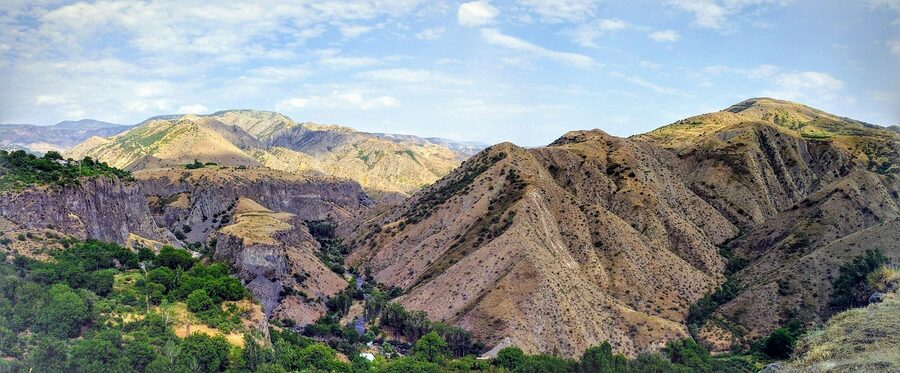
Now the part most people skip. From the temple you walk back through the village (or you drive five minutes downhill on a steep cobbled lane) to a parking area at the bottom of the gorge. From there a flat dirt track follows the Goght and Azat rivers along the canyon floor for about a kilometre and a half. Around the second bend, the cliff face on your right turns into something that does not look natural.
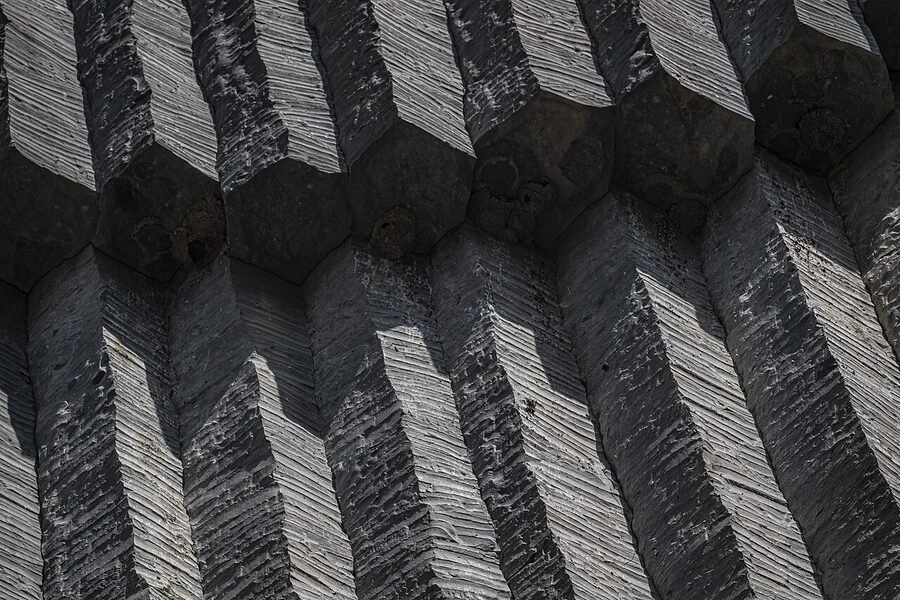
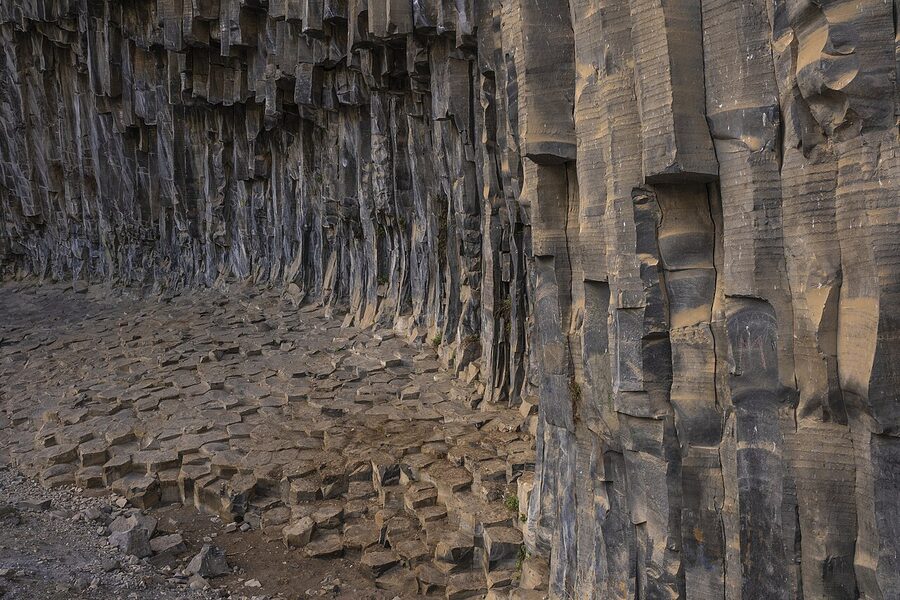
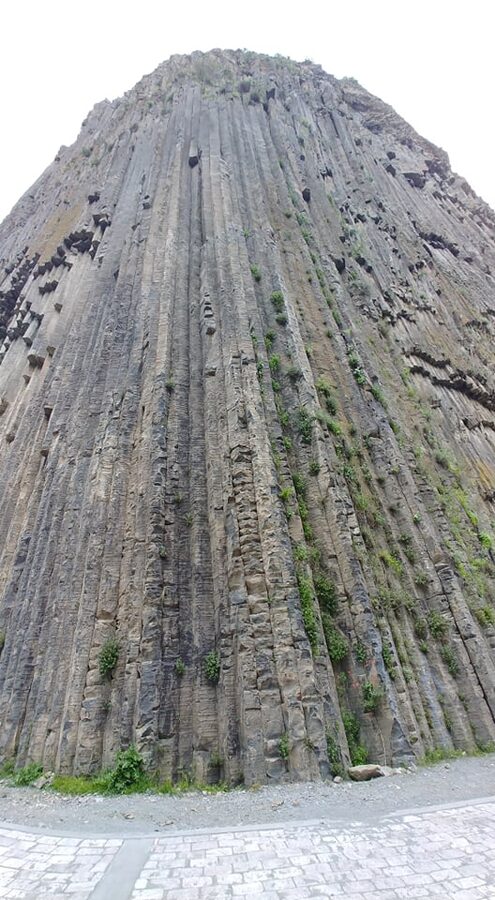
Hexagonal basalt columns hang from the cliff like the pipes of a church organ. They’re 50 metres high in places, packed together side by side, almost geometric, with very little weathering. Some lean inward, some hang at impossible angles, some have broken off and lie in piles at the base. The Armenian name is Bazaltayin Yerg, the basalt symphony, but everybody calls them the Symphony of Stones.
How the columns formed
The geology is the same process that built the Giant’s Causeway in Northern Ireland and Devil’s Tower in Wyoming: a mass of basaltic lava cools slowly, contracts uniformly, and cracks into hexagonal columns. Hexagons are what you get when a sheet contracts evenly in two dimensions; it’s the most efficient packing. Garni is one of the largest examples in the world by surface area. The Goght River cut down through the basalt over the last million years and exposed the columns from the side, which is why you see them as a hanging wall instead of as a pavement.
Stand under them and look up. They’re held together by friction and their own weight; nothing pins them. Every so often one breaks off and ends up at the base of the cliff. There are signs that say, in three languages, not to climb. Take that seriously. Two tourists died in 2018 from falling rocks dislodged by climbers above; the path along the river is the safe place to be.
Walking the canyon floor
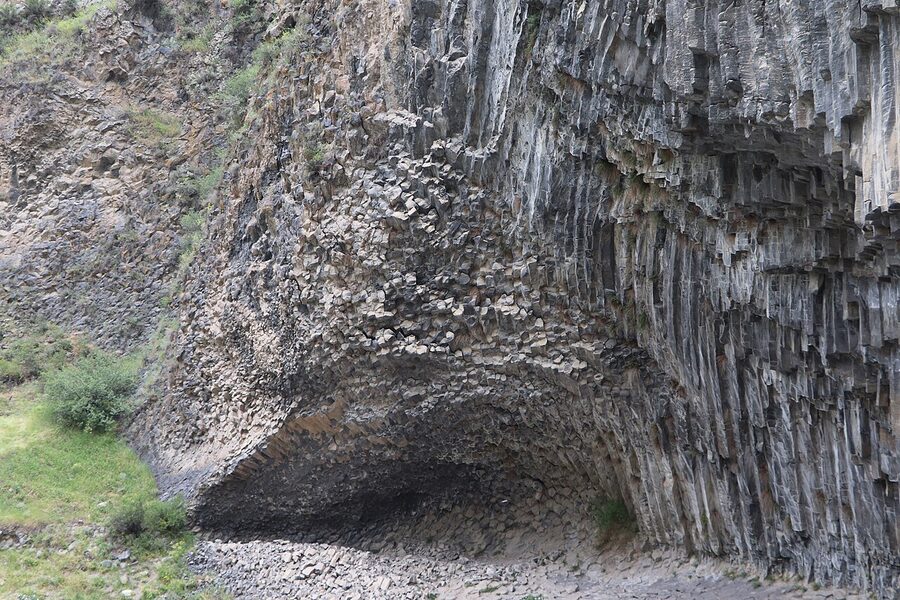
The walk in is easy. The river is small, fast, and very cold; people picnic on the banks and a few hardy locals fish for trout. There are no cafes, no toilets, no signage past the parking area. Bring water. Bring sun cover from June onwards because the gorge floor sees direct sun from mid-morning till about three.
If you carry on past the columns, the trail keeps going for another six kilometres and connects through to the Khosrov Forest State Reserve, the oldest protected forest in the world (gazetted by King Khosrov III in 332; there’s a strong claim that this is the first formal nature reserve anywhere). The Khosrov has wolves, bears, leopards (rarely), and a long history of being left alone. You can also pick up a side trail to Havuts Tar, the 11th-century monastery on the opposite ridge.
Havuts Tar: the side trip almost nobody does
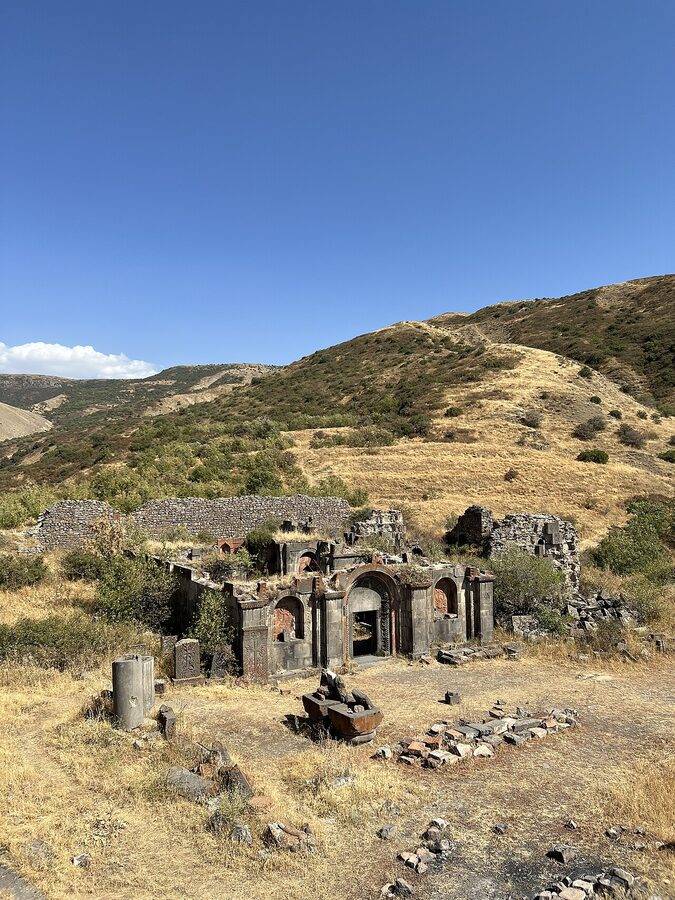
If you have a half-day on top of Garni and you don’t want Geghard, walk to Havuts Tar instead. It’s a ruined monastery complex from the 11th to 13th centuries, partly fortified, on the ridge across the gorge. The path is steep (you climb out of the canyon and back up onto the south rim) but it’s only about 90 minutes one way. Most days you’ll have the place to yourself. The two main churches are roofless and overgrown; one of them has carved khachkars (cross-stones) lying flat on the floor where they fell. Go in May or September if you can; in summer the south slope is brutal.
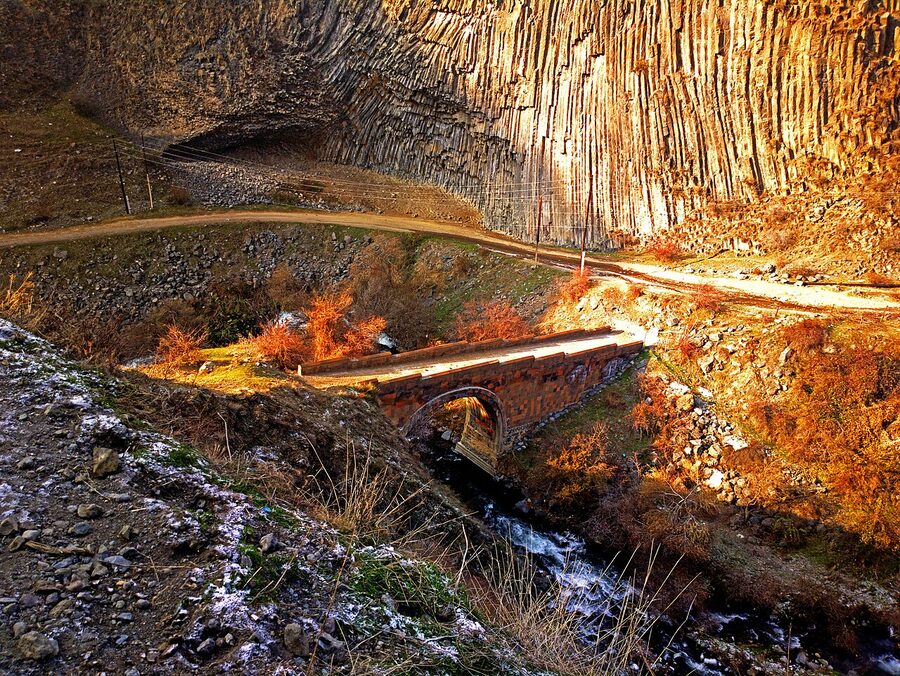
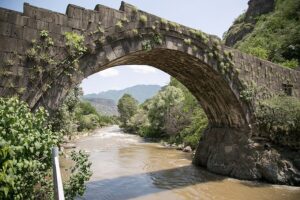
On the cobbled descent through the village to the gorge, you cross an 11th-century stone bridge over the Goght, the same kind of medieval span you can read about in our piece on the historic bridges of Armenia. It’s still load-bearing for foot traffic; people still cross it every day to bring sheep down to the river meadow. Stop on it, look upstream, and you can see the temple on its cliff edge through a gap in the cypress trees.
Getting there from Yerevan
By marshrutka
The cheapest option, and a small adventure of its own. Two minibuses on two streets:
- From central Yerevan, take a 100-dram city bus (route 22 or 51, ask at the stop on Abovyan near Koryun) east to GAI Poghots. The landmark is the Mercedes-Benz dealership; ask the driver “GAI” and they’ll let you off in the right place.
- From the small bus area opposite the dealership, marshrutka 266 runs to Garni village. 500 dram, about thirty to forty minutes depending on stops. Pay the driver in coins as you board; change is rare.
You’ll be dropped at the bottom of the village’s main street. The temple entrance is a six-minute walk uphill, signed in English and Russian as well as Armenian. Coming back, the same marshrutka turns around at the temple gate and runs the route in reverse roughly hourly until about 7pm. Don’t rely on later buses; if you’re staying for sunset, plan a taxi back.
Important note about the marshrutka: it does not continue to Geghard. If you want both, you have to take a taxi from Garni up to Geghard (about 2,500-3,500 dram one way, or 5,000 with a half-hour wait) or walk the 8 kilometres uphill, which is plausible in good weather but a long pull.
By taxi or hire car
For three or four people, splitting a taxi or a hired driver for the day is barely more than the marshrutka per person and saves you the bus stitching. A typical day rate from any Yerevan taxi app or hostel desk is 12,000 to 18,000 dram for a Garni-and-Geghard combo with waiting time included. The driver waits at each site, and most will detour to the gorge for an extra 1,000-2,000 dram if you ask up front.
Yandex Go and GG (the local app) both work in Yerevan. A one-way taxi from city centre to Garni without waiting is about 5,000-7,000 dram. Going back from Garni to Yerevan, you can sometimes flag down an empty marshrutka returning to the city for the standard fare; it’s about a fifty-fifty bet.
By organised tour
Every hostel in Yerevan books day trips that include Garni, Geghard, sometimes Echmiadzin, sometimes Lake Sevan. Group rates run 8,000-15,000 dram per person depending on inclusions. The downside is the timing: most tours give you 45 minutes at Garni, which is exactly enough for the temple and not enough for anything else. If you take a tour, ask whether the gorge is on the itinerary; if it isn’t, consider going independently.
Practicalities
Hours, fees, what’s included
The complex is open 9:00 to 22:00 in summer (May-October) and 10:00 to 17:30 in winter. Last entry is half an hour before closing. The 1,500-dram main ticket gets you the temple, the bath, the fortress site, the cuneiform inscription block, and a small museum near the entrance with finds from the excavations. The bath alone is 1,000 dram if you somehow want to skip the temple.
The site is illuminated after sunset year-round, and on summer evenings there are sometimes free outdoor concerts on the lawn in front of the temple: Armenian folk groups, occasionally classical chamber music. Check with the ticket office on the day; there’s no online schedule worth trusting.
Best time of day
Tour buses arrive in two waves: 11am and 1pm. Between those windows, the site is genuinely busy and the photo from the front path will have ten people in it. Aim for either 9am (right at opening) or after 4pm. The light is best from 5pm onwards in summer, when the basalt warms to a slate-blue and the columns throw long shadows across the krepidoma. By 6:30 in late spring, with the bus tours gone, you can have the temple practically alone.
If you do this, time your gorge walk for late morning instead, when the canyon is in shade. Reverse the usual order.
Best time of year
May, June, and September are the sweet spot. April can be cold and wet; July and August are punishingly hot at midday (38°C is normal in the gorge), and the temple’s exposed cliff position offers no shade. October is good but the gorge trail can be slick after rain. Winter is bracing but quiet. The temple in snow is one of the best photographs in Armenia, and you’ll have it to yourself, but the gorge is closed when ice forms on the trail (typically late December to mid-March).
Eating in Garni village
Garni village has a handful of small family-run restaurants on the road up to the temple, and one bakery worth knowing about. The bakery is on the second corner past the bus stop, on the right going uphill. There’s no signboard in English. The owners bake lavash in a tonir (a clay oven set into the floor) and you can usually walk in, watch, and buy a sheet for 200 dram. It’s the simplest food experience in the area and the best.
For a sit-down meal, try one of the courtyard restaurants down towards the gorge entrance: a plate of khorovats (charcoal-grilled pork or lamb skewers) with grilled vegetables, lavash, fresh herbs, and a glass of homemade wine runs about 4,500 dram. Service is slow in the way that all village service is slow in Armenia. Leave time. For more on what to order, see our guide to traditional Armenian food.
Pairing Garni with Geghard, or going on alone
Most people pair Garni with Geghard, and that’s the standard half-day trip from Yerevan. They sit on the same road, separated by ten kilometres, and they’re almost perfect opposites: Garni is open, sunlit, classical, foreign in style; Geghard is closed, rock-cut, dim, deeply Armenian. Doing both in one day is one of the strongest experiences in the country, and I’d recommend it as the standard pairing if you only have a day.
But here’s the contrarian version: skip Geghard the first time, and spend the whole day at Garni and the gorge. Geghard is best when you arrive fresh, when you have an hour to sit in the cave-chapels and listen to the carved acoustics. Coming in tired after a fast Garni visit, you miss it. If you have two days for the eastern Kotayk loop, do Garni in full one day and Geghard in full the next. If you only have one, do both, but understand which one you’re shortchanging.
The other things at Garni you’ll see in the brochure
The St Sion church
A small round 7th-century church called St Sion sits about 60 metres east of the temple, mostly knee-high stone now, never reconstructed past the foundation level. Worth a glance and a minute. It is the answer to the puzzle of why the pagan temple wasn’t destroyed: the Christians built a church next to it rather than on top of it, which is unusual and supports the “tomb, not temple” reading of the colonnade. If it had been an active pagan worship site, Gregory the Illuminator would have torn it down. He didn’t.
The royal palace remains
Foundation stones from the royal palace and a courtyard with column bases are scattered north of the temple. The palace was where the kings of Armenia summered until late antiquity. There’s not much to see (knee-high walls and a few capital fragments) but it’s the original reason for the fortress’s existence, and it gives some sense of scale. The temple was the point of focus, but the palace was the point of the place.
The medieval khachkars
A small cluster of carved cross-stones, mostly from the 12th and 13th centuries, stands near the bath complex. Khachkars are the most distinctive form of Armenian stone-carving and they’re worth a slow look if you haven’t seen any yet. The crosses bloom; the borders interlace; no two are the same. UNESCO inscribed the practice of khachkar carving on its Intangible Cultural Heritage list in 2010.
One more take, before you book
Garni is a strange place. It does not match anything else you’ll see in Armenia. You walk up expecting Greece, you find a small Roman building on top of an Urartian foundation, with a Roman bath and a complaining mosaic and a 4,000-year-old cyclopean wall, and then you walk down into a canyon where the cliff face is decorated like a cathedral pipe organ for half a kilometre.
The temple is fine. It’s interesting and well-restored and the photos turn out the way you’d expect. The bath is better than the temple. And the gorge is better than both. The proportions of the visit, if you have any choice in the matter, should reflect that.
Forty minutes for the temple. An hour for the bath, the fortress, and the Urartian inscription. Two hours in the gorge. Lunch in the village. Done by 4pm if you started at nine. Or do it the other way and start at three so you finish in evening light, with the temple lit and the village empty. Either works. The middle of the day, with bus tours and direct sun, is the worst time, and that’s when most people come. Go off-peak. Stay long. Walk down.