From Yerevan, take marshrutka 202 or 203 from Kilikia bus station, pay 250 dram, and you are in Vagharshapat in about 40 minutes. The cathedral grounds are free to walk. The Treasury Museum costs 2,000 dram for foreigners and is closed Mondays. That is the trip. The rest of this guide is what you do once you get there, what you skip, and the bits the bus driver will not tell you.
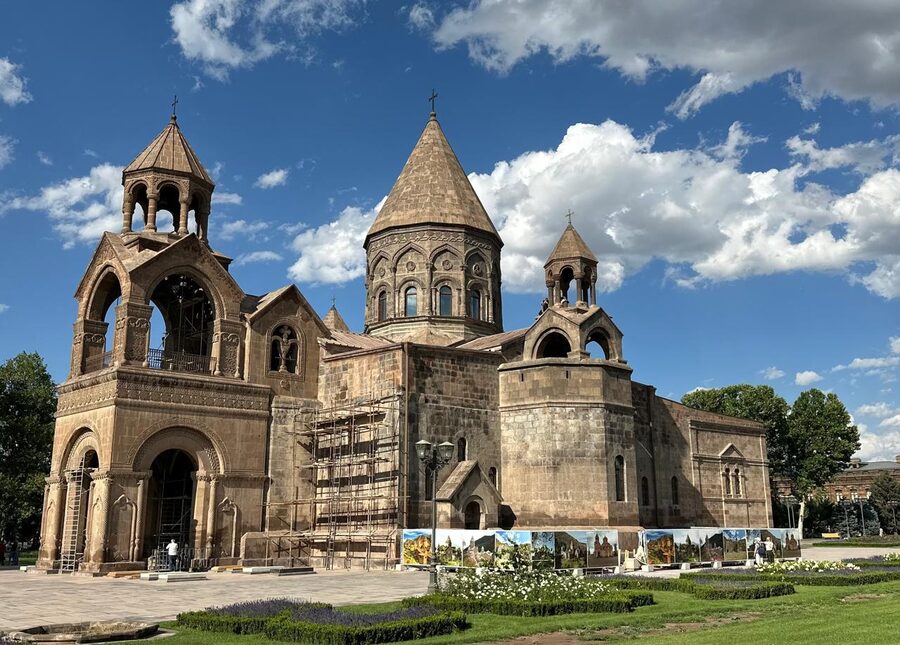
Etchmiadzin (also spelled Echmiadzin or Ejmiatsin, the town is also officially called Vagharshapat) is the Mother See of the Armenian Apostolic Church. It is the seat of the Catholicos of All Armenians, the equivalent of the Vatican for Armenian Christians. The cathedral here was the first cathedral built in the country that was the first nation in the world to make Christianity its state religion, in 301 AD. UNESCO put the cathedral and its three older neighbours on the World Heritage list in 2000.
That sentence does a lot of work. Most visitors come for the religious history, but the practical experience of the day is closer to a country-park stroll with old churches in it. You walk gravel paths between four buildings spread over a couple of square kilometres of small-town Armenia, you eat lunch at a guesthouse café, and if you have time you carry on to Zvartnots ruins down the road towards Yerevan. It is a half-day trip, comfortably. A day trip if you stop for a long lunch and visit Zvartnots properly.
In This Article
- Getting to Etchmiadzin from Yerevan
- Marshrutka, the cheap and normal way
- Taxi or rideshare
- Hire car for the day
- Organised tour
- What is actually here
- How long to budget
- The cathedral itself
- Inside the cathedral
- The relics
- The other UNESCO churches in Vagharshapat
- St Hripsime
- St Gayane
- Shoghakat
- Zvartnots, on the road back
- Mass schedule and visiting during services
- What to eat in Vagharshapat
- When to come
- Big feast days to plan around
- What to skip
- Where Etchmiadzin fits in an Armenia trip
- Quick reference
Getting to Etchmiadzin from Yerevan
Vagharshapat is 20 km west of Yerevan along the M5 highway, towards the Turkish border. You have four ways to do the trip and they sort by price and patience.
Marshrutka, the cheap and normal way
Routes 202 and 203 leave Kilikia bus station (Avtokayan, in southwestern Yerevan) every 20 to 30 minutes from early morning until early evening. The fare in late 2025 was 250 dram, paid in cash to the driver as you board or get off (Armenian custom is to pay on exit). The ride takes 35 to 45 minutes depending on traffic out of Yerevan. The bus drops you near the central square in Vagharshapat, a 5-minute walk from the cathedral grounds.
Two practical things. The minibuses are full-size vans, not coaches, and they fill up at the start of the route, so if you board mid-route on a Saturday morning you may be standing. And the return point in Vagharshapat is not always the same as the drop-off; ask “Yerevan?” and a driver will point you to the right corner.
Taxi or rideshare
A Yandex Go from central Yerevan to the cathedral runs around 4,000 to 5,500 dram one way at off-peak hours, sometimes higher in the evening. Splitting between two or three people, this is faster and only marginally more expensive than the marshrutka, and you can get dropped at the cathedral’s main gate rather than at the central square.
If you want a driver to wait while you visit, expect 10,000 to 14,000 dram for the round trip with a 90-minute wait. Agree the price before you set off, not after, and have them write the figure on a piece of paper if your Russian or Armenian isn’t up to it. Drivers near Republic Square in Yerevan will quote higher; drivers near Kilikia bus station will quote closer to the real number.
Hire car for the day
Etchmiadzin sits naturally on a half-day loop with Zvartnots and, if you push the day, Saghmosavank or Hovhannavank monasteries an hour north. Renting a car from Yerevan for a day costs 25,000 to 35,000 dram for a basic compact and gives you the freedom to leave when you’re done rather than waiting for the next marshrutka. Driving in Armenia is fine if you’ve driven in Italy or Greece. The standards are similar, the road surface in the Ararat valley is good, and the route to Vagharshapat is one straight road.
Organised tour
Half-day tours from Yerevan covering Etchmiadzin and Zvartnots run around 8,000 to 12,000 dram per person and usually include a guide who can explain the iconography inside the cathedral, which the cathedral itself does not. If you want the religious history rather than just the architecture, this is the version to take. If you want to potter around the grounds and eat khachapuri in your own time, take the marshrutka.
Many travellers combine the cathedral with other sites. A similar logic applies to Garni Temple paired with Geghard Monastery, or to Khor Virap with the Areni wine valley. Etchmiadzin’s natural pairing is Zvartnots, on the way back, plus optionally St Hripsime and St Gayane churches inside Vagharshapat itself.
What is actually here
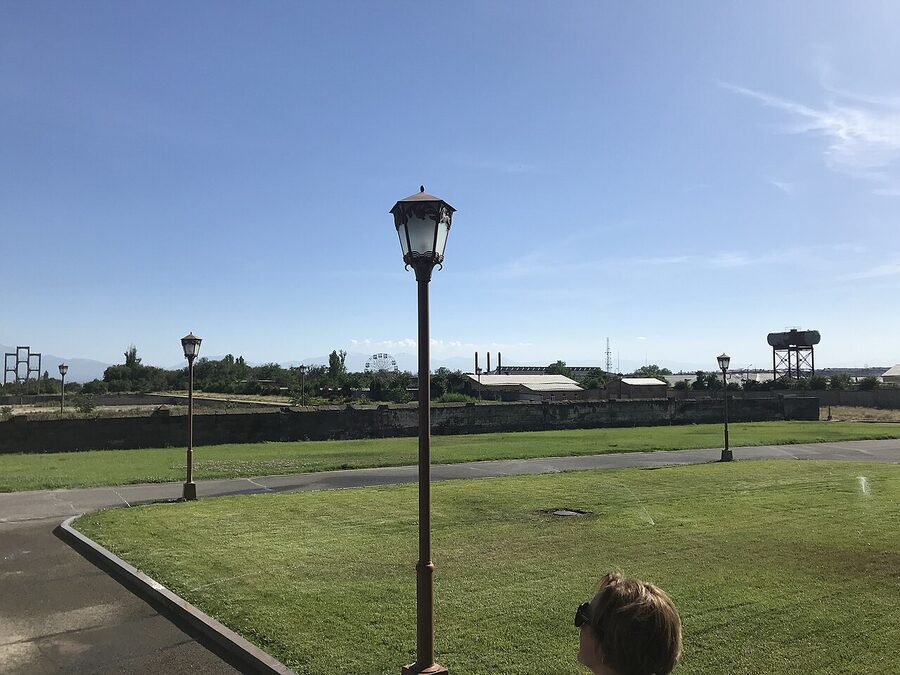
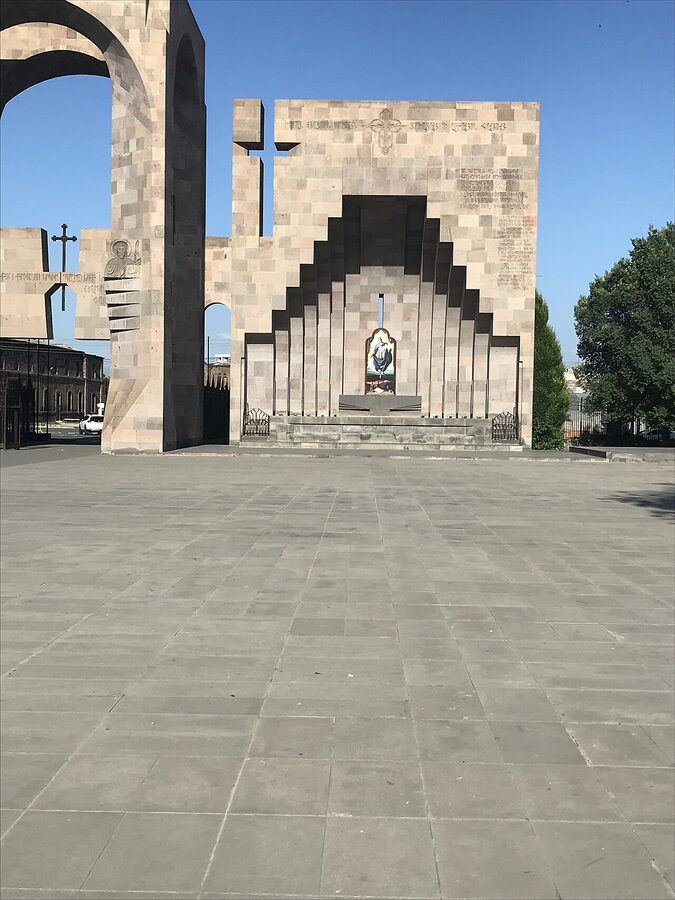
The Mother See complex is a walled compound at the centre of Vagharshapat. Inside the walls are the cathedral, the Catholicos’s residence, the Gevorkian Theological Seminary, the Treasury Museum, the Ruben Sevak Museum, the Khrimian Museum, a baptistry, a brotherhood cemetery, and the open-air altar where major outdoor services are held. The grounds are landscaped, easy to walk, and free to enter.
Three more sites live just outside the Mother See walls but inside Vagharshapat town: St Hripsime Church (7th century), St Gayane Church (7th century), and Shoghakat Church (17th century). These are the four buildings UNESCO listed together in 2000, alongside the Zvartnots ruins on the road back to Yerevan. The whole UNESCO ensemble is what you’ve come to see, even if Etchmiadzin Cathedral is what people mean when they say “Etchmiadzin”.
How long to budget
Cathedral and complex grounds: 60 to 90 minutes if you’re moving briskly, two hours if you go through the Treasury Museum properly. Add 30 minutes for St Hripsime, 20 for St Gayane, 15 for Shoghakat. Zvartnots takes 45 to 60 minutes. Lunch at Machanents takes 90 minutes. The whole half-day from Yerevan, comfortably done, is about six hours door to door.
The cathedral itself
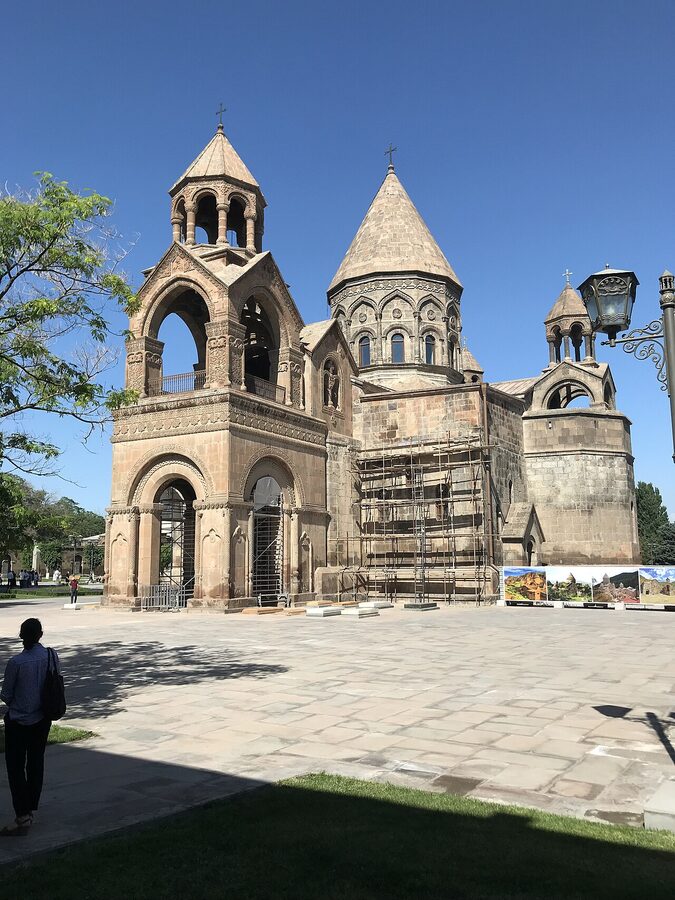
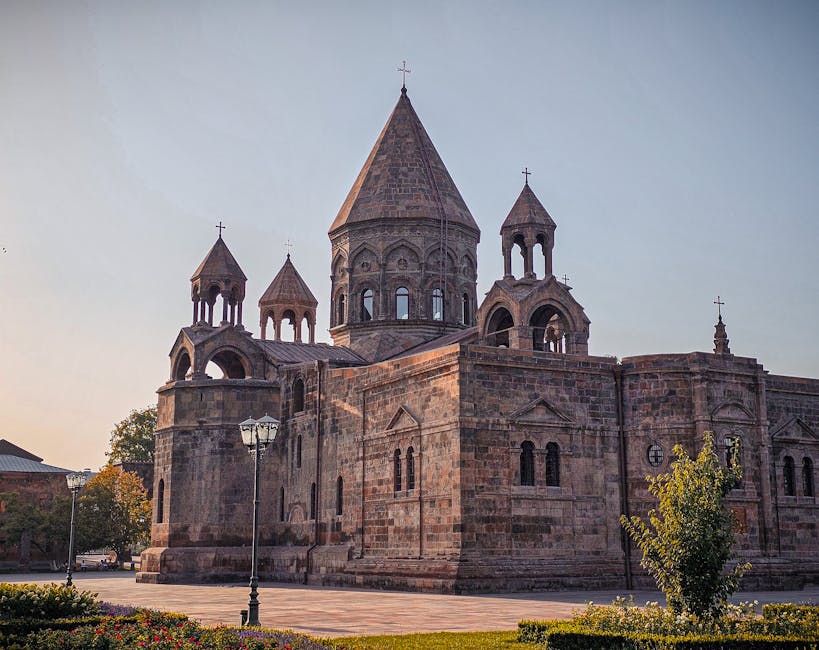
What you see when you walk into the courtyard is a compact, cross-shaped granite building topped with a tall central drum and a conical roof, four bell towers around it, and a single squarish portal at the western end. The structure is 33 metres long, 30 metres wide, and 34 metres high at the outer dome. It looks older than it is. The current building’s core dates to 483 to 484 AD, when Vahan Mamikonian rebuilt the cathedral after Persian invaders had wrecked the original. The belfries went up in the 1650s. The smaller corner towers came in 1682. The eastern sacristy and museum room were added in 1868. Almost every century since the fifth has put a hand on this building.
The first Etchmiadzin, built around 301 to 303 AD by Gregory the Illuminator after King Tiridates III converted Armenia to Christianity, sat on the same spot. Tradition has it Gregory had a vision of Christ descending from heaven and striking the earth with a golden hammer to mark the site. The name Etchmiadzin translates as “the descent of the only-begotten”, the moment that vision describes. The 4th-century original was a basilica, partially wooden, and probably modest; the foundation lines of that early church are visible inside the current building.
Inside the cathedral
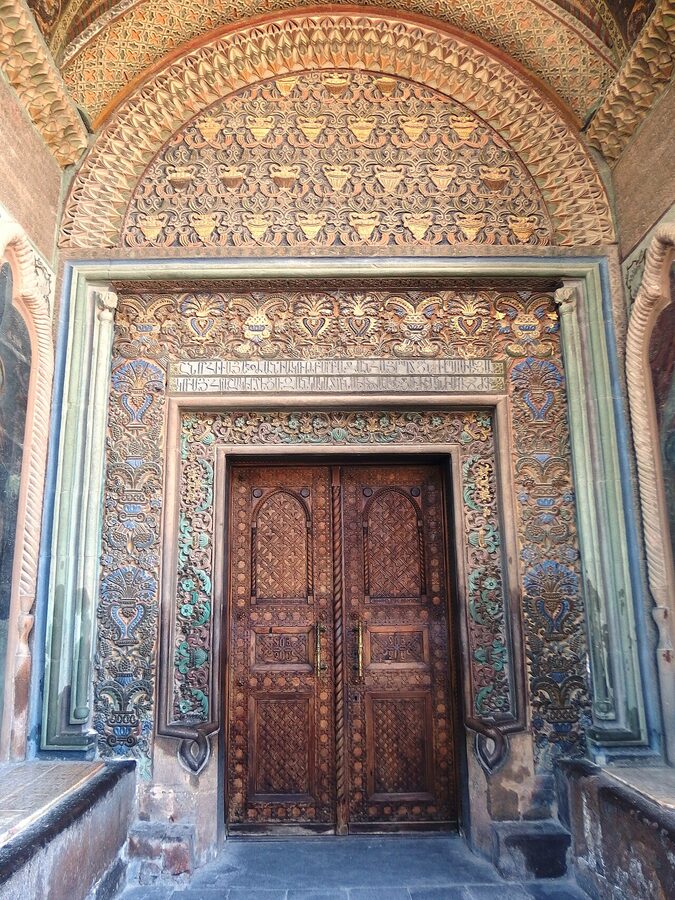
From 2012 to 2024 the cathedral was closed for major structural restoration. The dome, the columns, the arches, and the vaults all turned out to be in worse shape than initial roof-tile inspections suggested, and the project ran a decade long. The reconsecration service was held on 29 September 2024, with the Prime Minister of Armenia and the Catholicos in attendance. What you walk into now is essentially a freshly redone interior over a 1,500-year-old structure.
The dome is painted with stylised vines and earth tones, with gold motifs on a lighter ground. The walls are pale stone, the floor marble, and saints’ icons hang in heavy gold frames. It does not feel old in the way the dim 7th-century stonework of Geghard Monastery feels old. It feels actively used. The altar is at the eastern end, lifted on a stepped platform; the apsidal arrangement and the cross-in-square plan here became the template for Armenian church architecture across the next 1,500 years.
Two practical bits of etiquette. Cover your legs (men and women), don’t wear a hat (men), and women may but are not required to cover their hair. Service times aside, parishioners walk backwards out of the cathedral so as not to turn their back on the altar; you are not expected to do the same as a visitor, but it’s worth knowing if you wonder why a queue at the door is moving the wrong way.
The relics
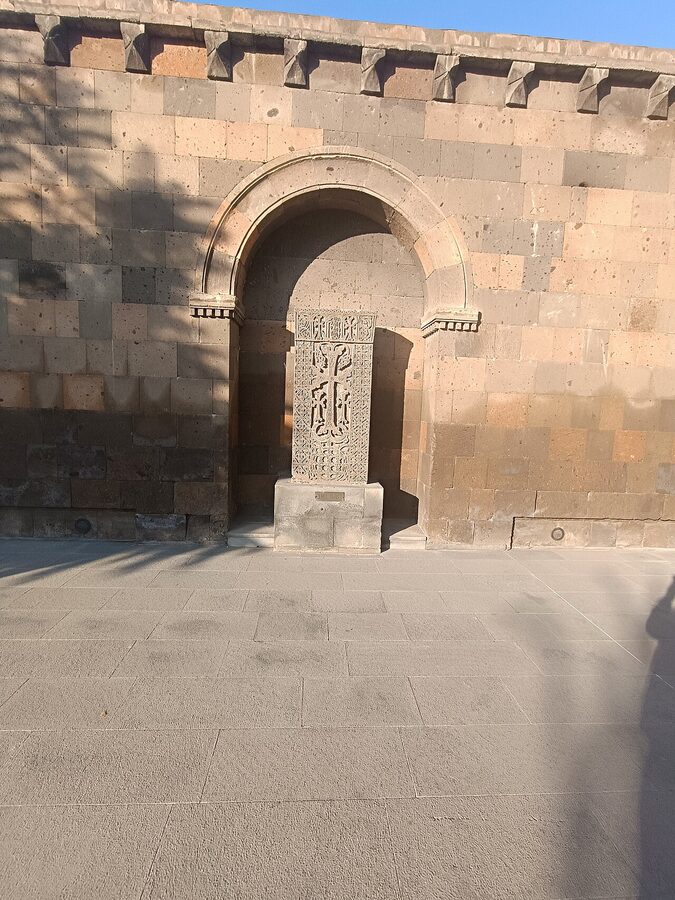
The Treasury Museum, in a building on the south side of the courtyard, is what most pilgrims actually queue for. Inside are the church’s sacred objects: medieval Armenian gospel manuscripts, gold and silver liturgical vessels, vestments, reliquaries. The headline objects are a fragment said to be from Noah’s Ark, and the Holy Lance (Geghard in Armenian, which gives Geghard Monastery its name) which tradition identifies as the spear that pierced Christ’s side. Conservatively, both are objects of veneration whose authenticity history cannot prove and which have been in Armenian hands for many centuries. Take that as you will. They are exhibited in beautiful filigreed reliquaries that are themselves worth the museum ticket.
Treasury Museum admission is 2,000 dram for foreign visitors, 1,000 for adult Armenian citizens, 500 for students with student ID, and 300 for schoolchildren. ICOM members, pensioners, military and preschool children enter free. The hours are Tuesday to Sunday, 10:30 to 17:30. Closed Monday. If you visit on a Monday, you will see the cathedral and the grounds but not the relics.
The other UNESCO churches in Vagharshapat
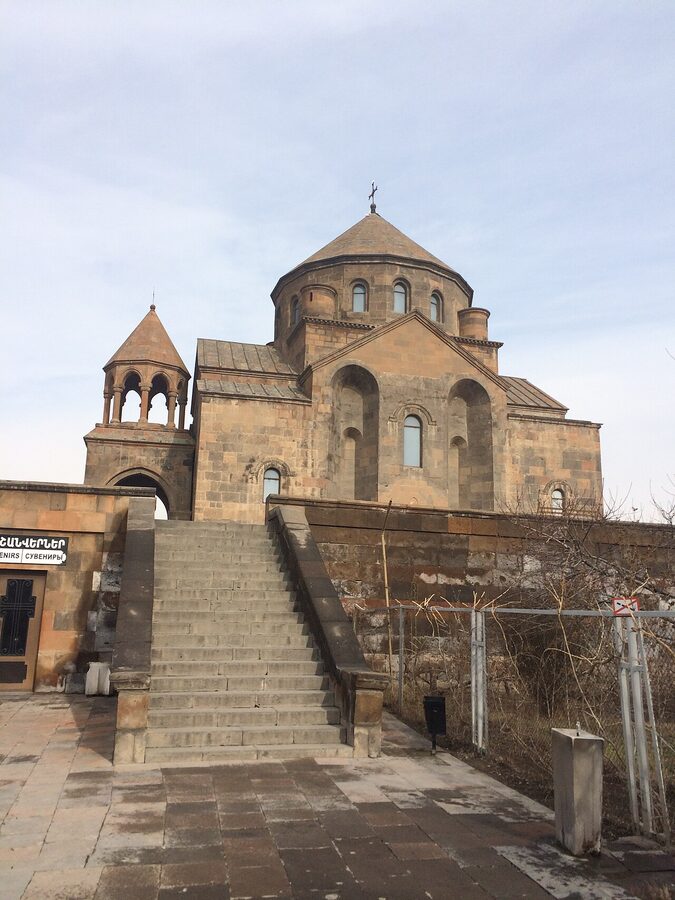
Three other churches share the UNESCO listing with the cathedral. They are all in Vagharshapat, all walkable or one short taxi away from each other. They are connected by a thread of legend that the guidebooks repeat in slightly different versions: a group of Roman nuns, fleeing the Emperor Diocletian, came to Armenia. Their leader Hripsime was famously beautiful; King Tiridates III wanted her, she refused, and he had her killed along with her companion Gayane. After Gregory the Illuminator converted the king, both nuns were canonised, and three of the surviving early-medieval churches in town are dedicated to them or to events in the cycle.
St Hripsime
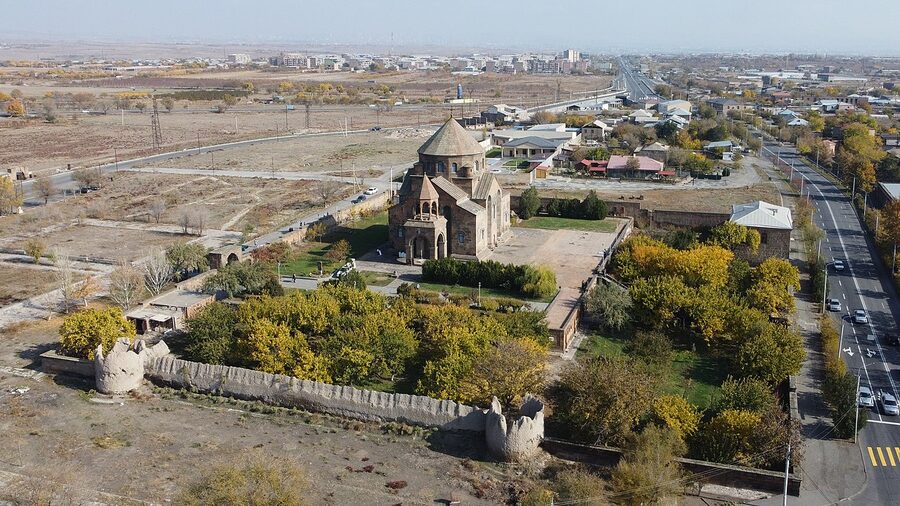
If you only see one of the three, see this one. Built in 618 AD over a much earlier 4th-century chapel, St Hripsime is one of the cleanest, most influential examples of Armenian classical church architecture you can walk into. Cross-domed, four-apsed, dressed in red volcanic tuff, with a quiet old wall around it and a working cemetery behind. The interior is austere, no frescoes survive in the nave itself, just dark basalt and the curve of the dome, and the contrast with Etchmiadzin’s painted interior is the whole point of seeing both in one trip.
Hripsime’s tomb is in a small chamber under the church, accessible by a narrow stair from inside the nave. It is sometimes open and sometimes locked depending on whether a service has just finished. If it’s open, go down. The 4th-century foundations are still there.
St Hripsime sits on the eastern edge of town, basically the first thing you pass driving in from Yerevan. It is open the same hours as the cathedral, free to enter.
St Gayane
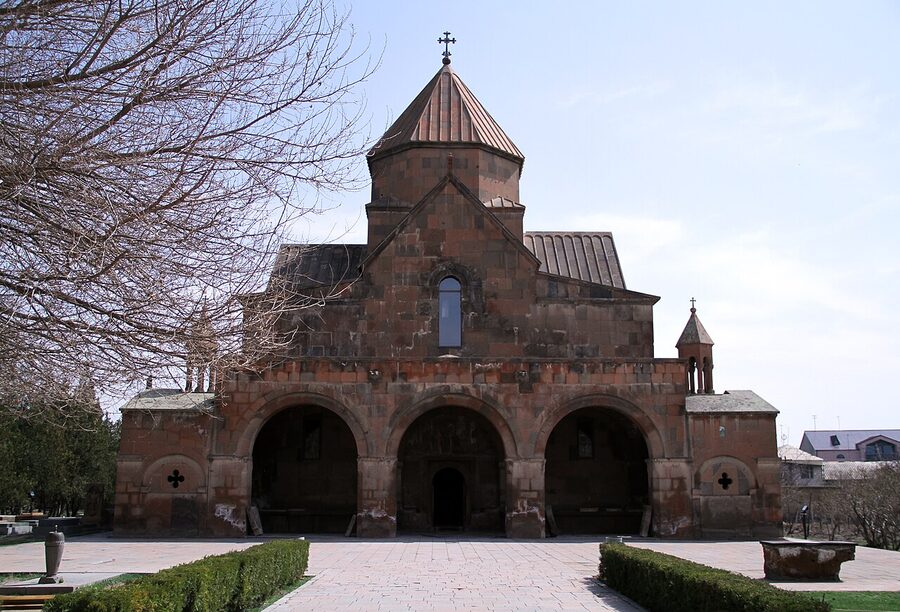
St Gayane sits behind the Mother See compound, a five-minute walk from the cathedral’s southern wall through quiet residential streets. It’s a touch later than Hripsime, built in 630 AD, and its plan is the older basilica-with-dome type that gradually got replaced by the Hripsime model. The interior is brighter than Hripsime’s: pale plaster, simple, with a 17th-century gavit (covered porch) added at the western end. The arched ceiling of the gavit is the most photographed bit.
It’s a much-loved local church, and on Saturdays you’ll often find a wedding ceremony in progress. Armenian weddings are not closed events; you can quietly stand at the back, but step out if you’d be in the way. There’s a small cemetery behind the church in use today.
Shoghakat
Shoghakat is the smallest and least-visited of the three town churches and the latest, built in 1694 by Prince Aghamal Sorotetsi over an earlier 7th-century structure that did not survive. The name translates as “drop of light”, from a legend about light from heaven striking the spot where one of the original martyred nuns died. It’s a single-nave church with a tall conical drum and not much interior decoration. Five minutes inside is enough. It’s worth visiting only if you’ve already done the other two and have the time.
Zvartnots, on the road back
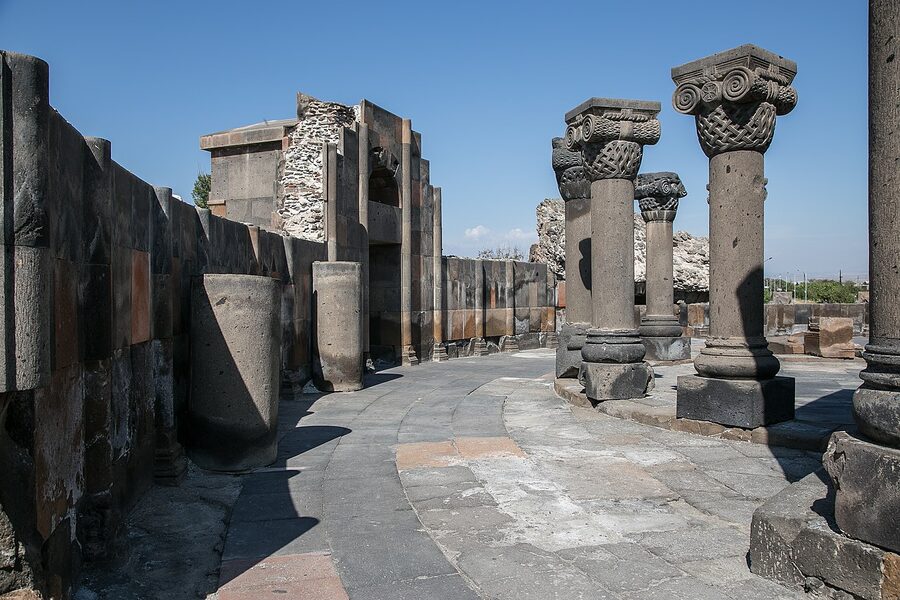
About 5 km back towards Yerevan, set in vineyards and apricot orchards, are the ruins of Zvartnots. A 7th-century round cathedral that, from what we can reconstruct, was the ambitious cousin of Etchmiadzin. Catholicos Nerses III the Builder commissioned it around 643 AD. Three storeys tall, circular in plan, with elaborately carved column capitals featuring eagles, vines, and human figures, Zvartnots was almost certainly the most architecturally adventurous building in 7th-century Armenia.
The cathedral collapsed in the 10th century (historians argue between earthquake and Arab invasion as the cause) and was never rebuilt. What’s left now is a circular footprint of column bases, the lower storey of the surrounding wall, and a scatter of carved capitals on display around the site and inside the small on-site museum. The museum has a 1:25 scale model of the original building that helps you understand what the standing stones were once part of.
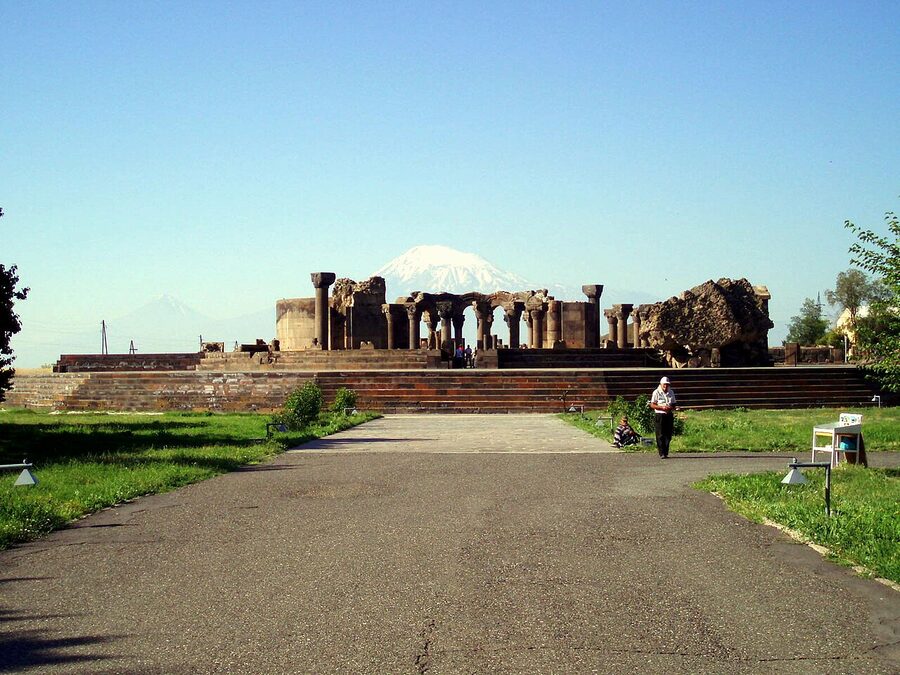
Behind the cathedral are the ruins of the patriarchal palace, with a wine press still visible cut into the stone. Zvartnots was the catholicate residence as well as a cathedral. It’s not extensively excavated, so you walk freely between low walls and foundation lines.
Admission is 1,300 dram for foreign visitors. Open Tuesday to Sunday, 10:00 to 17:00; closed Mondays. There’s no shade beyond the museum building, so on a hot day come in the morning or wait until 4 pm.
Getting between Etchmiadzin and Zvartnots is the awkward part of the day. Bus 202 or 203 runs the highway between the two and you can ask the driver to drop you at the Zvartnots stop, then flag down another marshrutka in either direction afterwards. But the highway is busy and the walk between the bus stop and the entrance gate is not picturesque. Most people taking the day on public transport just take a taxi from Etchmiadzin to Zvartnots (around 1,500 dram) and then board a Yerevan-bound 202/203 from the Zvartnots gate.
Mass schedule and visiting during services
The cathedral is an active church, not a museum. Sunday Divine Liturgy (Surb Patarag in Armenian) is the main weekly service and the cathedral fills with worshippers; this is the right time to come if you want to see Armenian Apostolic worship at its mother church and hear the choir. Liturgies are also held on major feast days and during Holy Week. Visitors are welcome but the rules tighten: keep voices low, don’t move around the nave during the service, and don’t photograph people praying.
The cathedral grounds are open daily, roughly 7:00 to 20:00. The cathedral itself is unlocked the same hours but if a service is in progress, the western half of the nave is reserved for worshippers and the visitor route narrows. If your only goal is to walk the building empty and look at the structure, come on a Tuesday or Wednesday morning.
For the canonical service schedule and any feast-day information, the Mother See’s office is +374 10 517110. The site itself is at armenianchurch.org.
What to eat in Vagharshapat
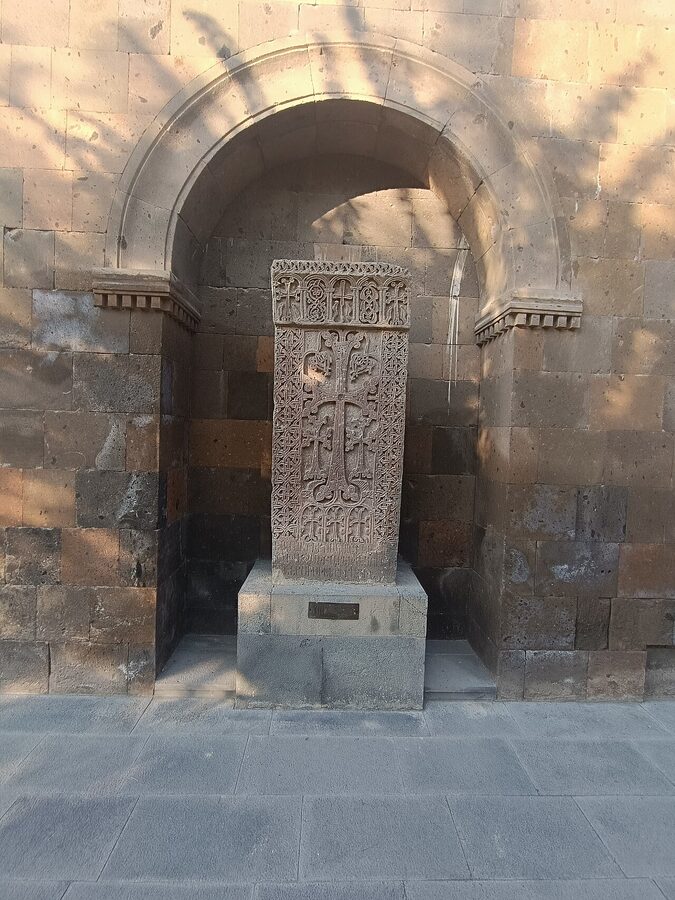
The food scene in Vagharshapat is small. A handful of cafés in the central square serve coffee and the standard sweet pastries, and there are 24-hour shawarma stands near the Mother See’s western gate that are reliable but not memorable. For a sit-down lunch, two places are worth the walk.
Machanents Tourism & Art Centre, at 36 Shahumyan Street, is the local institution. It’s a converted old courtyard house with a working theatre, a guesthouse, and a restaurant that serves the standard Armenian set: khorovats (grilled meat), tolma, lavash made on the table, hand-rolled khinkali, the tan and beer. Two can eat well for around 8,000 to 12,000 dram. The garden seating in summer is the better option than the indoor dining room, which can feel like a coach-tour set-up at lunch.
Old Erebuni, a few streets northeast of the cathedral, is plainer, cheaper, and patronised by locals more than tourists. The kebabs and barbecue are the thing to order. No English menu most days, so be ready to point.
If you want a wider take on what to order before your visit, our guide to traditional Armenian food covers the dishes you’ll see on every menu.
When to come
Vagharshapat sits in the Ararat Valley at low elevation. Summers are hot, 30 to 35 degrees through July and August, sometimes higher. Spring (April to early June) and autumn (mid-September through October) are the two genuinely pleasant windows; the apricot blossom around the seminary gardens in late March is a small extra reason to come then. Winter is cold but not snowed-in; the cathedral and the museums stay open year-round.
Sunday mornings are crowded with worshippers; the grounds are still open but the cathedral interior is essentially closed to sightseeing during the liturgy. Saturdays have weddings at St Gayane and Hripsime, which are charming but the churches themselves are full. Tuesday through Friday is your quiet window.
Big feast days to plan around
The Feast of the Holy Etchmiadzin Cathedral is celebrated 64 days after Easter. The date moves each year, but it’s typically in late June or July. The Catholicos officiates, the open-air altar comes into use, and tens of thousands of pilgrims fill the grounds. If you want to see the cathedral as a working pilgrimage site, this is the day. If you want to look at the architecture, come a different week.
The other big day is the Anointing of the Holy Muron. Every seven years, the Catholicos consecrates the holy oil that supplies every Armenian Apostolic church worldwide. The next anointing is scheduled for 2030. Worth noting if your visit happens to coincide.
What to skip
A few small things in Vagharshapat get sold to visitors and aren’t worth the time.
The Hovhannes Hovhannisyan house museum, in a Soviet-era apartment block off Komitas Square, is for fans of late-19th-century Armenian poetry specifically. The Khoren Ter-Harutyunyan museum near the cathedral is small, cheap, and pleasant if you have an hour to kill, but it isn’t going to be a highlight. The Mher Abeghyan museum at Komitas Square has a similar profile. If your time is constrained (and a half-day from Yerevan is constrained), these are easy cuts.
The Ruben Sevak Museum, inside the Mother See, is dedicated to a single 20th-century Armenian writer killed in the 1915 genocide. It’s a small two-room exhibit; ticket is 500 dram for foreigners. Worth going only if Sevak’s story specifically interests you.
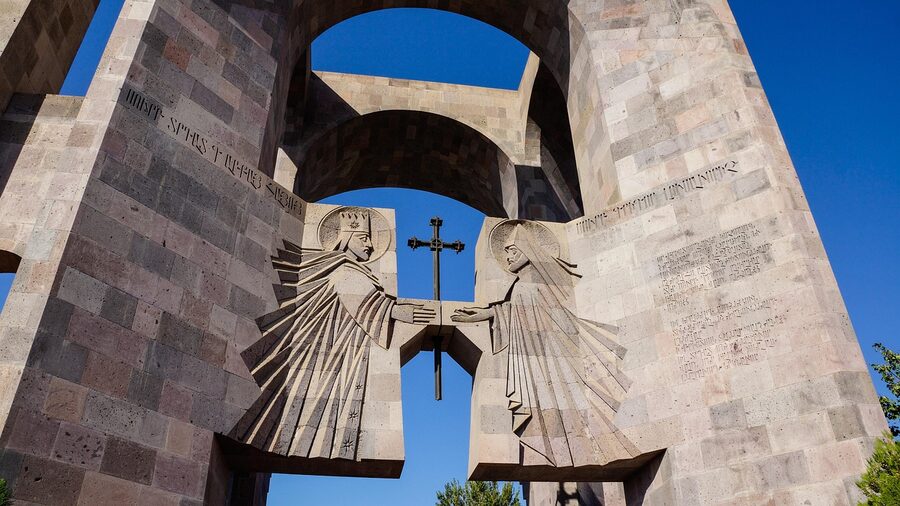
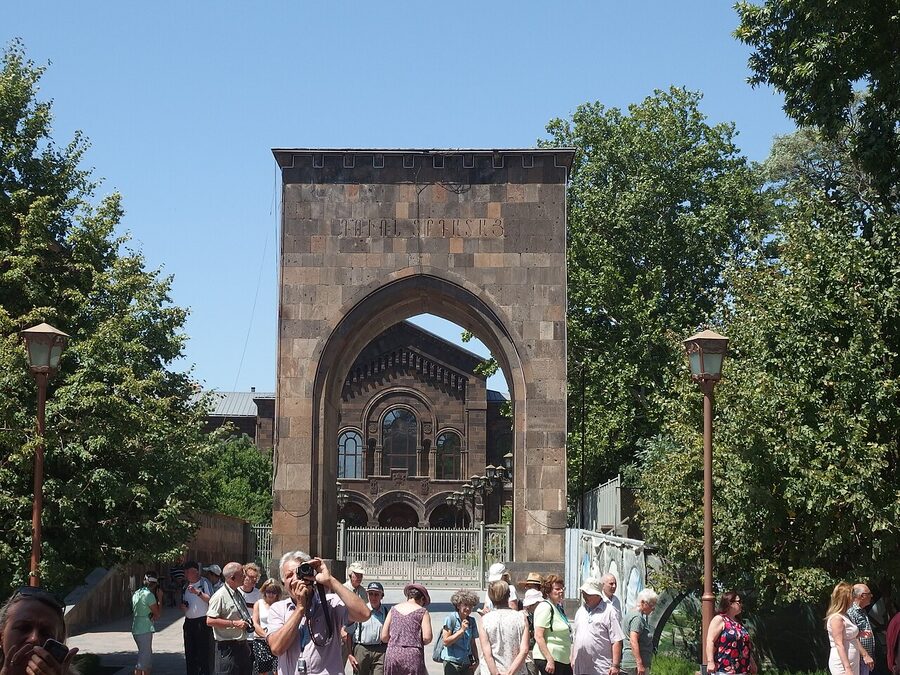
The “Pope’s Visit” memorial gate at the western entrance, installed in 2001 to mark Pope John Paul II’s visit, is the kind of thing that generates a mention in every travel article without being something anyone would deliberately go to see. It’s at the gate, you’ll walk through it without noticing if no one points it out.
Where Etchmiadzin fits in an Armenia trip
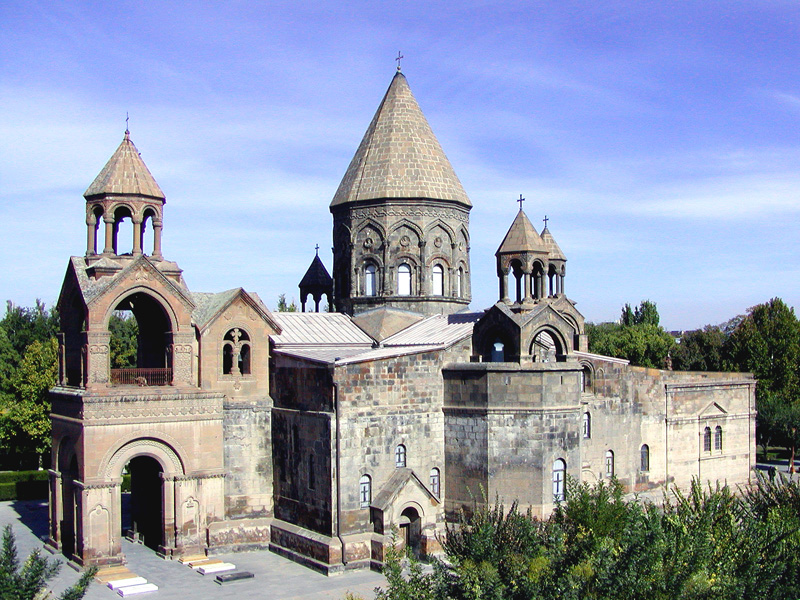
If you have three days in Armenia, you have time for Etchmiadzin. If you have two, it’s a tougher call. The country’s headline monasteries (Geghard, Khor Virap, Tatev, Sevanavank) each have a stronger sense of place than the cathedral, which sits in a working town rather than a dramatic landscape. What Etchmiadzin offers that the others don’t is the centre of the religion itself: the Mother See, the relics, the seminary, the catholicate. It is the religious capital, not the photogenic mountainside.
A common Armenia loop pairs Etchmiadzin with Zvartnots as a half-day, then Khor Virap and Noravank as a full day south of Yerevan, then Garni and Geghard as a half-day east, then a longer trip to Tatev. If you can only do one religious-history day, doing the southern run (Khor Virap plus Noravank) gives you Mt Ararat views and the Areni wine region as a built-in second pleasure. Etchmiadzin, by contrast, is a town day. Its rewards are quieter and more architectural, and best for a traveller who already cares about the religion or the building lineage.
For Yerevan-side context before or after a visit, the Saryan House Museum in the city centre is a good companion piece for the painted dome interiors. So is the Yerevan theatre scene if you want a contrasting evening: the same culture’s secular face, in central Yerevan, two hours after you walk back through the cathedral gates.
Quick reference
Mother See of Holy Etchmiadzin, Vagharshapat 1101, Armavir Province. Phone: +374 10 517110. Website: armenianchurch.org
- Grounds and cathedral: daily, roughly 7:00 to 20:00. Free.
- Treasury Museum: Tuesday to Sunday, 10:30 to 17:30. Closed Monday. Adults: 2,000 dram (foreign), 1,000 dram (Armenian citizens). Students 500 dram. Schoolchildren 300 dram. Pensioners, military, ICOM, preschool: free.
- Ruben Sevak Museum: Tuesday to Sunday, 10:30 to 17:30. 500 dram (foreign).
- St Hripsime, St Gayane, Shoghakat: daily, similar cathedral hours, free.
- Zvartnots: Tuesday to Sunday, 10:00 to 17:00. 1,300 dram (foreign). 5 km from Etchmiadzin towards Yerevan.
- Marshrutka 202/203: Kilikia bus station, Yerevan, every 20 to 30 minutes. 250 dram. About 40 minutes.
- Dress code: covered legs (men and women), no hats for men in the cathedral, hair covering optional for women.
Plan to be in Vagharshapat before 16:00 to fit the Treasury Museum into your visit. If you’ve come on a Monday and the museum is closed, do the cathedral, the three town churches, and Zvartnots. That day still earns its bus ticket.