Martiros Saryan moved into the house at 3 Saryan Street in 1932. Alexander Tamanian, the architect who gave Yerevan its pink-tuff Republic Square and the Opera, designed it for him. Thirty-five years later, on 26 November 1967, the gallery wing was attached, the doors opened, and Saryan walked his own visitors through the rooms. He was 87, still painting, and would keep painting for another five years until he died in the same building in 1972. The museum has been here since, run by his family, with about 300 of his works hung roughly in the order he made them.
That timeline is most of why this place feels different from a regular art museum. You’re not in a gallery that bought a Saryan and put it on a wall. You’re in his house, looking at his easel, in front of his stairs, on his street. If you have an afternoon free in Yerevan and you care about art at all, this is one of the easier choices in the city.
In This Article
- Quick visit guide
- Who Saryan was, in plain terms
- Why his style still hits
- The house and the gallery
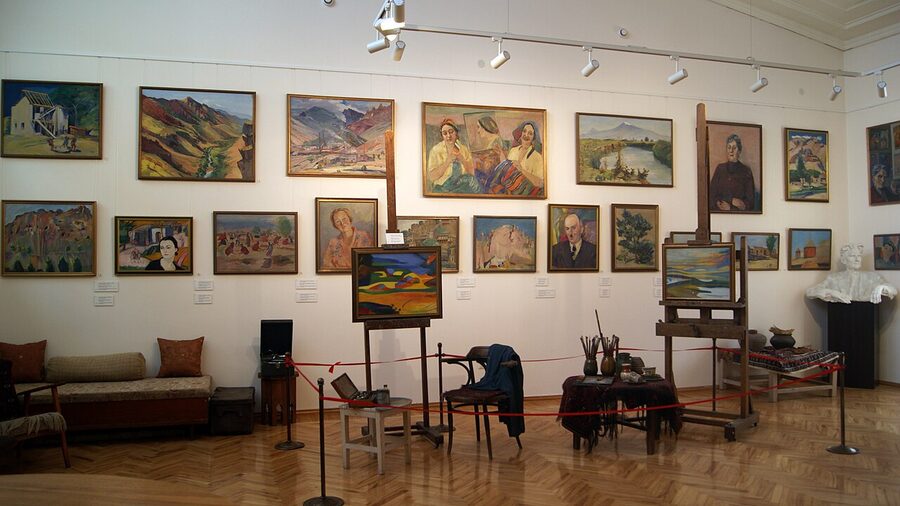
- What you’ll see floor by floor
- Ground floor: early work and the Eastern travels
- First gallery floor: 1920s to 1940s, the Armenian period
- Second gallery floor: late work and family portraits
- Fourth floor: temporary exhibitions
- Saryan’s studio: the room nobody else can copy
- Take a guided tour or wander on your own?
- The painted staircase you might walk past
- Saryan Street and the neighbourhood
- Getting there and getting in
- Combining the museum with other Yerevan visits
- What I’d skip and what I wouldn’t
- Practical bits people ask about
- Is it accessible?
- Photography?
- How does it compare to the National Gallery?
- Is there a cafe inside?
- Best time of day to visit?
- How does it sit inside a wider Armenia trip?
- Final read
Quick visit guide
If you’re scanning the page, here’s what you actually need.
| Detail | Info |
|---|---|
| Address | 3 Martiros Saryan Street, Yerevan 0002 |
| Phone | +374 10 58 05 68 |
| Website | sarian.am |
| Ticket | 1,000 AMD (about $2.60 USD) |
| Tour in Armenian | 2,000 AMD (about $5.20) |
| Tour in English / Russian / French | 4,000 AMD (about $10.40) |
| Yerevan Card | Free entry included |
| How long to allow | 1.5 to 2 hours, longer if you take a guide |
Who Saryan was, in plain terms
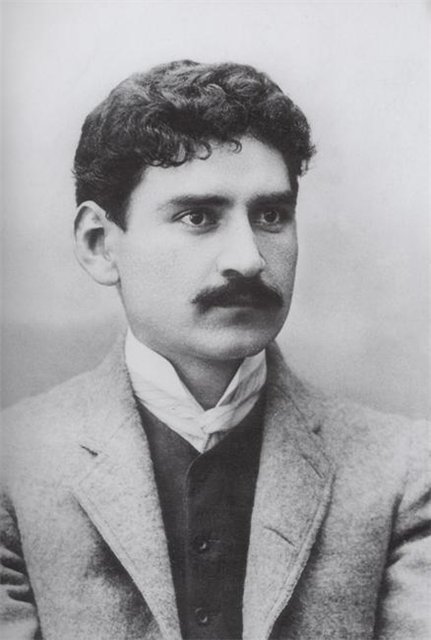
Born in 1880 in New Nakhichevan, in what’s now Rostov-on-Don, Saryan grew up speaking Armenian in a town of Armenian merchants and farmers. He trained at the Moscow School of Painting, Sculpture and Architecture, where Konstantin Korovin and Valentin Serov taught him. By his late twenties he was travelling: Constantinople in 1910, Egypt in 1911, Persia in 1913. The Eastern light is what changed him. He came back painting in flat sun-bleached planes of yellow, ochre, magenta, and turquoise that nobody else in Russian art was making at the time.
He moved to Yerevan in 1921. He painted Armenia constantly after that: Lake Sevan in different lights, the wheat fields under Aragats, mountain villages, Lori valley orchards, the head of an old peasant woman, his wife, his children, himself. He led the Union of Armenian Artists from 1945 to 1951, sat in the Soviet parliament, and ended up the closest thing twentieth-century Armenia had to a national painter. The Armenian art world calls him the Master of Color, which sounds like a marketing line but is fair: when you stand in front of one of his Egypt paintings the colour does the whole job, and the drawing is almost an afterthought.
If you’re trying to place him among the European modernists, the rough comparison is Matisse. Saryan was a few years younger than Matisse and never quite as famous outside Russia, but they were working the same problem: how flat colour and simplified line can carry an image. They met in Paris in 1928 and the story goes that they got on. Walking the rooms here, you can see the family resemblance to a Matisse Nice studio without it ever feeling derivative. The Armenian colour is its own thing.
Why his style still hits
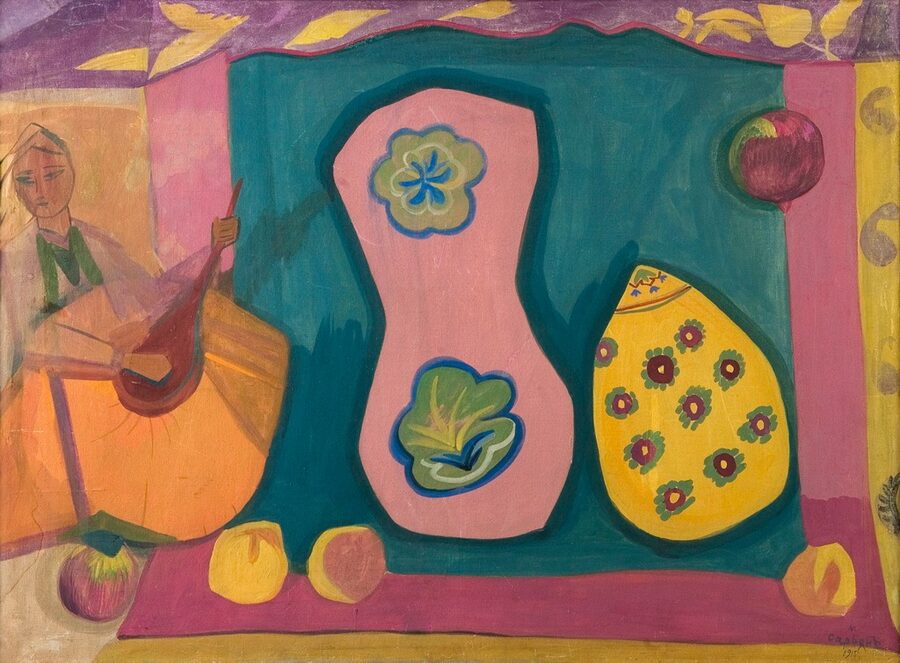
Sit in front of one of the 1910 to 1915 canvases for two minutes and the trick becomes obvious: very few colours, very large flat areas of those colours, dark contour where it’s needed and nowhere else. He took the Russian Symbolist habit of dreamy atmospherics and stripped it down. What’s left is a kind of poster-quality clarity that reads from across a room.
The other thing that makes Saryan stick, especially in the Armenian work, is heat. Not the literal heat of an Egyptian noon, although that’s there in the early stuff. It’s the warm-spectrum bias of the palette: ochre, magenta, yellow ochre, burnt sienna, oranges, with cool colours showing up as accents instead of as the structure. Stand in any of the rooms and you’ll notice your eyes feel different than they would in a room of Russian-school landscapes. There’s no grey-green Tonalism here, no Levitan moods. Saryan’s Armenia is a bright country.
If you only know one painting before you arrive, make it Mount Aragats (1925). It’s not in this museum (it’s at the National Gallery on Republic Square, ten minutes’ walk away), but the language of that canvas is what every flat blue and yellow you see here is doing. The house collection goes wider than the headline pieces, and that’s part of why a slow visit pays off.
The house and the gallery
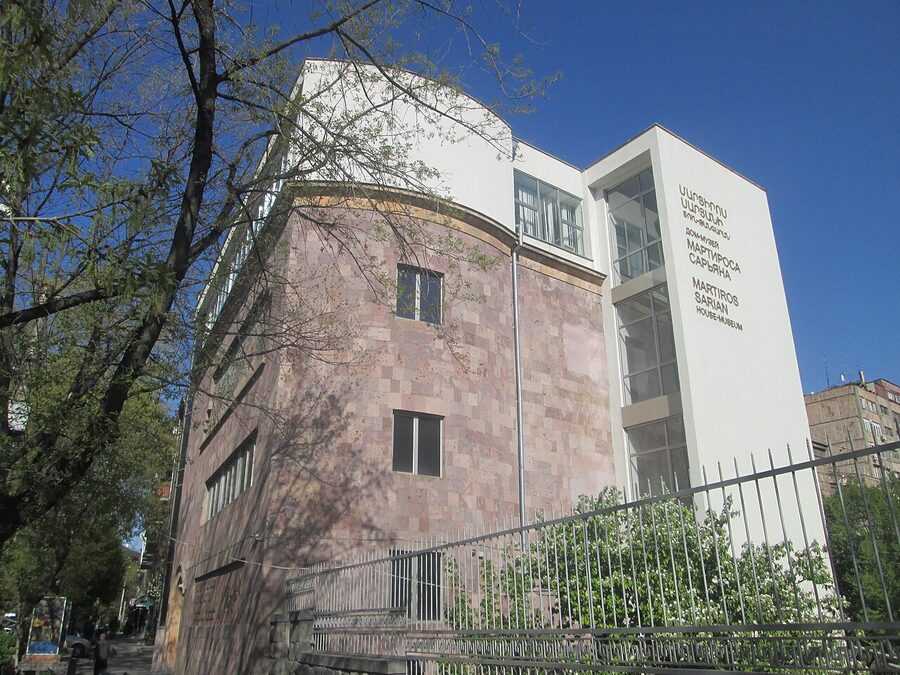
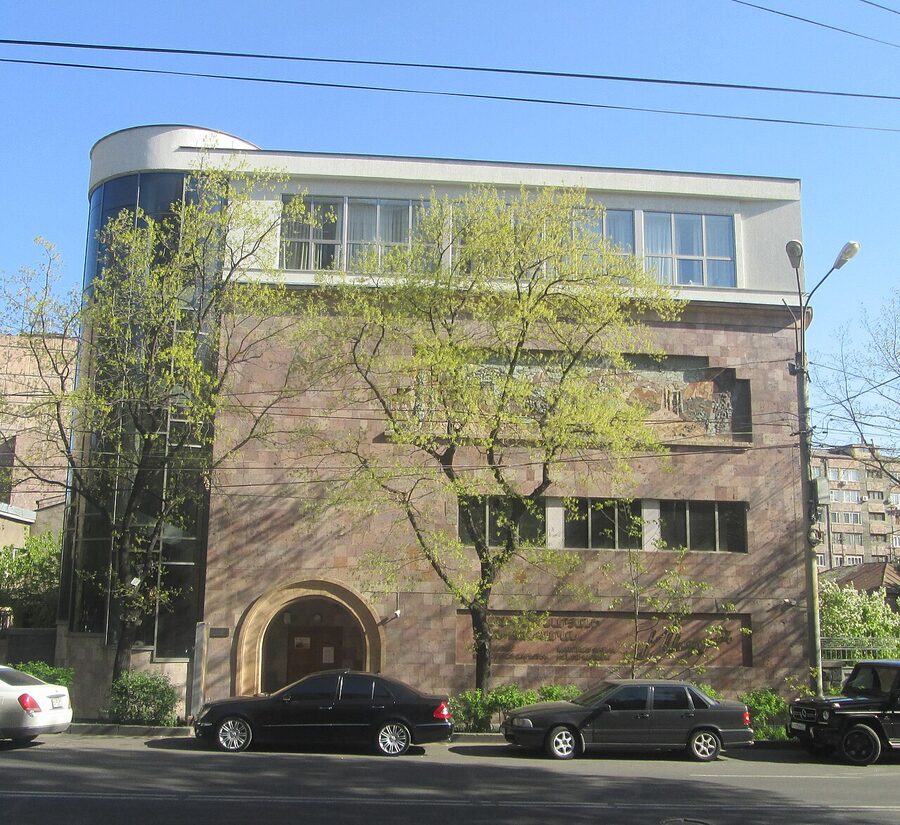
The complex is two buildings joined into one. The original two-storey house, on the left as you face it from the street, is where Saryan and his wife Lusik raised their family from 1932 onwards. Tamanian designed it in his usual register: pink and ochre tuff stone, careful proportions, an arched balcony, no fuss. If you’ve already seen the National Theatre of Opera and Ballet on Tumanian Street and the buildings around Republic Square, the family resemblance will be obvious. This is small Tamanian rather than monumental Tamanian, and that’s what makes it good.
The three-storey gallery on the right was added in 1967, designed by Mark Grigorian. The four-storey extension you might see in photos is from a 2016 reconstruction, which added a top floor used for temporary exhibitions, concerts, and lectures. The whole thing is faced in matching tuff so it reads as one building from the street.
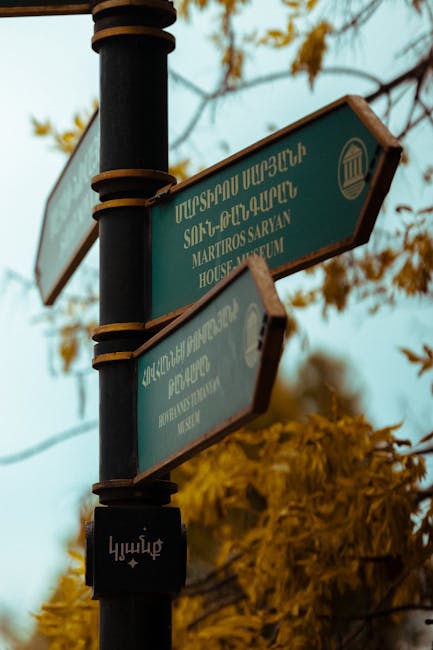
The frieze across the upper facade is the part most people miss. Saryan sketched it himself, and the artist Gagik Smbatian executed it in mosaic and inlay. It’s worth crossing the street to look up at it before you go in.
What you’ll see floor by floor
The permanent collection is about 300 works, hung chronologically across three floors. The arrangement starts with Saryan’s earliest sketches (some made when he was 16) and works up to paintings he finished in his last months. You don’t need to know the periods in advance, but they help.
Ground floor: early work and the Eastern travels
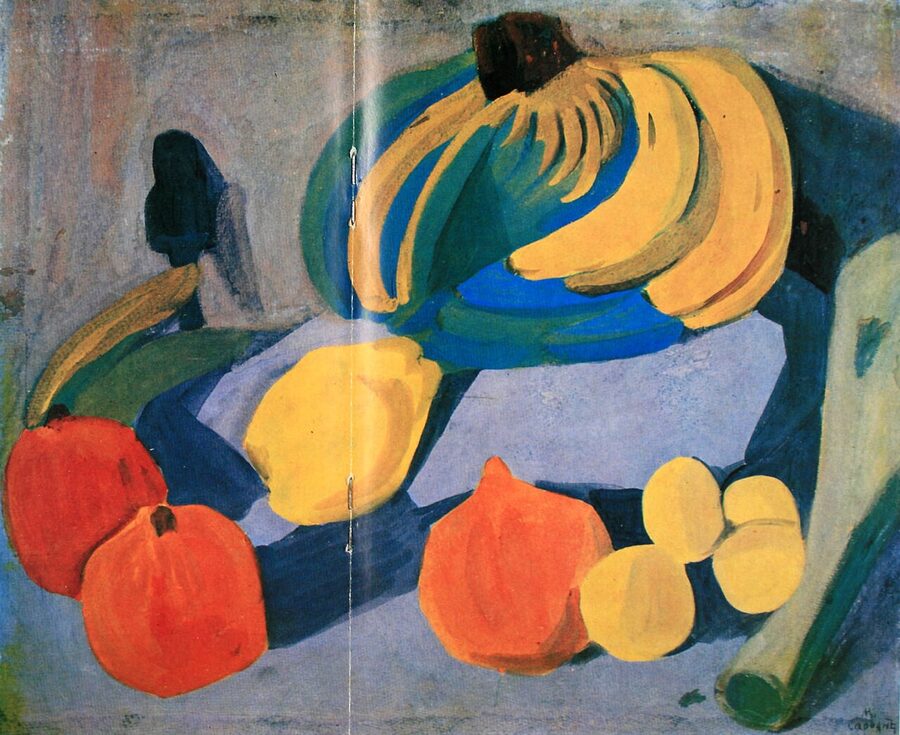
The first rooms cover his student work and the explosive 1908 to 1913 period that made his name. The Eastern travel canvases live here: Constantinople, Egypt, Persia, the donkey caravans, the still lifes with pomegranates and bananas, the desert mountains under hard noon light. If you’ve only got 45 minutes in the museum and you want the famous Saryan, this is the floor to spend it on.
First gallery floor: 1920s to 1940s, the Armenian period
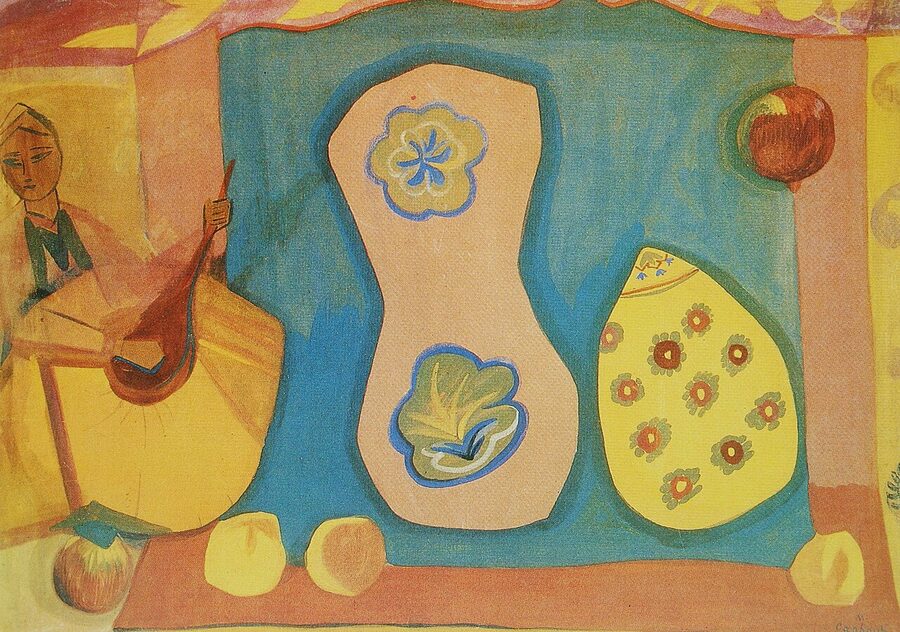
After Saryan moved to Yerevan in 1921 the work changed. The travel paintings are about colour as a force; the Armenian work is more grounded. Wheat under Aragats. A portrait of a stonemason. A couple harvesting cotton. Lake Sevan from a balcony. The colour is still strong but the structure is heavier. There are also illustrations he made for Hovhannes Tumanyan’s writing, and for the anthology Poetry of Armenia, which he illustrated for a 1916 Moscow edition. The Tumanyan illustrations are the small reward of this floor: pen-and-ink work that you might walk past quickly if you don’t know to look for them.
Second gallery floor: late work and family portraits
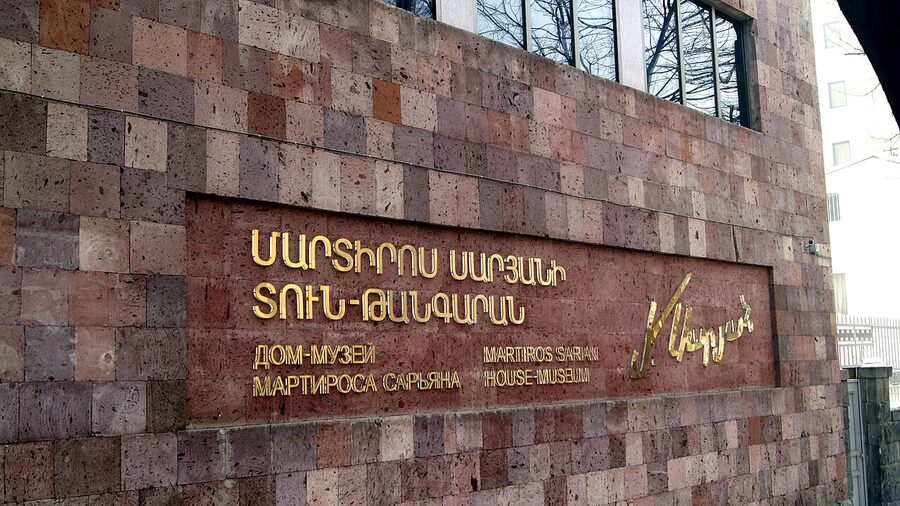
The top floor of the permanent display covers the 1950s onwards. Saryan was painting his way through old age by then; the brush is looser, the colour is louder in places, and the family portraits get sentimental in a way the early work never did. He kept painting flowers obsessively, especially after his wife Lusik died in 1965. The flower paintings on this floor are why this museum is unsubtly nicknamed Saryan Flowering by people who run it.
Fourth floor: temporary exhibitions
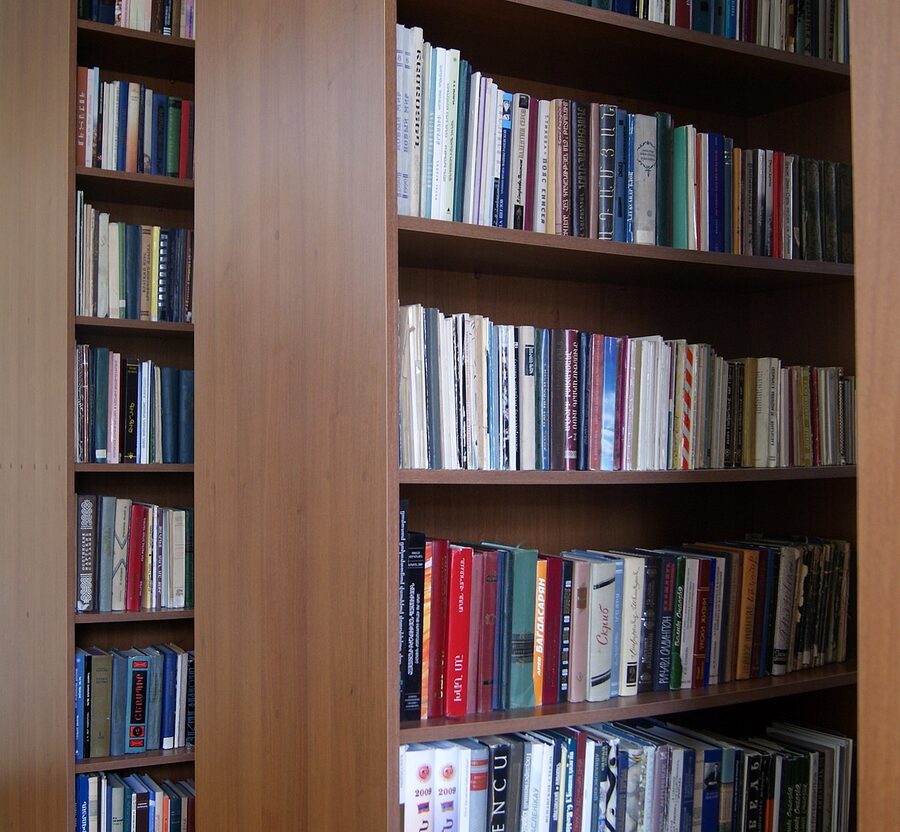
The added top floor hosts rotating shows: a Sarian Watercolour exhibition, a tribute to his composer son Ghazaros Sarian, family-themed shows tied to specific anniversaries. If you happen to be in Yerevan when one of these is on, it’s a real reason to go a second time.
Saryan’s studio: the room nobody else can copy
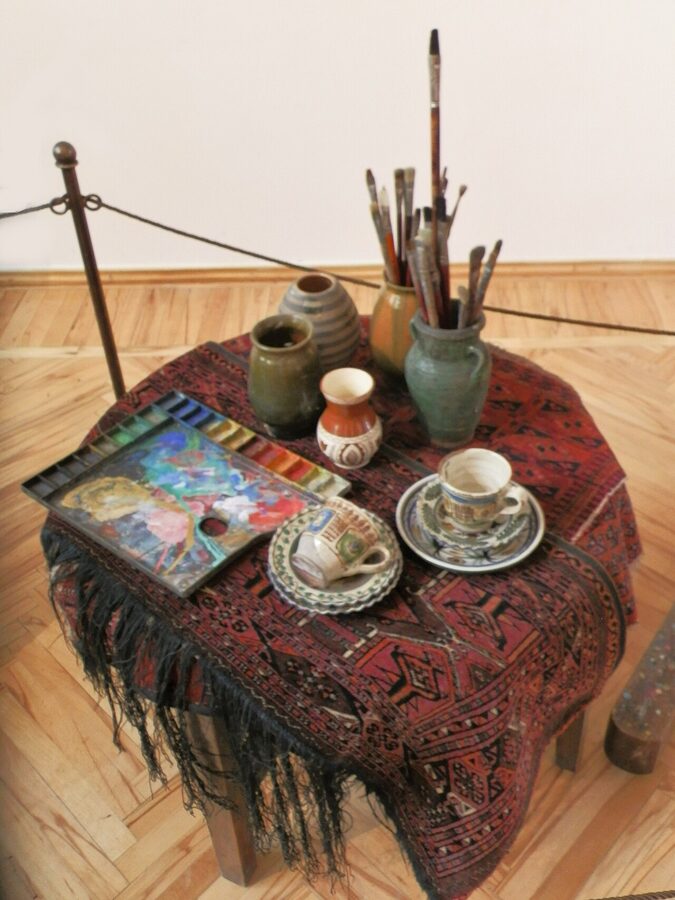
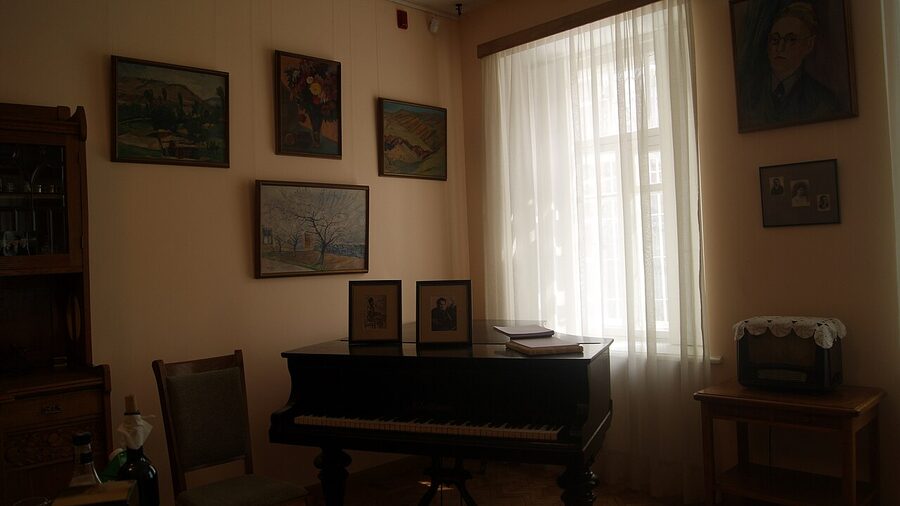
The studio is the room everyone remembers. It’s preserved exactly as Saryan left it: easel, brushes, paint tubes, books in Russian and Armenian, family photographs, a few pipe stands, and the chair he worked from. There are sketches stacked against walls and unfinished canvases turned to face away from the window light. If you’ve ever seen a working artist’s space, you’ll recognise the look. It’s a room that gets used; it just hasn’t been used since 1972.
This is also where most of the personal memorabilia lives: his Order of Lenin, the silver-plated drawing instruments his daughter gave him in 1965, letters from Avetik Isahakyan and from Yeghishe Charents, a photograph of him with Aram Khachaturian from 1944, his pince-nez. None of it is roped off behind glass in the cinematic way; it’s there at the same heights it always was, like he might walk back in.
If you like art-history houses for what they tell you about a person rather than for the canvases themselves, this is the bit to slow down for. Stand in the doorway and look back at the easel. That’s the view he had every morning for forty years.
Take a guided tour or wander on your own?
Take the guide, especially if it’s your first time. The wall labels are in Armenian and Russian, with patchy English in places, and a museum like this rewards context. The English-language tour is 4,000 AMD on top of the 1,000 AMD ticket, which is around $13 all in. Tripadvisor reviews mention a guide named Arthur a lot; he’s been there for years and knows the family material well, and a couple of reviewers say he’s good with kids if you’re bringing one.
The Armenian-language tour is 2,000 AMD if you’ve got an Armenian-speaking friend or guide with you. Russian and French are priced the same as English. Tours are roughly 60 to 75 minutes; you can stay on as long as you like after.
If you’d rather wander, give yourself 90 minutes minimum. The museum runs free entry on the Yerevan Card, which is worth getting if you’re planning to hit more than three or four city museums in a few days; the card covers Cafesjian Center for the Arts, the Modern Art Museum of Yerevan, the Sergei Parajanov Museum, and around 30 others.
The painted staircase you might walk past
One small detail people miss: there’s a staircase near the museum that’s been painted with one of Saryan’s compositions across the risers. It’s a public artwork, not an official part of the museum, and you can see it from outside. A regular reviewer on Tripadvisor flagged it as the thing nobody told them about. Walk a few metres in either direction along Saryan Street after you come out and look down side passages, and you’ll spot it. Bring a real camera if you want a clean shot; phone cameras tend to flatten the painted risers into mush.
Saryan Street and the neighbourhood
The street the museum is on used to be quiet. It isn’t anymore. Saryan Street is now one of the busiest restaurant strips in Yerevan, lined with wine bars and cafes from Mashtots Avenue down to Sayat-Nova. In Vino, Tapastan, Yasaman, and a couple of dozen other places sit within a hundred metres of the museum entrance. Lunch or dinner in the area is easy if you want to anchor your day around the visit.
For something more grounded in Armenian cooking, the area around the museum is a good base for finding khorovats, dolma, and lahmajun within a short walk. The wider Yerevan food scene has its own logic, which we cover in our traditional Armenian food guide: what to order, what to avoid, and where the local crowd actually eats.
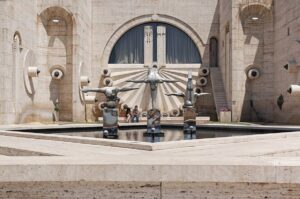
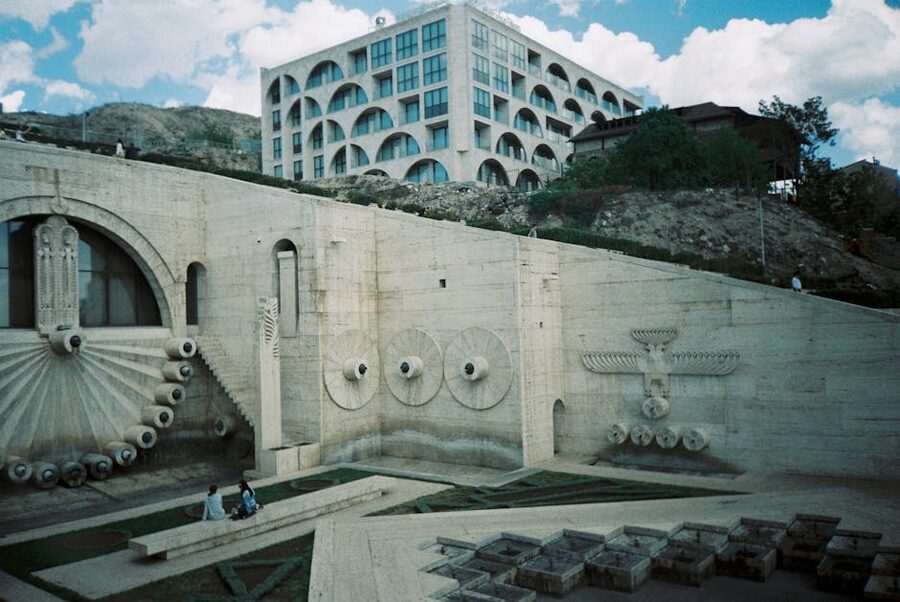
Five minutes’ walk to the east, you reach the foot of the Cascade Complex. The big monumental stone steps run up the hill toward the Mother Armenia statue, and the Cafesjian Center for the Arts sits inside the structure at the bottom. Local artists have painted on the Cascade for decades. It’s free to climb at any hour and the view from the top across to Mount Ararat is the cliched Yerevan postcard for a reason.
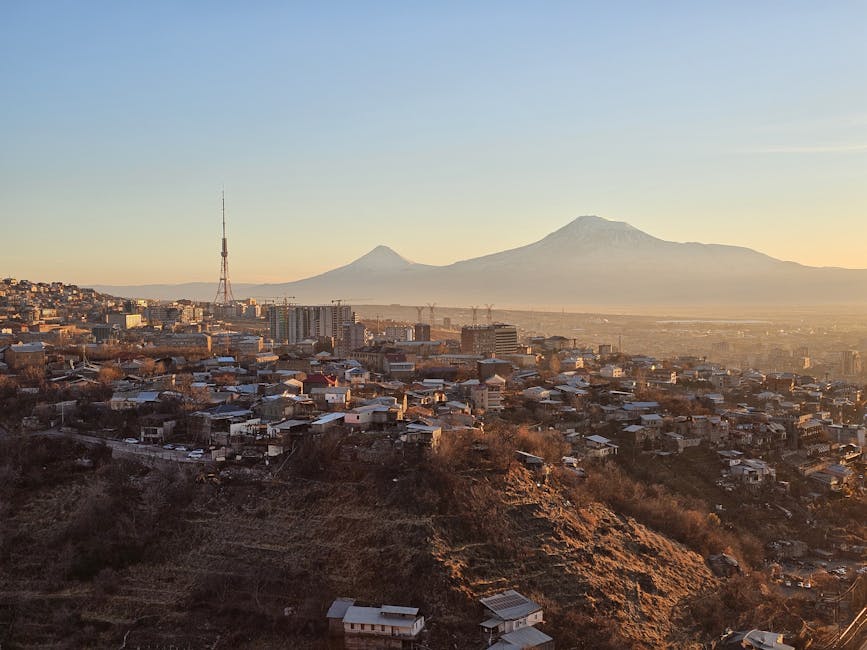
The Saryan monument, with its bronze figure of the painter looking towards the Opera, sits in the small park between the Opera House and the Cascade. On weekends the surrounding park fills with the open-air painting bazaar: local artists selling their own work in a loose arrangement of fold-out stalls. If you want a Saryan-influenced canvas to take home (and there are many around, of varying quality), this is the place. The connection to the museum isn’t accidental. A lot of the artists working that bazaar trained at academies that were built around Saryan’s example, and many learned by copying the works you’ve just seen on the gallery walls.
Getting there and getting in
The museum sits on Saryan Street between Mashtots Avenue and Tumanyan Street. From Republic Square it’s a fifteen-minute flat walk north up Mashtots, then one block east. From the Cascade it’s five minutes downhill on Moskovyan Street, then two blocks south. The closest metro station is Yeritasardakan (Youth) on Line 1, about a twelve-minute walk. A taxi from anywhere central is around 600 to 1,000 AMD with Yandex Go or GG, both of which work fine in Yerevan and let you pay in dram cash to the driver.
The entrance is the door on the gallery wing, not the door of the original house. There’s no long queue at any time of day in my experience, but Yerevan Card holders sometimes wait while the desk takes a phone call or scans the card; it can add a couple of minutes. Cash and card both work. Tickets are issued on a paper roll; keep yours in case you want to wander back into a room you saw earlier.
Toilets are on the ground floor next to the cloakroom. Bags above day-pack size go in the cloakroom; they don’t make a fuss about small handbags. There’s a coat check but no lockers.
Combining the museum with other Yerevan visits
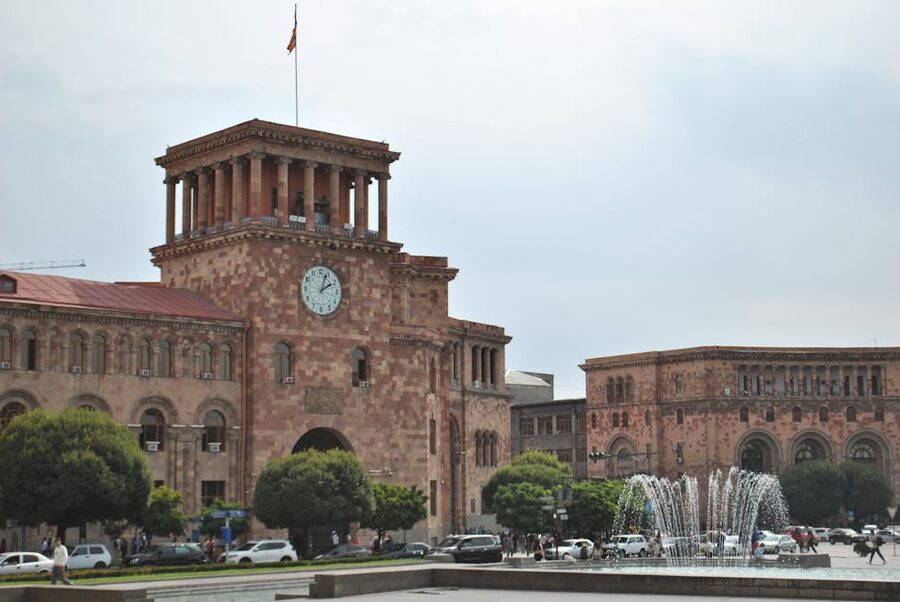
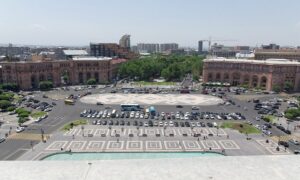
If you’ve got a half-day, here’s a sequence that flows naturally and doesn’t double back. Start at the Saryan museum at 11:00 when it opens; the rooms are quietest then. Walk five minutes east to the Cascade and take the moving walkways or the steps up. Spend an hour at the Cafesjian Center for the Arts inside the Cascade. Drop down to Saryan Street for lunch. Walk south through the Opera park (look at the Saryan monument) and then on to Republic Square for the rest of the afternoon.
For a full day with cultural depth, slot in the Matenadaran (Armenia’s manuscript museum, ten minutes’ walk north up Mashtots Avenue) before lunch, and finish the day with a play or concert at the Sundukyan or the Opera. The capital’s stage scene is healthier than most travellers expect; we walk through what’s worth booking and how the ticketing works in our Yerevan theatre guide.
If you’re already planning day trips out of the city (Garni, Geghard, the route up to Tatev), the Saryan museum fits well as a slow morning between bigger excursions. It’s the kind of place that’s better when you’re not rushing.
What I’d skip and what I wouldn’t
Skip: the museum gift shop. The reproductions are workmanlike and the postcards are a bit washed out. If you want a Saryan reproduction, the National Gallery of Armenia on Republic Square has a better catalogue and the Vernissage market on weekends has a better range of original local work.
Don’t skip: the studio. If you only have time for one floor, the studio is the floor. Whatever else is on at the time, that room is the part that doesn’t exist anywhere else.
Also don’t skip: the guide if you can stretch the 4,000 AMD. The labels alone won’t tell you which canvas was painted on which trip, who’s in the family photographs, or which letters you’re reading. A good guide pulls forty years of family detail into the visit and it’s worth the difference.
Practical bits people ask about
Is it accessible?
Partial. The ground floor is at street level. The upper floors are reached by stairs; the 2016 reconstruction did not add a passenger lift. If stairs are an issue, call ahead on +374 10 58 05 68 to confirm what’s possible on the day.
Photography?
Photography without flash is generally fine in the permanent rooms; ask before you shoot in the studio or in any temporary exhibition. Tripod and selfie-stick policies vary; flag them at the desk.
How does it compare to the National Gallery?
The National Gallery of Armenia on Republic Square has a much wider Saryan collection (around 50 works), set among Russian and European old masters. The house museum has fewer works but more context: the studio, the family material, the building itself. If you only do one and you want the masterpieces in pure exhibition form, the National Gallery wins. If you want to understand Saryan, do the house.
Is there a cafe inside?
No. There’s a small reception area and bathrooms. The street outside is full of cafes; you don’t need to bring lunch.
Best time of day to visit?
Weekday mornings, especially Friday or Monday, just after the 11:00 opening. Weekend afternoons get coach-tour groups. Saturday around 16:00 is the worst window I’ve seen.
How does it sit inside a wider Armenia trip?
The museum is a Yerevan-only visit; you won’t divert anywhere else for it. If you’re planning a longer trip out into the regions, our roundup of the historic bridges of Armenia covers the kind of detail-rich half-day stops that pair well with a couple of city days in Yerevan.
Final read
The Saryan House Museum is one of the small, calm pleasures of Yerevan. It doesn’t try to be a complete twentieth-century-art museum and it isn’t pretending to compete with the National Gallery. What it does is hold a single artist’s life and work in the same rooms where he lived it, in a city that loves him, in a building designed by the architect who shaped the city’s centre. Two hours is enough. Take the guide if the budget stretches. Walk out into Saryan Street afterwards, find a wine bar, and you’ve had a good Yerevan afternoon.