
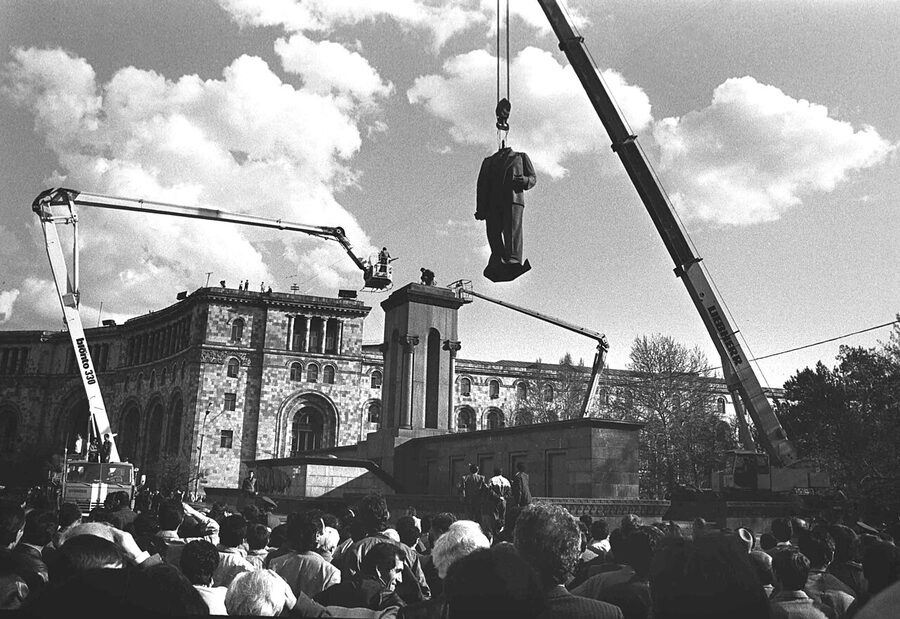
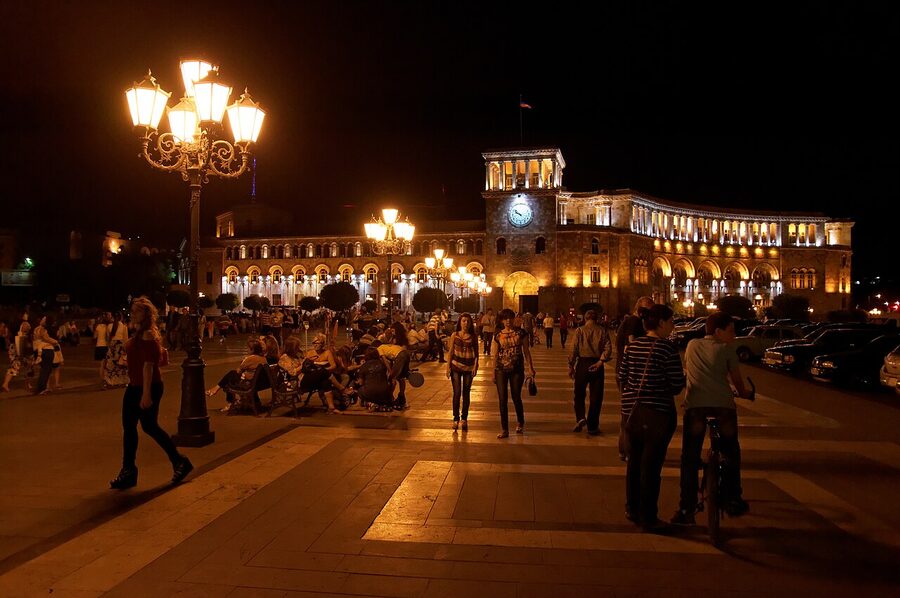
On the afternoon of 13 April 1991, a 7-metre copper statue of Lenin was lifted off its pedestal in the centre of Yerevan, placed on a flatbed truck, and driven slowly around the square while people threw coins and pebbles at it. The pedestal stayed up for another five years and caused a fight nearly as bitter as the one over the statue itself. What you walk into today, when you come up the metro escalators or down Nalbandyan Street into the trapezoid that locals just call Hraparak, is the empty centre of that argument: pink and yellow tuff buildings on every side, a roundabout where the Soviet podium used to be, and a fountain pool where the Aquatique Show jets fire on summer nights. Republic Square is the most photographed place in Armenia. It also takes about ten minutes to walk across, which is the first thing nobody tells you.
In This Article
- Reading the square
- Five buildings, one design problem
- Government House (1926-41)
- The History Museum and the National Gallery (1950s-77)
- The Marriott (formerly Hotel Armenia, 1958)
- The empty Foreign Affairs building (1955)
- The former Trade Unions and Communications building (1933-56)
- The carpet underfoot
- Where Lenin used to stand
- The fountains, properly
- When they actually run
- Where to stand
- The Yotnaghbyur drinking fountain
- The fountain pool in winter
- Hraparak as a protest stage
- The History Museum and the National Gallery, briefly
- History Museum of Armenia
- National Gallery of Armenia
- Eating and drinking on the square
- Getting there
- When to come
- What to walk to next
Reading the square
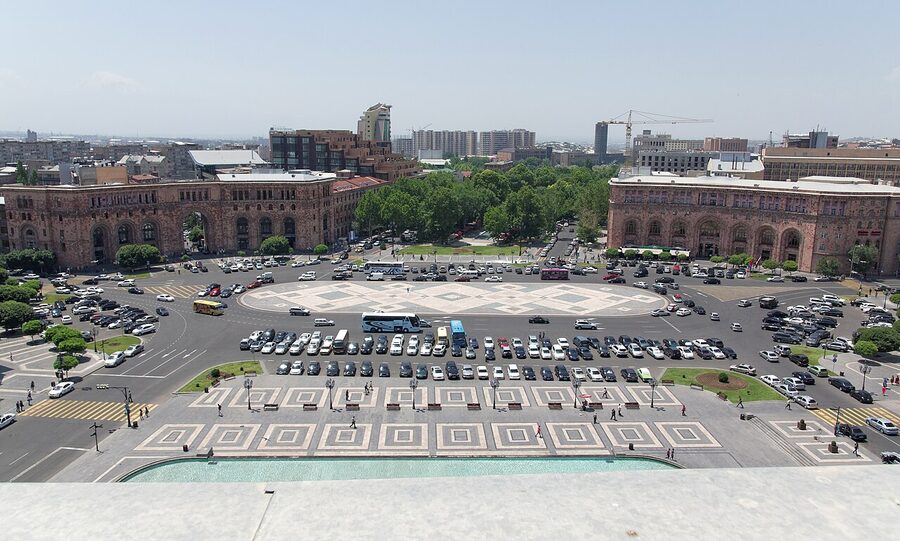
The shape is two halves stuck together. An oval roundabout to the south-west, where five streets meet and traffic loops around a stone pattern set into the pavement. A flat trapezoid to the north-east, with the fountain pool and the museums building closing it off. The whole thing covers about three hectares, small for a capital’s central square, large for the size of the city around it. Yerevan has a population of just over a million, and Hraparak is roughly the size of three football pitches sitting in the middle of it.
You’ll hear the square called Republic Square in English, Hanrapetut’yan hraparak in Armenian (Հանրապետության հրապարակ), and just Hraparak in conversation. The full name is what’s on the signs and the metro station; the short form is what people actually use. If you’re trying to give a taxi driver a destination and your Russian is better than your Armenian, “ploshchad’ Respubliki” works too, most drivers above a certain age learned the city when it was still Lenin Square.
For where the square fits into a wider plan of the city, the easiest read is to start here on day one and let the rest of the centre unfold from it. That’s how the architect designed it, and it still works that way for visitors. The shape of the trip and how to thread the square together with everything within walking distance is the subject of our 48-hour Yerevan guide; this article is about the square itself, building by building.
Five buildings, one design problem
Alexander Tamanyan drew up the master plan for Yerevan in 1924. He’d come back to Armenia in 1923 from Iran, where he’d lived for two years in Tabriz after the Bolsheviks took over, and what he found in Yerevan in 1923 was a town of about 30,000 people on dusty streets, very few of which would still be there once he’d finished. The square was the centre of his plan, and the proportions of the first Government Building set the rules for everything else. Five buildings rose around the oval and trapezoid over the next half-century. The last of them, the museums building, wasn’t finished until 1977, the same year Tamanyan’s grandson was supervising the final stones. That’s a fifty-year construction project, which is the second thing nobody tells you.
What gives the square its visual coherence is the stone. Everything is faced in pink and yellow tuff, volcanic rock from quarries north of Yerevan, soft enough to carve but durable enough that the friezes still look sharp seventy years on. The base layers are basalt. The decorative work is borrowed wholesale from medieval Armenian architecture: arches lifted from the cathedral ruins at Zvartnots, cornices from the dukedom at Dvin, capitals from Tekor. Tamanyan studied those sites with the historian Toros Toromanyan and didn’t copy anything; he reinterpreted it. The result is a square that feels Armenian without ever being literal about it.
Government House (1926-41)
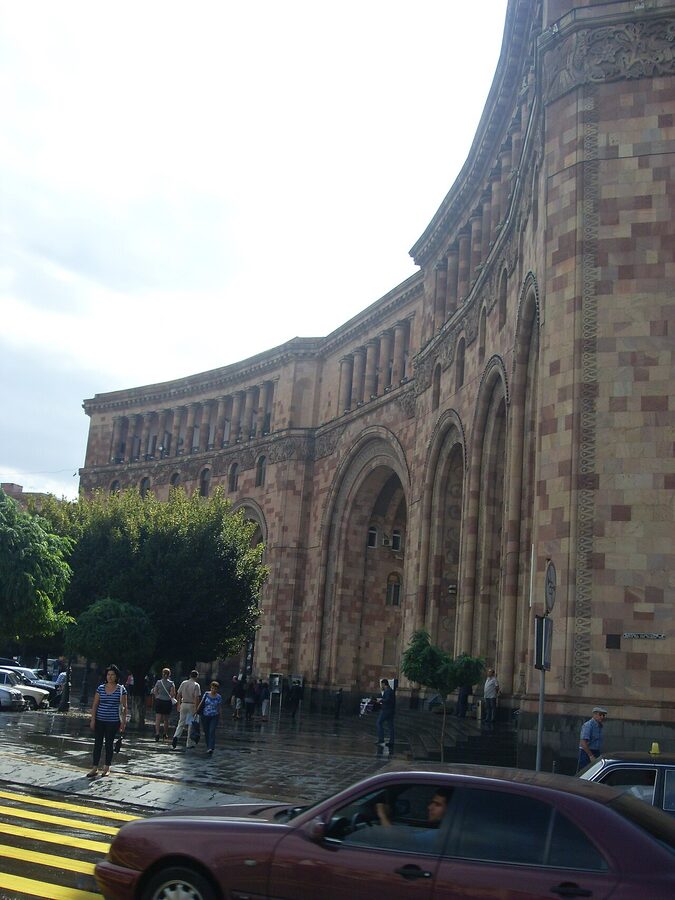
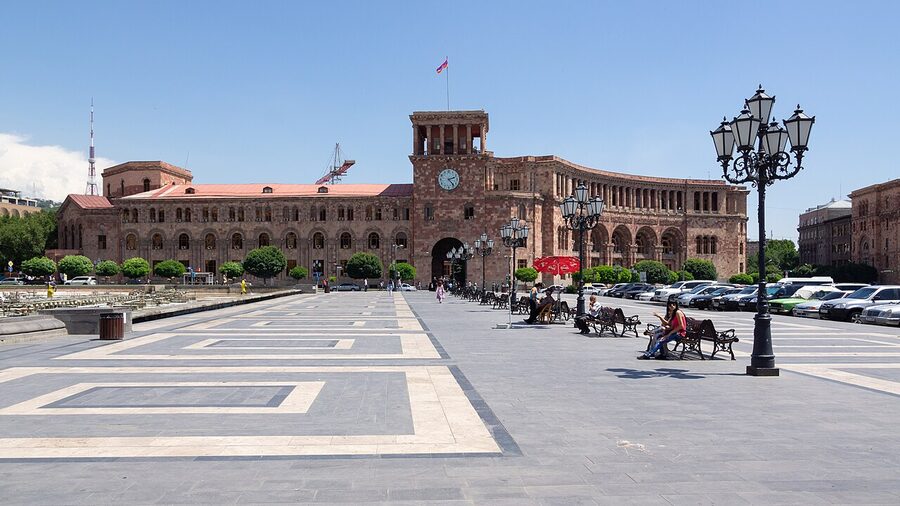
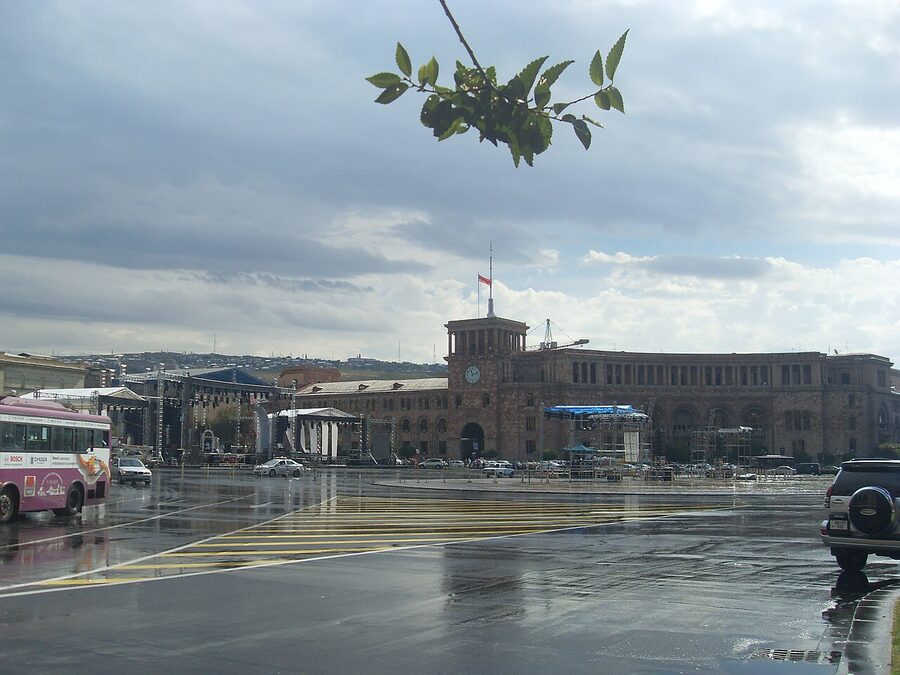
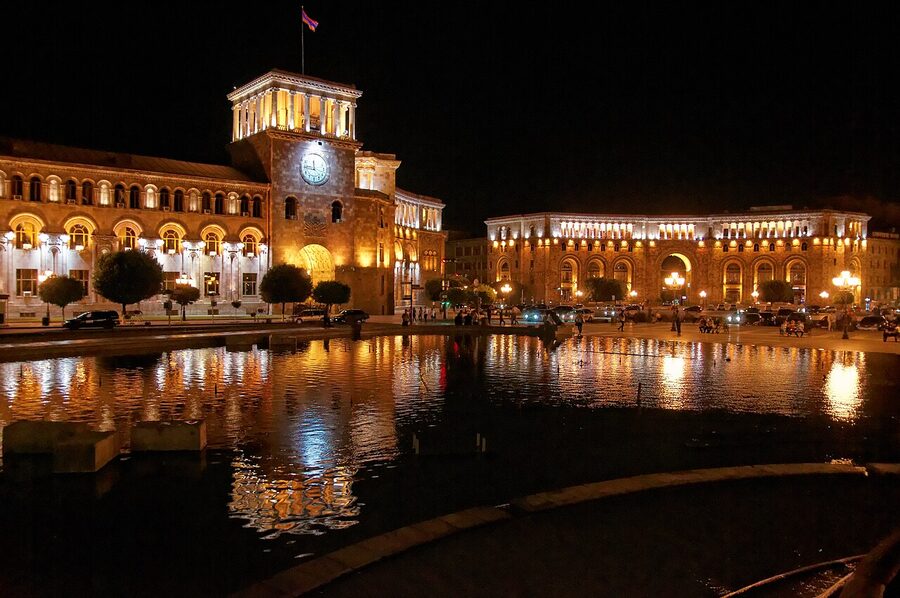
The Government Building anchors the south-west corner of the square, the side with the clock tower. Tamanyan designed the north-western portion himself between 1926 and 1929; his son Gevorg took over in 1938 after Alexander died and finished the rest in 1941. It’s still the seat of the Government of Armenia, which means there are guards out front and you can’t go in. The clock at the top of the tower is the country’s official clock; on New Year’s Eve, the chimes you hear on the live broadcast come from this tower.
If you stand in the centre of the oval and look at it square on, the proportions feel right but you can’t quite say why. Tamanyan’s trick was to take the height of the columns on the ground floor and use them as the unit for everything else, door heights, frieze depths, the spacing of the windows on the upper floor. Once you notice it, the whole square reads as a series of variations on a single ratio.
The History Museum and the National Gallery (1950s-77)
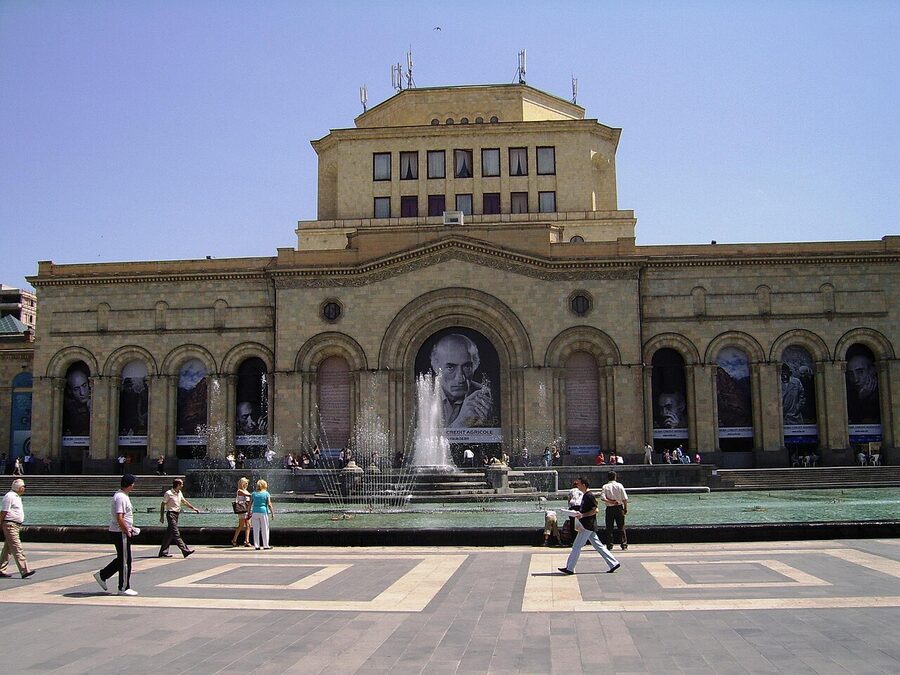
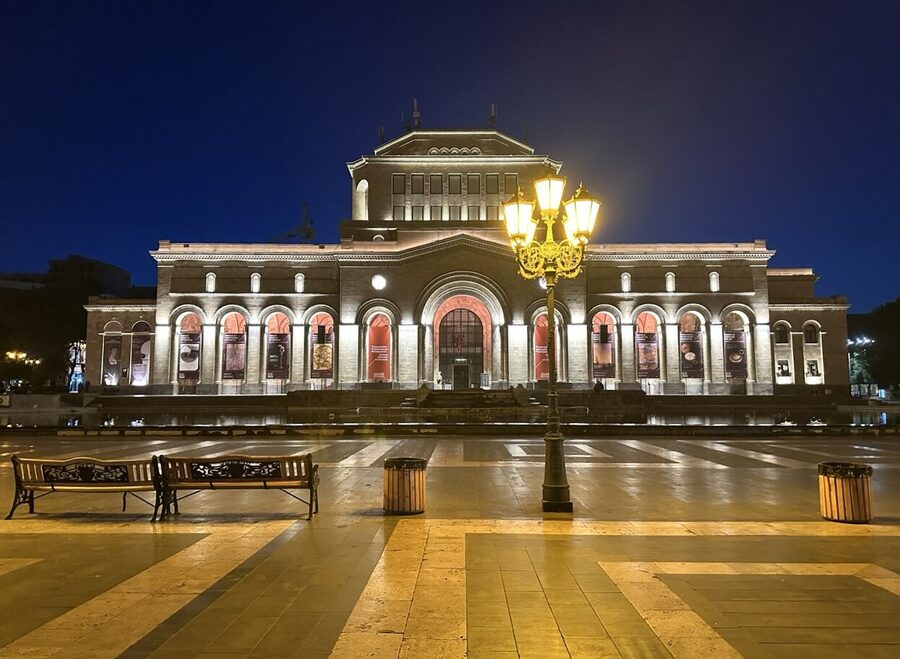
This is the trapezoid’s anchor, the long building closing off the top of the square, with the fountain pool laid out in front of it. Mark Grigorian and Eduard Sarapian designed it, construction started in the 1950s, and the National Gallery half wasn’t finished until 1977. It’s a single building containing two institutions: the History Museum of Armenia on the lower floors, the National Gallery of Armenia on top. One ticket gets you into one or the other; you’ll need two if you want to see both, which most people do, and which is why an unhurried visit easily fills four hours.
A small section of the same complex, tucked behind the museums, is the Arno Babajanyan Concert Hall, dating to 1916 and the only piece of the ensemble that predates the Soviet construction. It’s an active concert venue. If you’re around in winter when the Armenian Philharmonic plays here, the Yerevan ticket prices are gentle; the same orchestra in Vienna would be triple the cost. We’ve covered the broader theatre and concert scene in our guide to going to the theatre in Yerevan.
The Marriott (formerly Hotel Armenia, 1958)
On the south-east side of the trapezoid, opposite the museums, is the building that started life in 1958 as Hotel Armenia, was renamed in 2003 after a Marriott takeover, and is officially called the Armenia Marriott Hotel Yerevan. The same architects designed it, Mark Grigorian and Eduard Sarapian, working in the same pink tuff. From the outside, it reads as part of the ensemble; from the inside, it’s a comfortable four-star with 380 rooms. The lobby has been renovated more times than is good for it. The location, though, is the actual selling point: you walk out the front door and you’re on the square. If you like staying somewhere that’s worth the trip on its own and don’t mind paying more for it, this is the one.
Armenia Marriott Hotel Yerevan (Booking.com | Official site), directly on the square; rooms with a view of the fountain are worth asking for at booking time.
The empty Foreign Affairs building (1955)
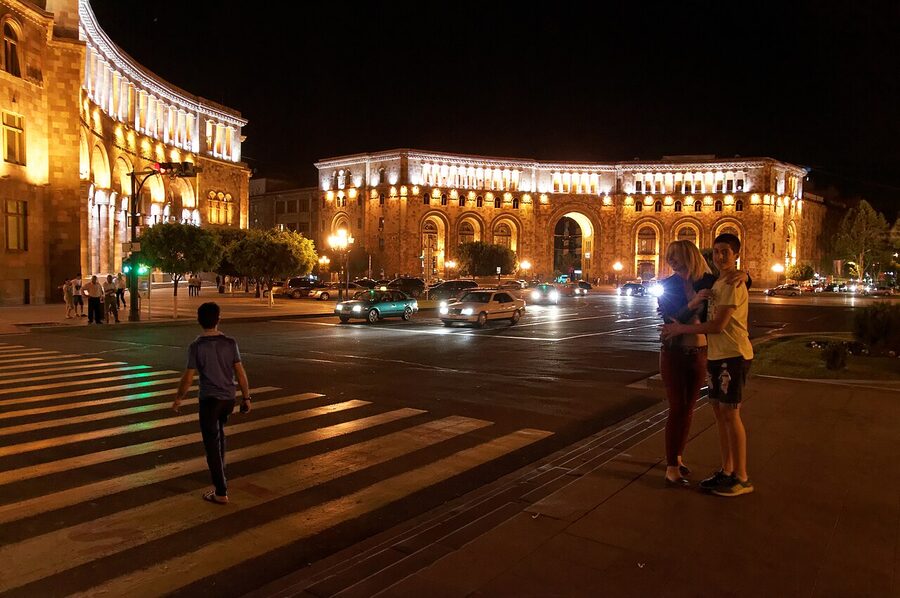
On the north side of the square, opposite the Marriott, is a building most people walk past without realising what it is. Samvel Safaryan, Rafayel Israyelian, and Varazdat Arevshatyan designed it, and it was finished in 1955. From 1996 to 2016 it housed the Ministry of Foreign Affairs. Then in 2013 the Armenian government sold it for over $51 million to a company owned by the Argentine-Armenian businessman Eduardo Eurnekian. It’s been effectively abandoned since the mid-2010s, the friezes above the first-floor windows are visibly incomplete (the carving was stopped during construction and never finished). If you look up at the right spot, you can see where the masons stopped: the panels are just blanks. It’s the only flaw on the square, and it’s been sitting there for nearly seventy years.
The former Trade Unions and Communications building (1933-56)
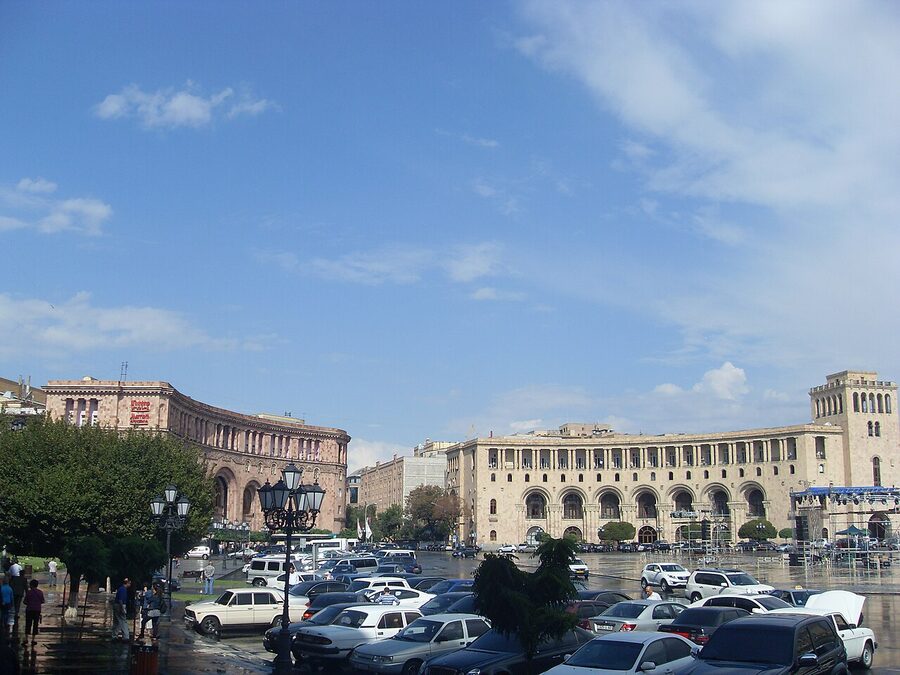
On the south-east, between the Marriott and Government House, is the long building that housed the Ministry of Transport and Communications until 2016. Mark Grigorian and Eduard Sarapian designed this one too, working over a long stretch from 1933 into the 1950s. The Armenian government announced its intention to privatise it in 2016 and then didn’t, so it sits half-used. The Central Post Office of Armenia takes up part of the ground floor, if you need to send a postcard or buy stamps, this is where you do it. The interior still has the original 1950s detailing.
The carpet underfoot
If you stand in the middle of the oval roundabout, which you can do safely, the central island is paved and pedestrian, look down. The pavement is a pattern of dark and light stones laid out to look like an Armenian rug seen from above. The pattern was added during a controversial 2003 renovation; before that, the centre of the oval was just the empty pedestal where Lenin used to stand and various unsuccessful attempts to fill the gap. The rug pattern is now itself controversial, some Yerevantsi like it, some find it a bit literal, but it’s at least a solution to the problem of what to do with the empty centre. From street level it just reads as a complicated pattern of tiles. From the top of the Marriott or from drone shots, the rug is unmistakable.
The renovation also turned up something more interesting underneath. Excavations during 2003 reached an archaeological layer from the 18th and 19th centuries, cellars and basements of pre-Soviet Yerevan, when the area was still partly inhabited and built up. They also found tuff water pipes dated to the 9th-11th centuries, which means there was a settlement on this exact site a thousand years ago. In January 2020 the Armenian government announced it was considering uncovering the older layers and turning the space into a museum accessible to the public. As of writing, that project is still on paper.
Where Lenin used to stand
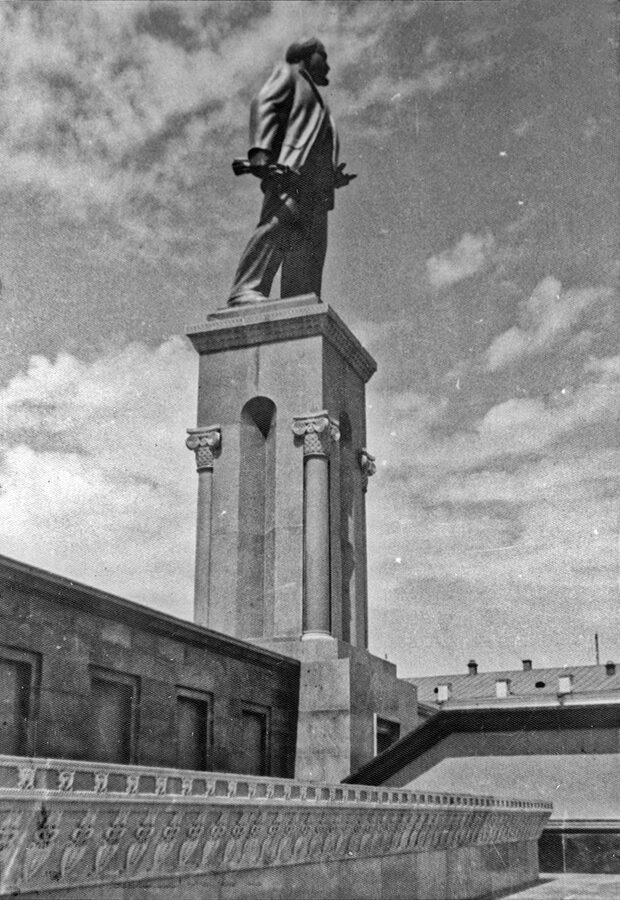
The 7-metre copper statue of Vladimir Lenin, sculpted by Sergey Merkurov, was inaugurated on 24 November 1940. It stood on a 12-metre granite pedestal in the centre of the oval, facing the site of the future National Gallery, which wouldn’t be finished for another 37 years. The pedestal was designed by Natalia Paremuzova and Levon Vartanov, and it was, depending on whom you asked, either a fine piece of Soviet monumental art or a colossal piece of Soviet vandalism on Tamanyan’s plan. Tamanyan himself had pencilled in a Lenin monument as part of the original design, although he died in 1936, four years before the statue went up.
On 28 March 1991, the Yerevan City Council voted to remove the statue. The mayor, Hambardzum Galstyan, abstained, he’d argued for a more nuanced approach, saying the statue had become part of the city’s history and didn’t need to be removed to be repudiated. Two weeks later, on 13 April, the statue came down. It was placed on a flatbed truck and driven slowly around the square while the crowd cheered. People threw small stones and coins at it as it passed. Photographs from that day show the statue tipped forward at an awkward angle on the truck bed, looking, as the historian Levon Abrahamian later wrote, “like the body of a deceased person, driven round and round the central square as if in an open coffin.”
The statue was eventually placed in the backyard of the museums building, where it still is. You can’t easily see it, the museums staff aren’t going to walk you out there, but if you ask politely, sometimes they will. The American singer Cher was photographed sitting on top of the headless statue when she visited Armenia in April 1993; the photo did the rounds in the diaspora press. The pedestal stayed up. President Levon Ter-Petrosyan ordered its dismantling in 1996, which set off a wave of public protests that were, oddly, more bitter than the protests over the statue itself. The poet Silva Kaputikyan called the dismantling “an act of vandalism.” Fifty members of the Armenian Communist Party broke through the construction barrier in July 1996 to try and stop it. The pedestal came down anyway.
What replaced it has been a series of failures. A 24-metre cross with 1,700 light bulbs went up on 31 December 2000 to mark Armenia’s 1,700 years as a Christian nation; it was taken down quietly at the end of 2001. A billboard-sized television screen showing advertisements appeared in 2004 and stayed for two years. In 2019 the municipality put up several karases, large clay wine amphorae, in the lawn that had been planted in the empty space. Several competitions over the past three decades have proposed permanent monuments: David of Sasun, Aram Manukian, King Argishti I, the apostles. None of them have been built. The space is still, in effect, empty. You can walk to where Lenin used to stand and stand on the same ground; there’s a small flat lawn there now and not much else.
The fountains, properly
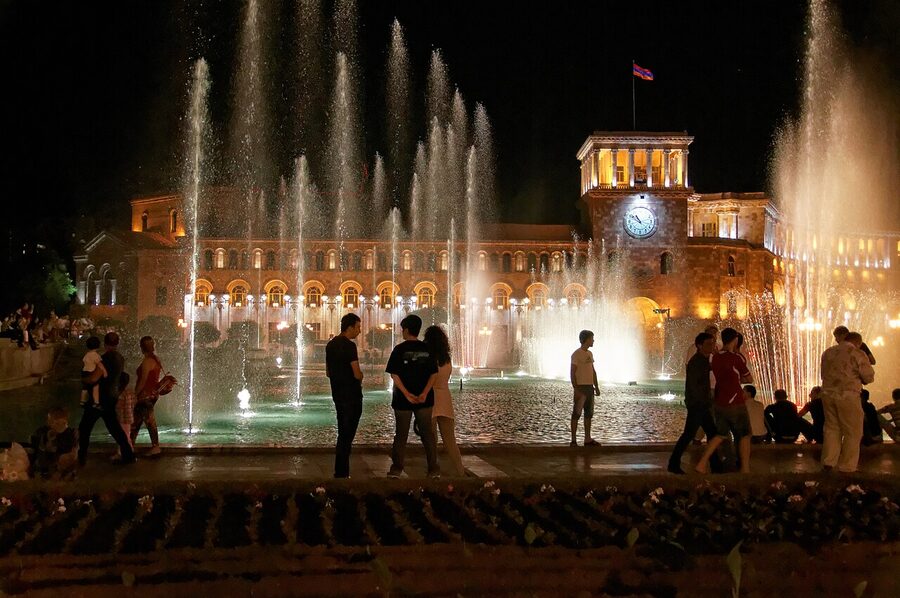
The musical fountains in the trapezoid pool are the reason people come to the square in the evening. They’ve been there in some form since the late 1960s, Yerevan was the first city in the Soviet Union to install dancing-water-and-music fountains, designed by the engineer Abram Abrahamyan. They fell silent during the late Soviet collapse and the war years of the early 1990s, then sat dry for nearly a decade. The current setup is a French rebuild: the fountains were renovated by Aquatique Show International for around €1.4 million and reopened on 21 September 2007, the 16th anniversary of independence.
When they actually run
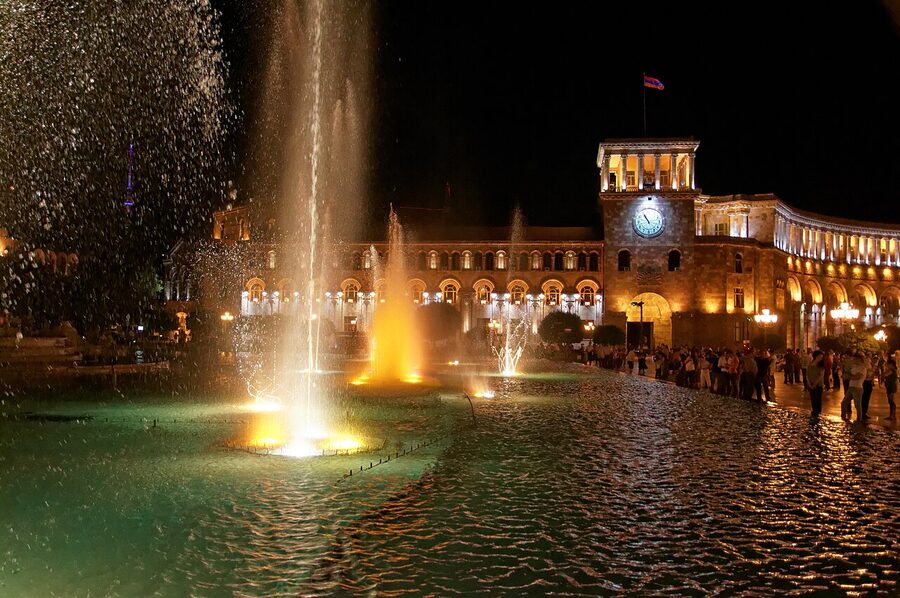
The published schedule is roughly: late May to late September or early October, every evening except Mondays, from about 21:00 to 23:00. In practice the start time shifts with the sunset, they don’t fire up until it’s properly dark, which in mid-summer means closer to 21:30 than 21:00, and in late September means closer to 20:30. They run on a programme of music: classical pieces, Soviet-era hits, Armenian folk, jazz, and modern pop. The programme always ends with Charles Aznavour’s “Une vie d’amour” (“Eternal Love”), which is treated locally as the official sign-off of the show. If you hear it start, you have about three minutes before the lights come up and the crowd begins to drift away.
If it’s been raining the show may be cancelled without warning. If the city’s celebrating something, a state visit, a national holiday, the day after a long-awaited football result, the fountains may run for longer or restart. The schedule is not on a single official page anywhere. Ask at your hotel or guesthouse the day of, or simply walk past the pool around 20:30 in summer and check whether the lights are coming on.
Where to stand
The natural crowd gathers along the southern edge of the pool, between the fountain and the museums building, looking back towards the Government House clock tower. That’s the postcard view. It’s also the densest crowd. Two better places: the steps along the eastern edge of the pool, where the crowd thins out and you get a side-on view of the jets against the museums building lit up behind them; and the far side of the oval roundabout, in front of the Marriott, where you’re far enough away that the music is muffled but the whole light show reads as one piece. The very best vantage is one of the upper-floor windows of the Marriott, if you happen to be staying there. The square is not that large; from anywhere within fifty metres you can see the whole show.
The Yotnaghbyur drinking fountain
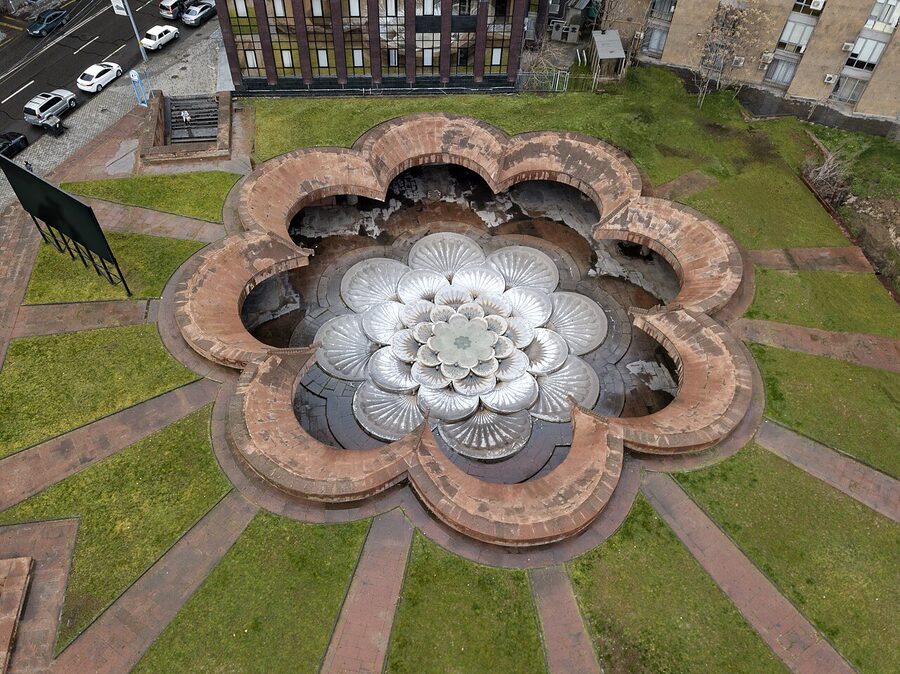
If you walk to the side of the museums building you’ll find a small, easily-missed drinking fountain called Yotnaghbyur, “seven springs.” Spartak Kntekhcyan designed it in 1965; the sculptor Nur renovated it in 2010. It has seven separate spouts arranged around a central compass marking the four cardinal directions, which doubles as a sundial. The water is from the city supply, which is potable in Yerevan; you can drink from it. Walk past it without noticing and you’ll miss something quietly clever. It’s worth a minute.
The fountain pool in winter
In winter, roughly October to May, the trapezoid pool is drained and there’s no show. The square in late December is taken up by the city’s Christmas tree, which has been installed in roughly the same spot every year since 1950. The exception was December 2020, a month after the Second Nagorno-Karabakh War ended; the city hall announced no tree and no decorations that year, in honour of the dead. The tree returned in 2021. If you’re visiting between November and April, the square is still worth seeing, but the experience is daytime architecture and an empty pool, not the night-time light show.
Hraparak as a protest stage
The square has been Armenia’s main political stage since before independence. During the Soviet years, military and non-military parades happened here twice a year, May Day, October Revolution Day, and (until 1969) Victory Day. The leadership stood on a podium below the Lenin statue. The Jubilee parades for Soviet Armenia’s anniversaries in 1961, 1970, and 1980 added a wooden extension to the podium so the entire national government could fit. The last of those Soviet parades was in 1988, the year of the Spitak earthquake. After that, the parade tradition shifted: military parades for Armenian independence have been held on 21 September of 1996, 1999, 2006, 2011, and 2016. The 30th-anniversary parade in 2021 was cancelled in the aftermath of the war.
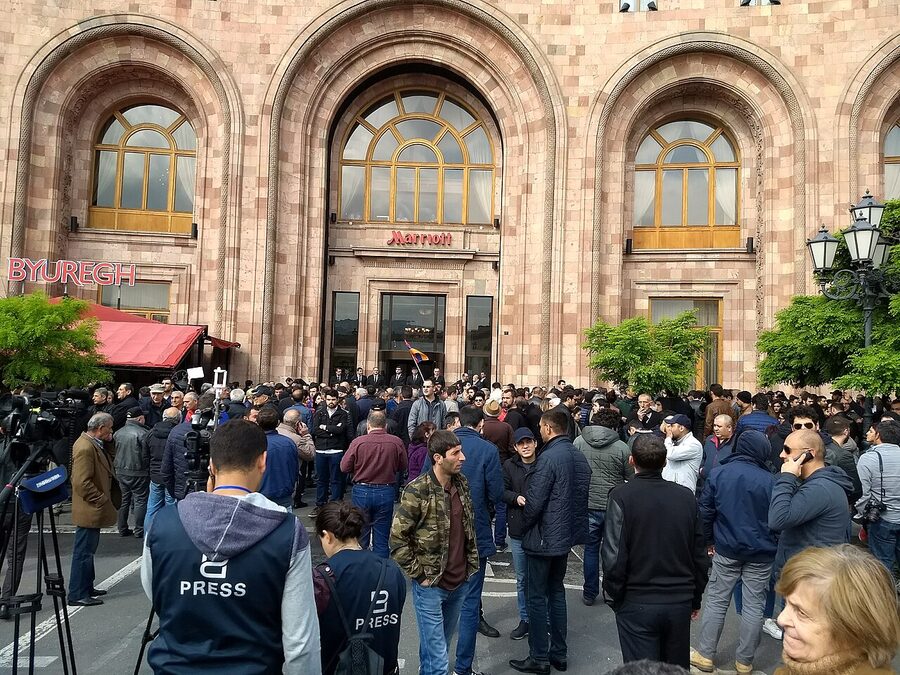
The square’s defining political moment in recent memory is the 2018 Velvet Revolution. From 17 to 23 April 2018 the demonstrations led by Nikol Pashinyan against the rule of Serzh Sargsyan filled Hraparak night after night. On 22 April, when Pashinyan was briefly arrested, police were deployed in the square and dozens of protesters were detained. By evening, around 115,000 people had filled the square and the surrounding streets. The next day, after Sargsyan resigned, the square became the centre of mass celebrations. On 24 April, Armenian Genocide Remembrance Day, protesters spent the morning cleaning the square and the streets around it before the official commemoration walk to Tsitsernakaberd. Pashinyan was elected prime minister on 8 May; his speech that evening was given from the same square. His 100-day rally on 17 August 2018 drew up to 150,000 people.
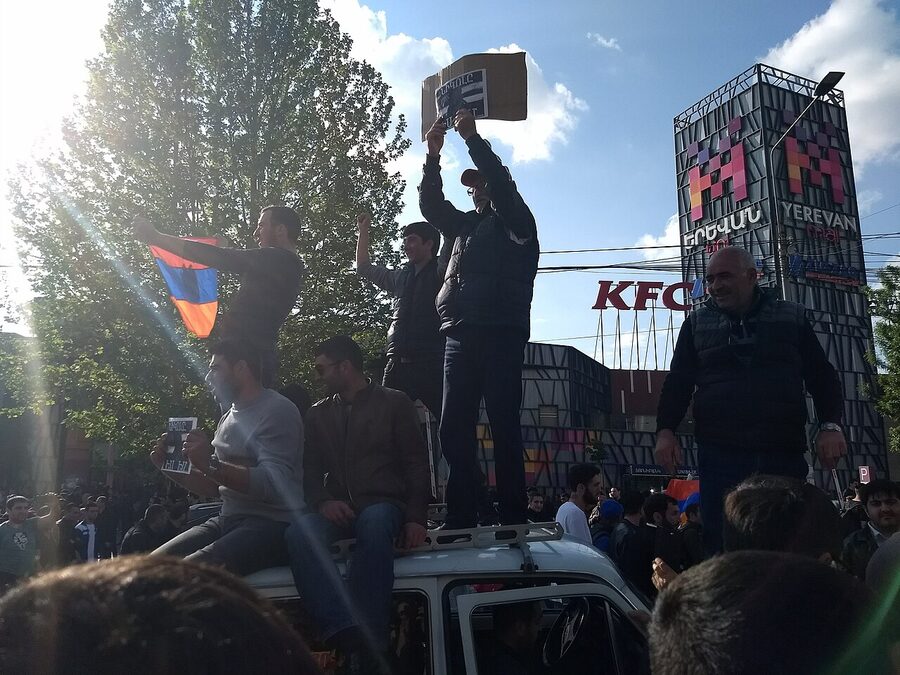
Less than three years later the square was hosting the opposition again, opposition to Pashinyan, this time, in the months after the Second Nagorno-Karabakh War. December 2020 and March 2021 both saw rallies of 20,000 and more calling for his resignation. The pattern is consistent: when something matters, Armenians end up at Hraparak. Knowing this is part of reading the square. It’s not just an architectural set piece. It’s the place where decisions get made, or unmade.
The History Museum and the National Gallery, briefly
The two institutions in the museums building are worth half a day if you have it. They’re not the kind of museum that demands a full day, and the labels are bilingual (Armenian and English) but skew toward the academic. Buy a single combined ticket only if it’s offered; otherwise, do them separately and pick which one you actually care about.
History Museum of Armenia
Lower floors of the building. The collection runs from prehistoric Urartu through medieval Armenia to the 20th century. The standout pieces are the Bronze-Age finds from the Ararat plain, chariots, bronze daggers, a particularly fine carved-wood wagon from around 2000 BC, and the section on Urartu, the kingdom that occupied the Lake Van basin in the 9th-6th centuries BC. The medieval rooms are dense; if you’re short on time, skip the 19th-century displays and spend the saved hour in the gallery upstairs.
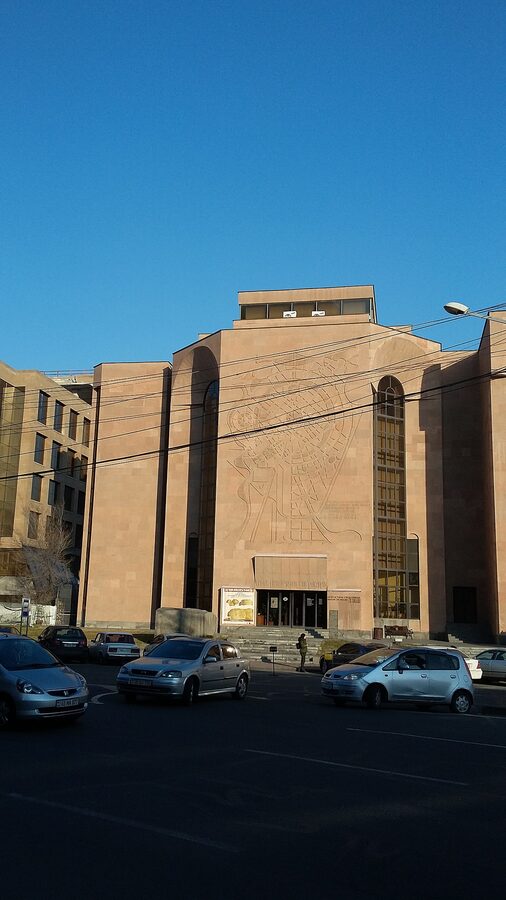
National Gallery of Armenia
Upper floors. This is the bigger collection and the more rewarding visit. The strength is the 19th-20th-century Armenian painting on the upper floors, Aivazovsky’s seascapes, Vrubel’s symbolist canvases, the painters of the Tbilisi school. The Saryan rooms here overlap somewhat with what you’ll see at the Saryan House Museum a few streets away, but the gallery has the bigger, more public-facing canvases, while the house museum has the studio work and the personal pieces. Do both if you can; if you have to pick, the gallery is the one for the public face of his work.
European wing on a lower upper floor: small but interesting holdings of Italian, French, and Dutch painting. Nothing that would make a top-50 list at the Louvre, but a couple of pieces that would surprise you in this context, a pair of Tintorettos, a Rubens-school canvas, some Northern Renaissance panels.
Eating and drinking on the square
The square itself has very few cafes, most of the buildings around it are government, museum, or hotel. The ones that do face the square cluster on the south-east edge, between the Marriott and the start of Abovyan Street. The Marriott has a lobby cafe with prices to match. Cross to the south side and the first block of Amiryan and Tigran Mets streets has the bulk of the actual eating-out options.
For a sit-down Armenian meal, walk one block south to where the small streets behind the Marriott pick up. Tavern Yerevan on Amiryan is the best-known of the traditional places, busy in the evening, reliable on khorovats, slightly touristy but the food is good. Lavash on Tumanyan (a five-minute walk north of the square) is the higher-end option for the same kind of cooking; reservations help on weekends. For coffee, Jazzve has a branch on the corner of Abovyan, and Coffeeshop Company has one a few doors down. Both are fine; neither is special. The country’s coffee culture is better than either suggests.
The deeper guide to what to eat in Armenia is our Armenian food guide; the short version for the square is: eat khorovats once, eat khash if you have a strong stomach and an empty afternoon, drink tan with every meal, and try to get apricot in something at least once a day in season.
Getting there
The metro is the simplest way. Hraparak’s metro station is called Hanrapetut’yan hraparak in Armenian, sometimes written “Republic Square” on the wall maps and tickets, on the city’s red line. Two stops south of Yeritasardakan, three stops north of Garegin Njdeh. A flat fare of 100 dram per journey gets you a token at the booth, you put it in the turnstile and you’re through. The station opened in 1981 and has its own modest piece of Soviet-era design worth a look.
Taxis from anywhere in central Yerevan will be 800-1500 dram via the GG or Yandex Go apps. Both apps work in English and accept cards. Don’t take an unmetered taxi from the rank in front of the square, the pricing is, very kindly, optimistic.
Walking is fine for almost any central destination. The square is the centre of town in the literal sense, five streets converge on the oval. From Republic Square you can walk to the Cascade complex in about fifteen minutes, the Opera in ten, the Vernissage market in seven. The fuller picture of how to get around the city and the country once you start moving further afield is in our Armenia transport guide.
When to come
Time of year first. The square is at its best from late May to mid-October, when the fountains run and the cafes around the edge are doing terrace service. July and August are hot, temperatures regularly hit 35°C in mid-afternoon, so plan to be on the square either before noon or after 19:00 on summer days. Late September and early October are arguably the sweet spot: the fountains are still on, the temperature has dropped to the mid-20s, and the light is gentler for photographs. Winter (November to March) flips the experience: the fountains are off, the pool is empty, but the architectural ensemble is at its most legible because the trees around the square are bare. December has the Christmas tree.
Time of day. Early morning, before about 09:00, the square is nearly empty. Useful if you want to photograph the architecture without people in the frame. Mid-morning to lunch, the square is moderately busy with tourists and office workers crossing it. Mid-afternoon in summer is too hot to spend much time outdoors. Evening is when the place comes alive, the local crowd shows up for the fountains, the cafes fill up, and the whole ensemble is lit. If you’re only here for a single visit, come at 20:30 in summer and stay for two hours.
What to walk to next
Hraparak works best as the start of a walk, not as a destination on its own. The natural sequence on a first day in Yerevan is: the square in the morning for the architecture, the History Museum or the National Gallery for ninety minutes, lunch on the south-east cafes, an afternoon walk up Northern Avenue to the Cascade, evening back at the fountains. That’s a full first day in central Yerevan and it doesn’t require any transport beyond your feet.
From the square, four short walks open up:
- North up Northern Avenue. Pedestrianised for ten minutes to the Opera and the Cascade. The fastest route to the second-most-photographed view in Yerevan.
- East to Vernissage. Five minutes along Hanrapetut’yan or Khanjyan streets to the open-air weekend market, paintings, carpets, duduks, silver, knives, second-hand books, samovars. Saturday-Sunday is the full version; quieter on weekdays.
- South-east to Tumanyan and the Genocide Museum at Tsitsernakaberd. Tumanyan is a fifteen-minute walk; Tsitsernakaberd is a longer trip and warrants a half-day on its own.
- West to the Blue Mosque and Hrazdan gorge. Twenty minutes through the side streets, old Yerevan, before Tamanyan re-cut everything.
The square will always be there when you come back, and you’ll probably end up doing the same. It looks different at every hour, and once you’ve seen the fountains run from the right spot, the whole rest of Yerevan reads more clearly. That’s not because the square is the most beautiful thing in the city, the Cascade probably is, but because it explains everything around it. Tamanyan’s plan, the Soviet additions, the post-1991 emptying-out and the slow business of figuring out what to do with the empty spaces: it’s all here, in three hectares.


.jpg)


.JPG)
.JPG)


