
The first time I climbed the Cascade, I made it to the third terrace before sitting down on a warm bench and giving up on the idea of doing this in one go. It was a Sunday in late May, around five in the afternoon. A jazz quartet was setting up below in the sculpture garden. A boy of maybe ten was running up and down the same flight of stairs, counting in Armenian, while his grandmother watched from a fountain wall. Mount Ararat was where it always is and almost never visible, somewhere south, behind a thin haze that wouldn’t lift until the next morning. I sat there for a long time before climbing the rest, and that is the version of the Cascade I keep coming back to. Not the postcard. The afternoon.
So this is a guide to what is actually up there, level by level, with the sculpture names and the architects’ names and the prices and the hours, and a few opinions about which parts deserve more time than they get. The Cascade is the most-photographed thing in Yerevan in 48 hours and one of the most under-explained. People show up at the bottom, ride the escalator, look once, and leave. I think you can do better than that, and I think the climb (or the slow descent) is half the point.
In This Article
- What the Cascade actually is
- The numbers, up front
- The view that everyone comes for
- Start at Tamanyan, not at the escalator
- The Tamanyan monument, and what he was thinking
- Botero’s three Colombians
- The Lion that’s made of tires
- Things to look for that aren’t on most lists
- The history, told fast
- 1924–1936: Tamanyan dreams it
- 1971: An obelisk goes up first
- 1980s: Phase one and a war
- 2002–2009: Cafesjian and the second life
- 2024: The vote that almost no one voted in
- Climbing it: terrace by terrace
- First terrace: a sundial fountain you don’t quite get
- Second terrace: plants, water, and the Visitor
- Third terrace: pomegranates and a cooler bench
- Fourth terrace: the dove relief and the khachkar wall
- Fifth terrace: the Divers and the long view
- Monumental Terrace: the obelisk and the long memory
- The escalator, the museum, and what’s actually inside
- What it feels like to ride it
- Cafesjian’s collection
- Plensa, Chadwick, and the upstairs garden
- What you can see from the top
- South: the Opera, Mashtots Avenue, Ararat
- West: Sports & Concerts Complex and the Genocide Memorial
- East and centre: the cathedral and the rooflines
- What Ararat looks like when it doesn’t show up
- When to go, and at what hour
- Spring and autumn beat summer and winter
- Sunrise vs sunset vs after dark
- Time to budget
- The practical bits
- Getting there
- Money: free vs paid
- Where to actually eat
- What to combine the Cascade with
- What’s good and what isn’t
- One thing to take away
What the Cascade actually is
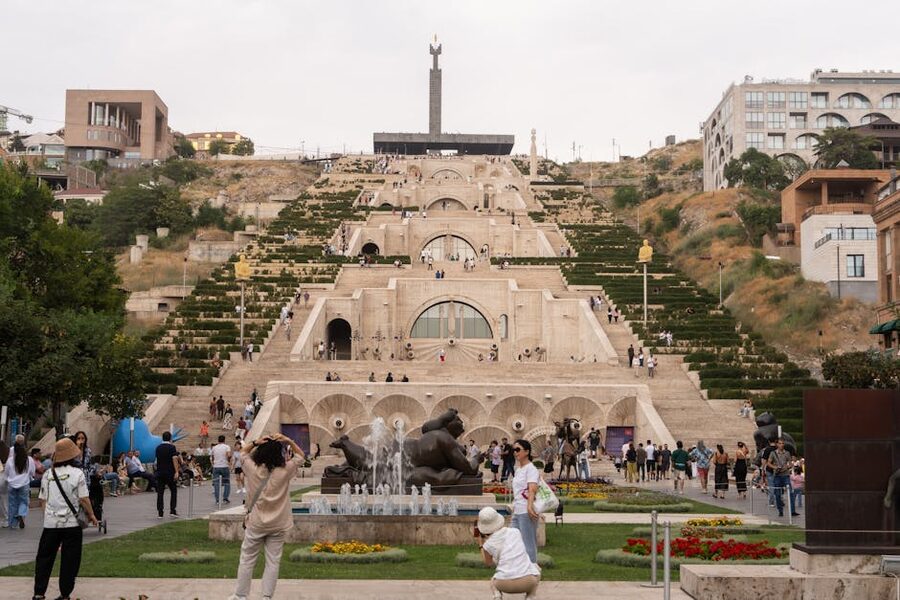
At its simplest: a 302-metre-long staircase made of milky white tuff and travertine, stepping up the hillside between the city centre and the Kanaker plateau. Five main terraces. 572 steps. 118 metres of vertical gain from the sculpture garden at Tamanyan Street to the top platform with the Soviet-era obelisk. An indoor escalator runs inside the structure for anyone who would rather not climb it, and the escalator itself doubles as a contemporary art gallery. It is free to use. The exhibition halls are free too, on the days they are open.
It is also a Cafesjian Center for the Arts, a sculpture garden, a public living room, a sometime concert venue, and an architectural argument that started in the 1920s and is technically still unresolved. The two things people get wrong are thinking of it as either just a viewpoint or just a museum. It is both, and the experience comes from how those two layers sit on top of each other.
The numbers, up front
If you only want the practical bits before you go: the outdoor stairs and sculpture garden never close. The interior escalator galleries (which is how most people actually get up) run 08:00 to 20:00, every day. The ticketed exhibition halls under the steps (Gallery One, the Khanjyan Gallery, the Eagle Gallery) are open Friday, Saturday and Sunday, 10:00 to 20:00, and admission to those is free as of late 2025, with occasional 1,000-dram special exhibitions that ask for a ticket. Closest metro stations are Yeritasardakan (650 m) and Marshal Baghramyan (1 km). A Yandex taxi from Republic Square to the bottom of the Cascade is about 700 dram on a normal day, slightly more in surge.
The view that everyone comes for
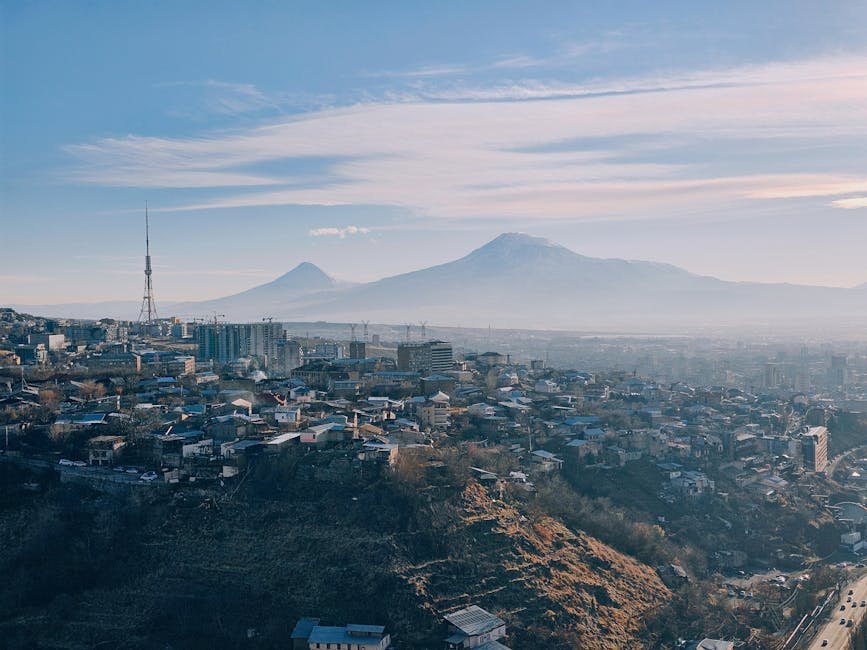
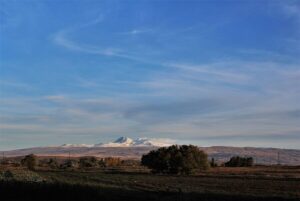
From the fifth terrace you look south down Tamanyan Street, past the Opera, over the spread of central Yerevan to Mount Ararat fifty kilometres away. Ararat is in Turkey and has been since 1921, and you cannot get to it from Armenia without going around through Georgia and Iran, which is half the reason every Armenian I have asked about it gives the same wry shrug. On a clear morning in spring or autumn the whole double-peak is sitting there above the city. On most summer afternoons there is a haze and you get a vague white shape, which is also fine. The view is good even when Ararat does not show up.
Start at Tamanyan, not at the escalator
This is the call I would defend through the whole article: enter from the bottom, walk through the sculpture garden, and climb at least the first two terraces on the outside before you go anywhere near the escalator. The Cascade is meant to unfold. Riding straight to the top in a glass tube and walking down through five identical-looking terraces does not unfold; it skips to the answer.
The garden between Moskovyan and the foot of the steps is where Cafesjian’s collection actually lives in the open air. The bronzes are paid for, named, and moved around occasionally (what you see today may not be exactly what you saw last year), but the heavy hitters have not changed in over a decade.
The Tamanyan monument, and what he was thinking
The first thing in the garden, on the southern end as you face the stairs, is the seated figure of Alexander Tamanyan. Sculpted by Artashes Hovsepyan, designed by architect Seda Petrosyan, inaugurated in 1974. Tamanyan is bent over a slab of stone resting on two smaller blocks. The two blocks are the point. One is meant to read as old Armenian architecture, the other as the new modern city; Tamanyan’s stone bridges them. He is the architect who designed Yerevan as a radial city in the 1920s and gave it the shape it still has: the ring boulevards, the centred Opera, and on his original master plan, a green axis running north from the centre up to the hills of Kanaker.
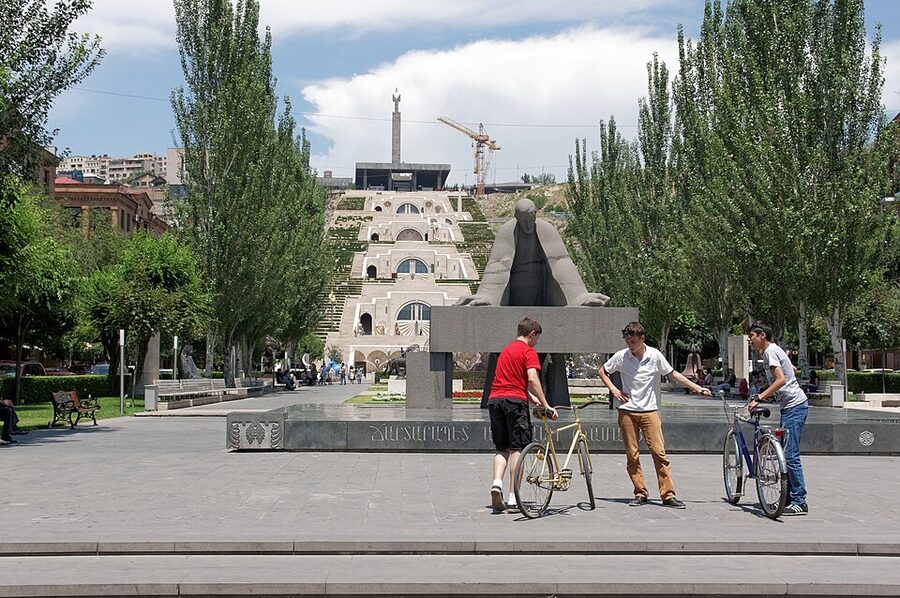
That green axis is the Cascade. The terraces, fountains, gardens, all of it was on his drawings as one continuous park leading up the hill. Stalin did not fund it. The Soviet 1960s did not, either. Tamanyan died in 1936 and never saw a single step poured. The Cascade you climb today is, in essence, a posthumous letter being slowly answered: first by the architects who picked it back up in 1971, then by Cafesjian in 2002, and now by whichever government can afford to finish the top.
Botero’s three Colombians
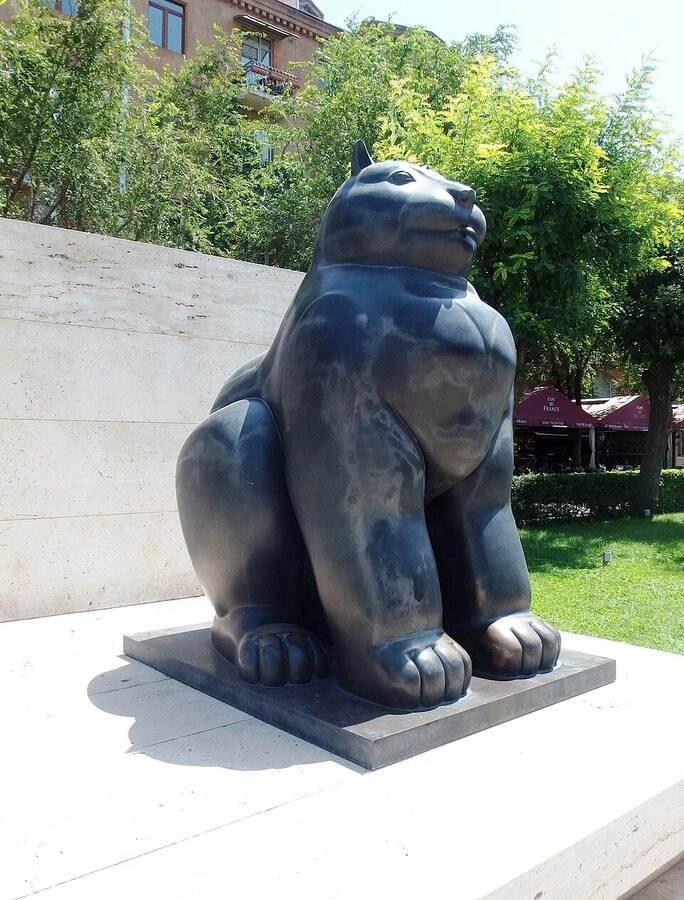
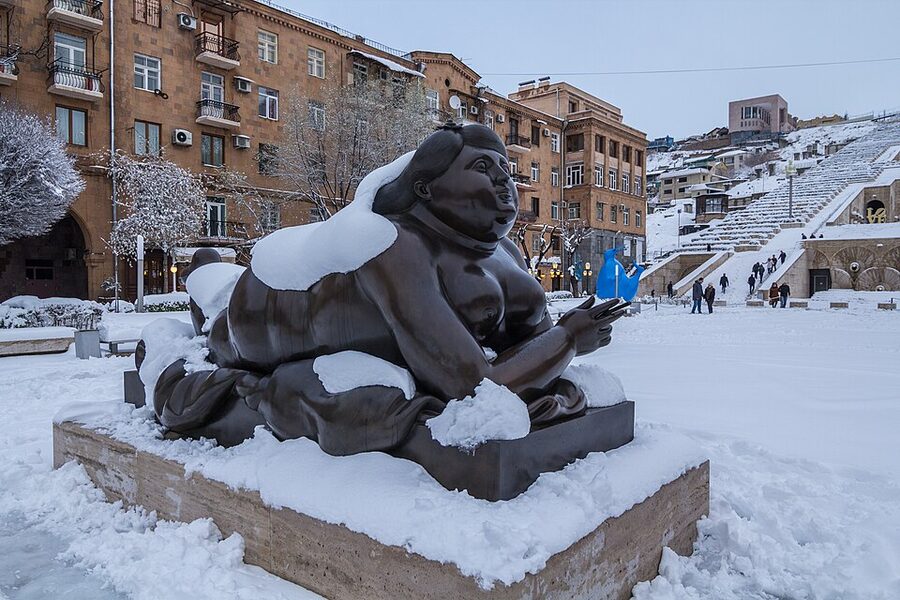
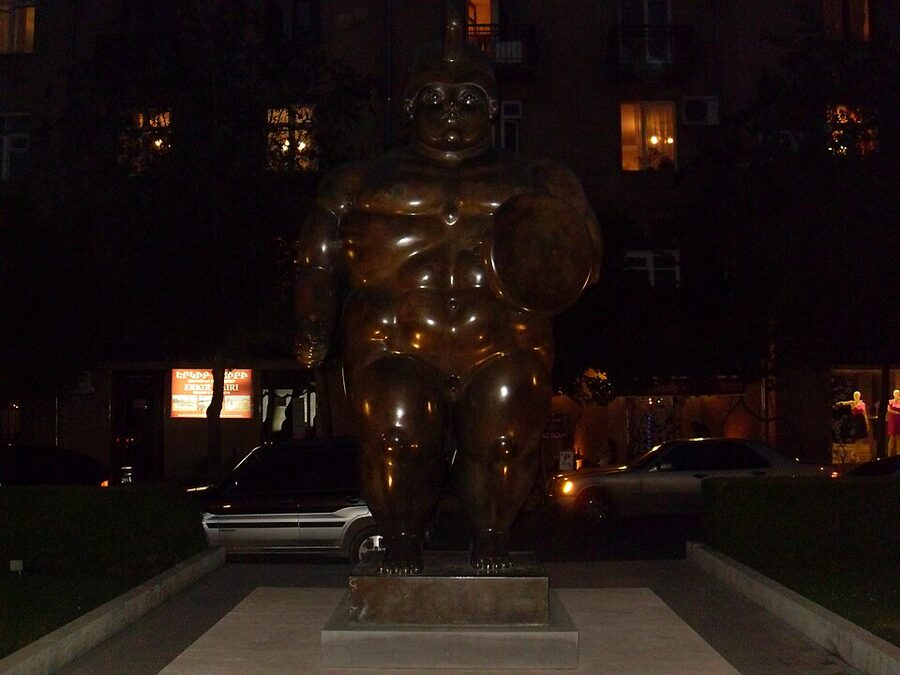
If you are not paying attention you will miss that three of the most popular sculptures in the garden are by the same artist. Fernando Botero, the Colombian painter and sculptor of round bodies and round animals, has three pieces here: Roman Warrior (1985–1986), Mujer Fumando un Cigarrillo (Woman Smoking a Cigarette, 1987), and Gato (Cat, 1999). All three are bronze. All three are exactly Botero’s signature in three dimensions: thick limbs, tiny features, an air of quiet absurdity that is hard to be in a bad mood near.
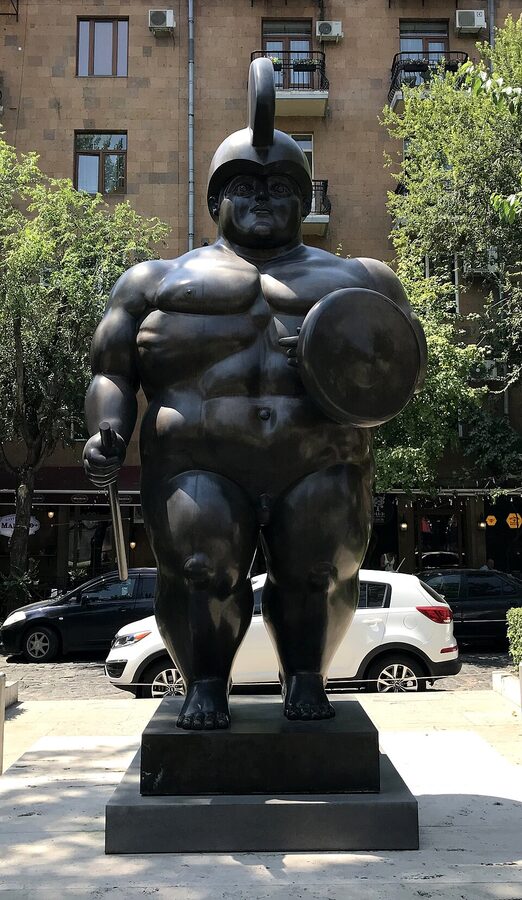
Botero died in September 2023, which is something I would not have known to mention except a Yerevan friend pointed it out the last time we walked past Gato. The cat, she said, is the people’s favourite. Children climb on it, couples take photos with it, dogs sniff it. It is the least solemn piece in a complex that gets called solemn rather a lot.
The Lion that’s made of tires
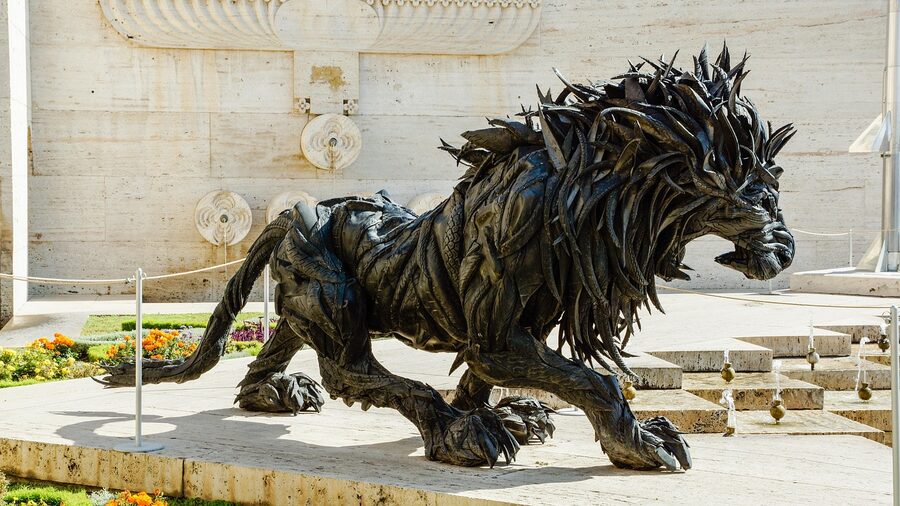
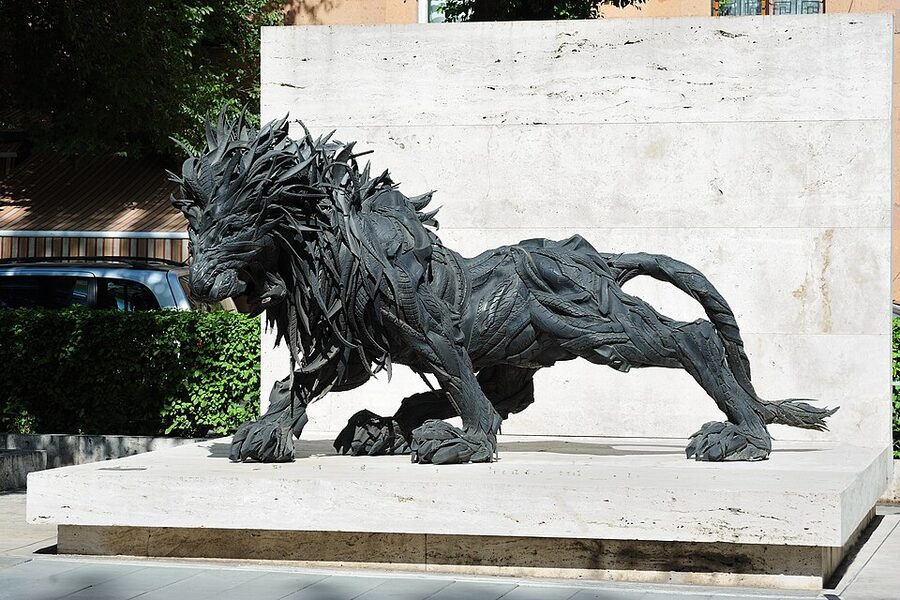
The piece in the garden that gets the most second looks is Lion 2 by South Korean artist Ji Yong-Ho (2008). From a distance it looks like a normal stainless-steel sculpture of a lion. Walk up to it and you realise the surface is made from cut and turned-out car tires: strips and scales of black rubber bonded over the steel frame. It reads completely differently up close: at ten metres a lion, at one metre a strange machine.
Things to look for that aren’t on most lists
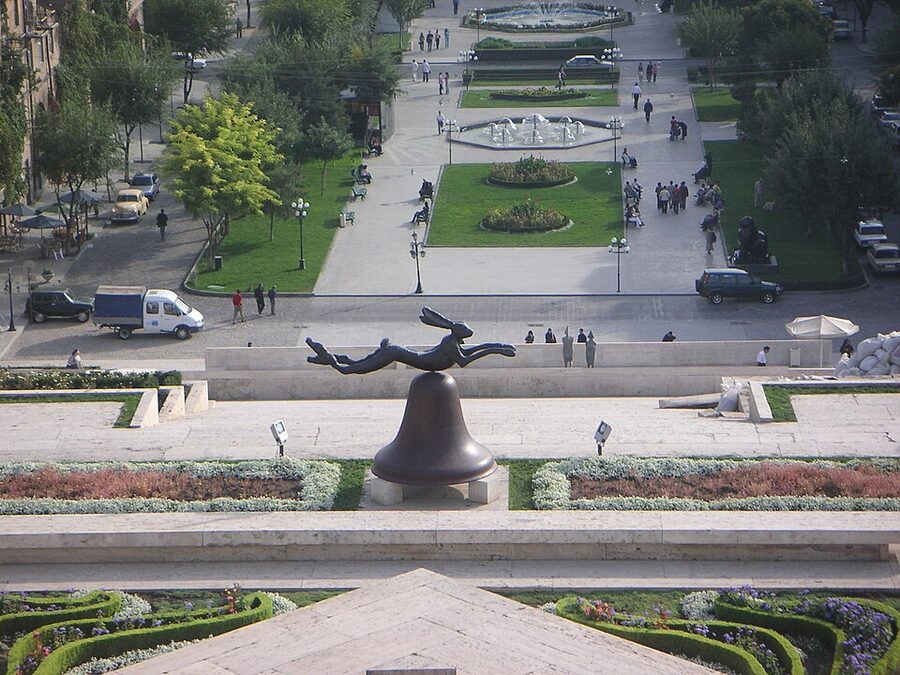
A few smaller pieces are worth slowing down for. Hare on Bell by British sculptor Barry Flanagan (a slim, leaping hare standing on top of a giant bell) sits on the eastern side of the garden. Flanagan’s signature long-eared hares are in collections from London to Tokyo, and this is one of the public ones that you can walk right up to without a barrier. Acrobats and Stairs, Two Watchers and Sitting Forms by Lynn Chadwick rotate through the garden and the upper terraces. A Paul Cox piece called Ahoy shows up somewhere on the lower terrace from time to time. It looks like a child’s cartoon boat painted into 3D.
The history, told fast
Long enough to actually understand what you are looking at, short enough not to be a Wikipedia paste.
1924–1936: Tamanyan dreams it
Alexander Tamanyan publishes the master plan for Yerevan in the 1920s. He has been hired by the new Soviet republic to redesign a small provincial capital into a proper modern city. He does. The plan is Renaissance-influenced, with radiating boulevards, a circular green belt, and a north-south axis from the centre into the hills. On the northern end of that axis he sketches a “stairway-cascade”: a system of terraces, fountains, plantings, and viewpoints climbing up to the high ground. Funding never appears. He dies in 1936.
1971: An obelisk goes up first
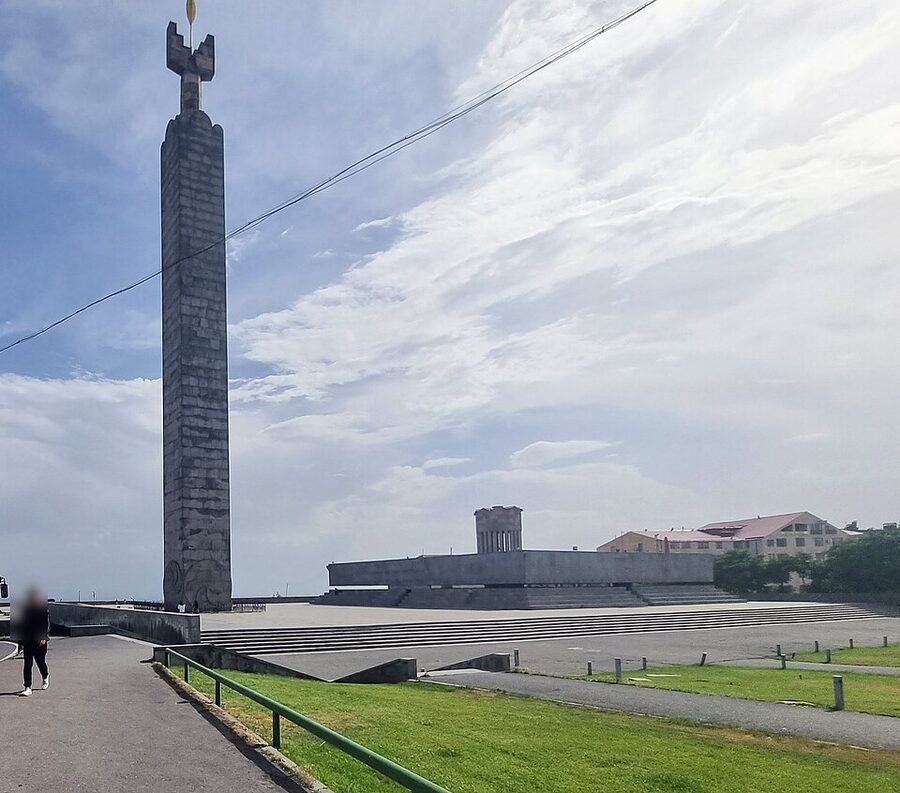
To mark the 50th anniversary of Soviet rule in Armenia, the government erects the Revived Armenia obelisk on top of the Kanaker plateau. It is 56 metres of carved tuff with Urartu-era sun discs and abstract Armenian motifs. Once it is standing, the obvious next question becomes: how do you connect this monument to the city below? That question is what eventually unfreezes the Cascade idea.
1980s: Phase one and a war
Three architects (Jim Torosyan as the lead, Sargis Gurzadyan, and Aslan Mkhitaryan) pick up the Tamanyan idea and draw a working version. Torosyan moves it away from being a pure staircase: he adds exhibition halls inside the terraces, hidden escalators, courtyards, a sculpture garden. Construction starts in 1980. The first phase is mostly built by the late 1980s. Then the December 1988 Spitak earthquake (the rebuild of which is on a later historic stone bridges list every year), the collapse of the Soviet Union in 1991, and the First Nagorno-Karabakh War all hit at once. Construction stops. The half-finished structure sits open to the weather for the next decade.
2002–2009: Cafesjian and the second life
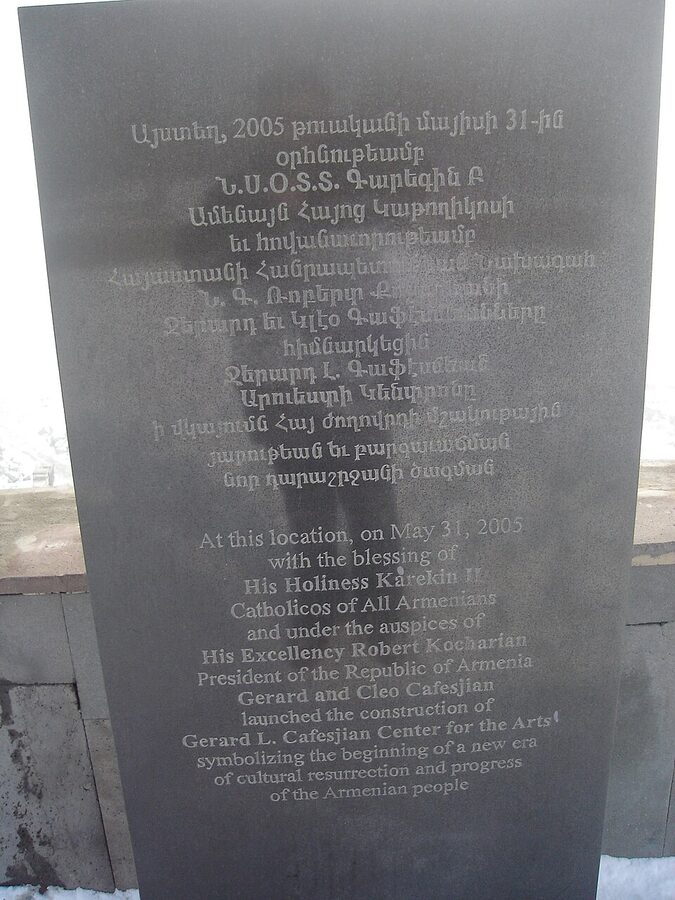
Gerard Cafesjian, an Armenian-American philanthropist who made his money at West Publishing, sees the half-built Cascade in the late 1990s. He commits, by his own foundation’s accounting, around $128 million to finishing it. He brings in American architect David Hotson, who folds a museum into the existing structure rather than redesigning around it. The Cafesjian Museum of Art opens on 17 November 2009. The escalator runs. The exhibition halls are wired and lit. The garden gets its first sculptures. Cafesjian dies in 2013, but the museum he funded is still the day-to-day operator of the complex.
2024: The vote that almost no one voted in
The top of the Cascade, the section between the fifth terrace and the obelisk, has never been finished. In September 2024, the Yerevan municipality put two proposals on the city’s “Active Citizen” online platform: a “Cascade Gardens” green-space option, and a “Cascade Cultural Center” with a concert hall and indoor museum extension. Only 2,030 people voted. 55.6% picked Cultural Center, 44.4% picked Gardens. The project was approved at around 20 billion drams, or roughly $7.8 million USD, on a five-year build. The Chamber of Architects of Armenia publicly criticised the choice. As of writing, the upper section is still a construction zone. Whatever you see when you go is a snapshot of an unfinished fight.
Climbing it: terrace by terrace
If you do go up the outside (and I think you should, at least the first three levels), here is what is actually on each one. I am going to count the way most signage and most local guides count: five terraces, plus the Monumental Terrace at the top.
First terrace: a sundial fountain you don’t quite get
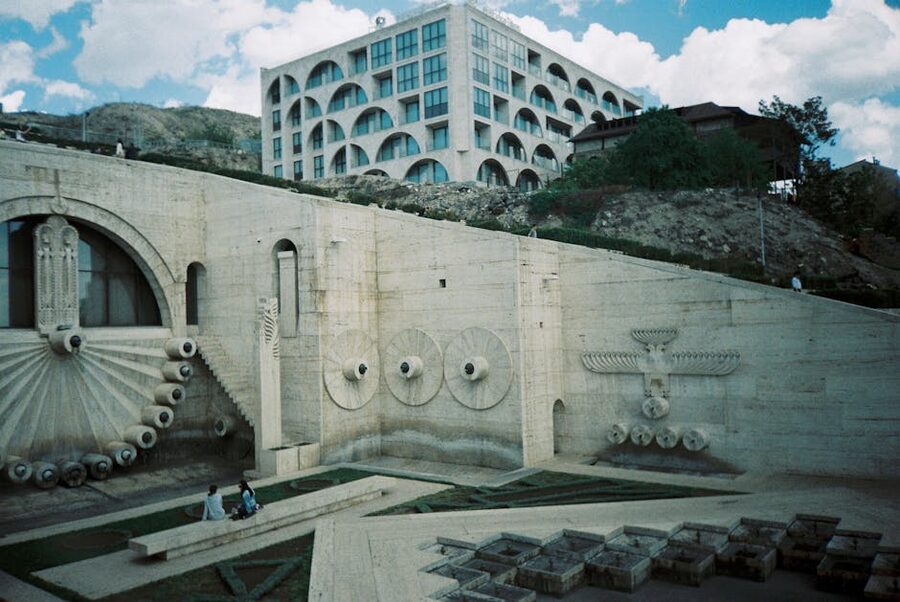
You climb the first set of stairs from Tamanyan Street and the first thing you see, set into the terrace floor, is a circular fountain ringed by fifteen jets pouring water out of carved concrete cylinders. The cylinders are made to look like medieval Armenian sundials. The fifteen-jet count is not random. Different Armenian sources give different readings of what the number means; the architects were fond of Christian and pre-Christian numerology and the easy guess is the fifteen Soviet republics, but you can also read it as fifteen disciples of Mesrop Mashtots, the inventor of the alphabet, or just fifteen and stop there. I would stop there.
Second terrace: plants, water, and the Visitor
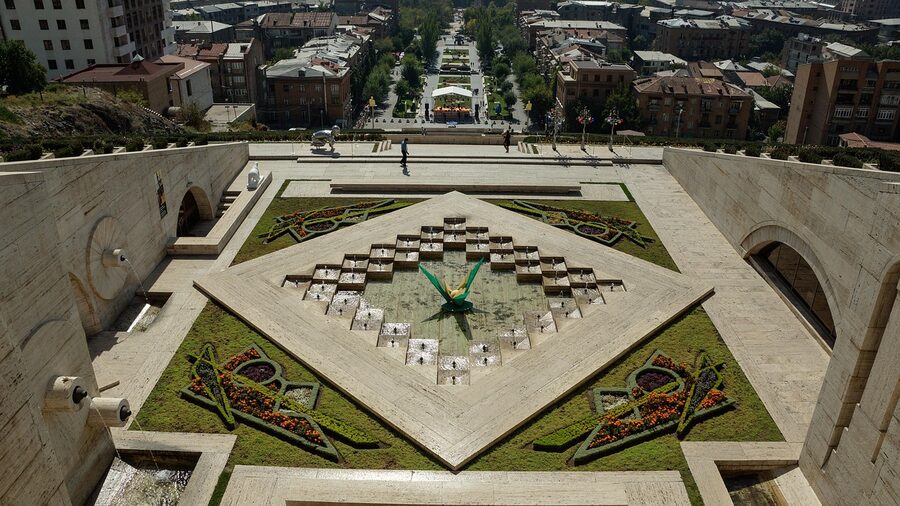
The second terrace flattens into a sunken garden with low retaining walls planted in seasonal flowers. In the central depression you’ll often find The Visitor, a bronze figure by British artist David Breuer-Weil: a single seated person staring outward over the garden. The placement is exactly the kind of thing the Torosyan team was good at: a piece of sculpture that uses the architecture to direct the viewer, rather than fighting against it. From the second terrace you start to see Yerevan opening up below you, but only just. Keep climbing.
Third terrace: pomegranates and a cooler bench
Third terrace repeats the formula (fountains, more carved-stone reliefs, another sunken garden) but the shade increases. There is almost always at least one bench in shadow at the back of this level and, if it is summer, that is the one I would use to drink half a litre of water before going on. The relief carvings on the back wall feature pomegranates, grapevines, and the tree of life; this is the level where you start to feel the building deliberately quoting traditional Armenian motifs without doing it loudly.
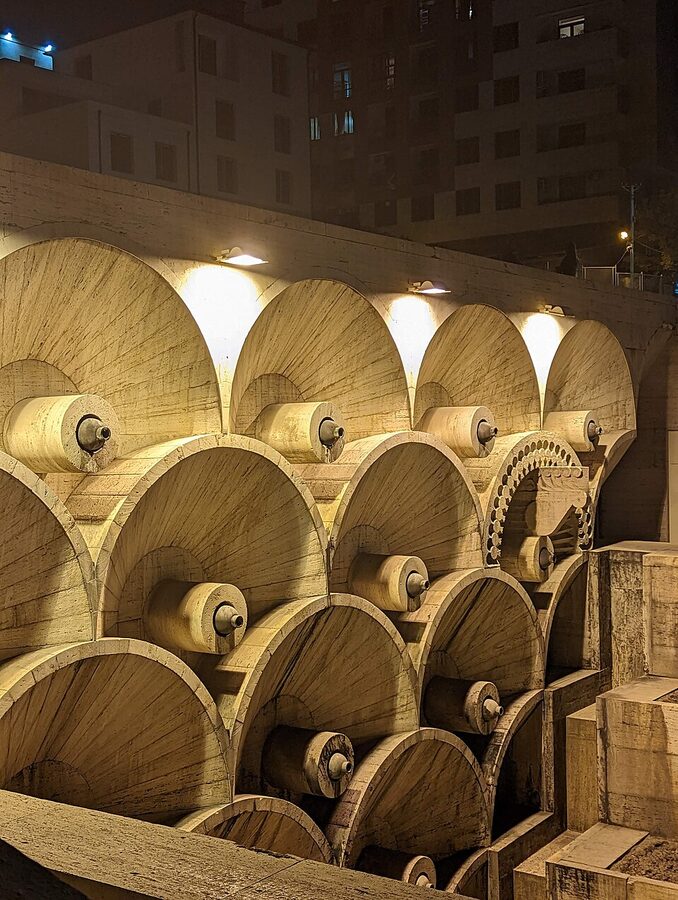
Fourth terrace: the dove relief and the khachkar wall
Fourth terrace is where the architecture starts to do the heavier work. The back wall holds a large bas-relief of a dove holding grapes and pomegranates: Christian iconography rendered in the same soft volcanic tuff used for everything else. To the right of the staircase up to the fifth, set into a small mid-level terrace, is a stele next to modern khachkars. Khachkars are cross-stones, intricately carved memorial slabs that are one of Armenia’s signature art forms; UNESCO listed the craft of carving them in 2010. These ones are modern, not medieval, but the design language is the same.
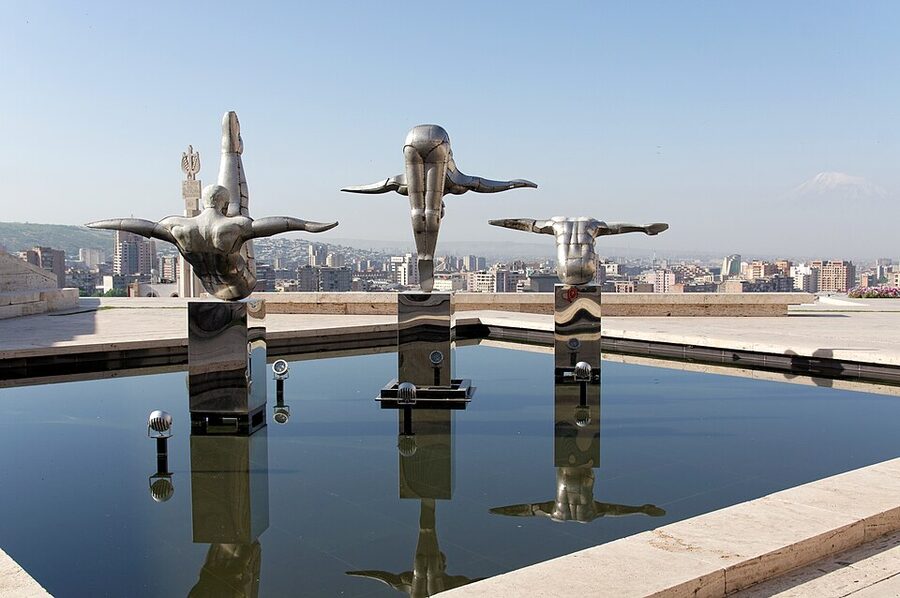
Fifth terrace: the Divers and the long view
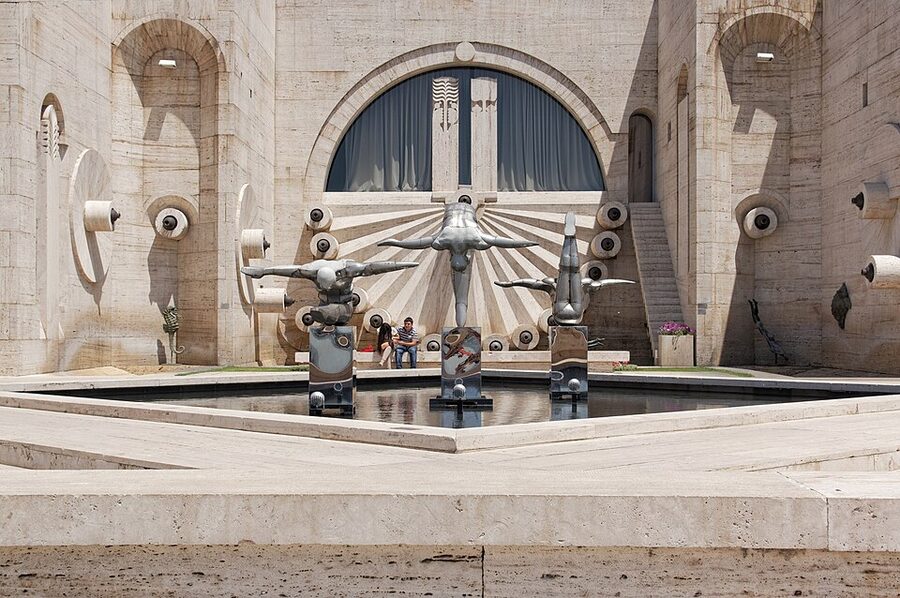
The top of the finished Cascade. Three Divers, a bronze by British artist David Martin, sits on a plinth here in three stylised figures mid-arc as if leaping forward over the city. It is the piece that ends up in everyone’s photos because it works visually with the view behind it: the Opera, the line of Mashtots Avenue, the city sprawled toward Ararat. From this terrace you also start to notice the construction zone above: the unfinished sixth and seventh terraces that the 2024 vote was about.
Monumental Terrace: the obelisk and the long memory
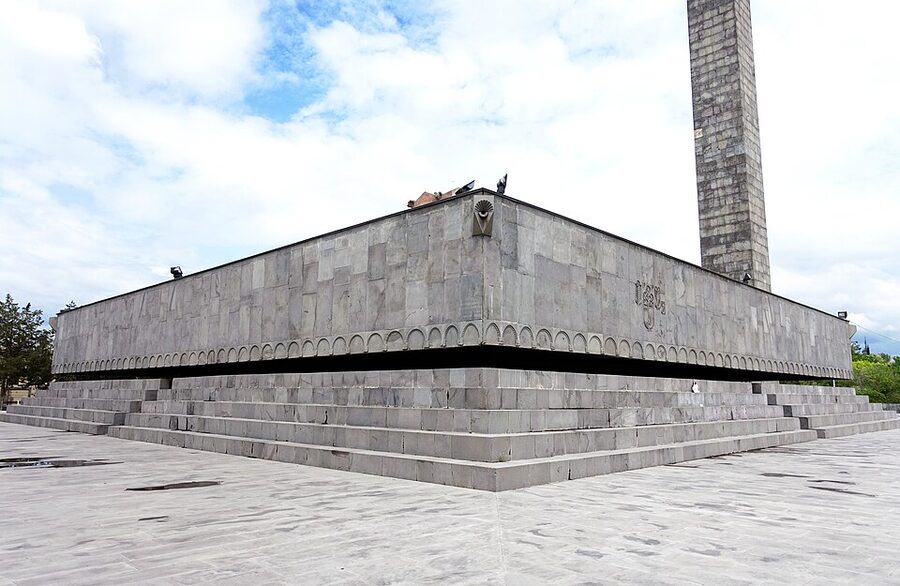
If you carry on up past the fifth terrace, around the construction fencing, you reach the Monumental Terrace and the Revived Armenia obelisk. Most visitors do not bother. I think it is worth fifteen minutes, partly for the view (which is even better than from the fifth) and partly because this is the historical anchor of the whole thing. The obelisk was here before the Cascade was. The Cascade was built to point at it.
The escalator, the museum, and what’s actually inside
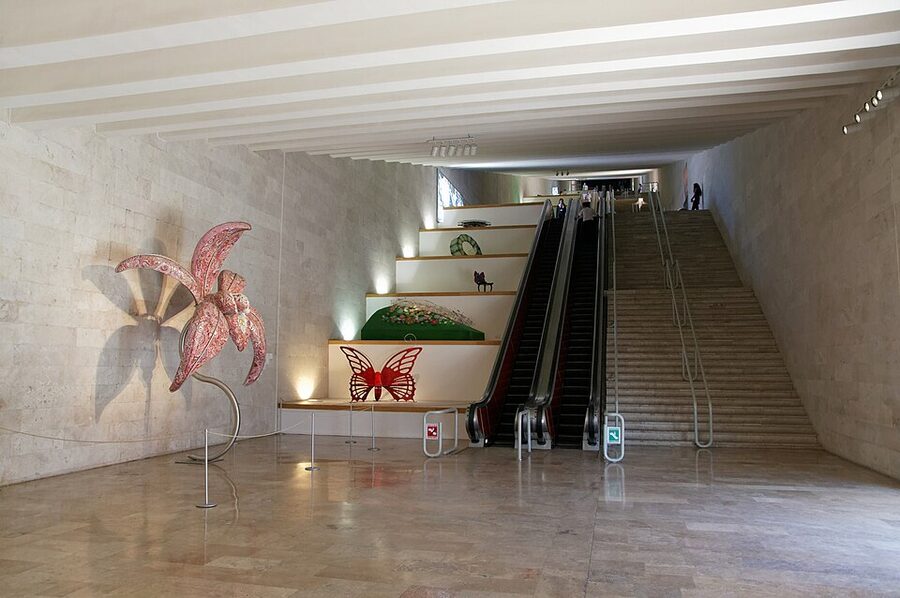
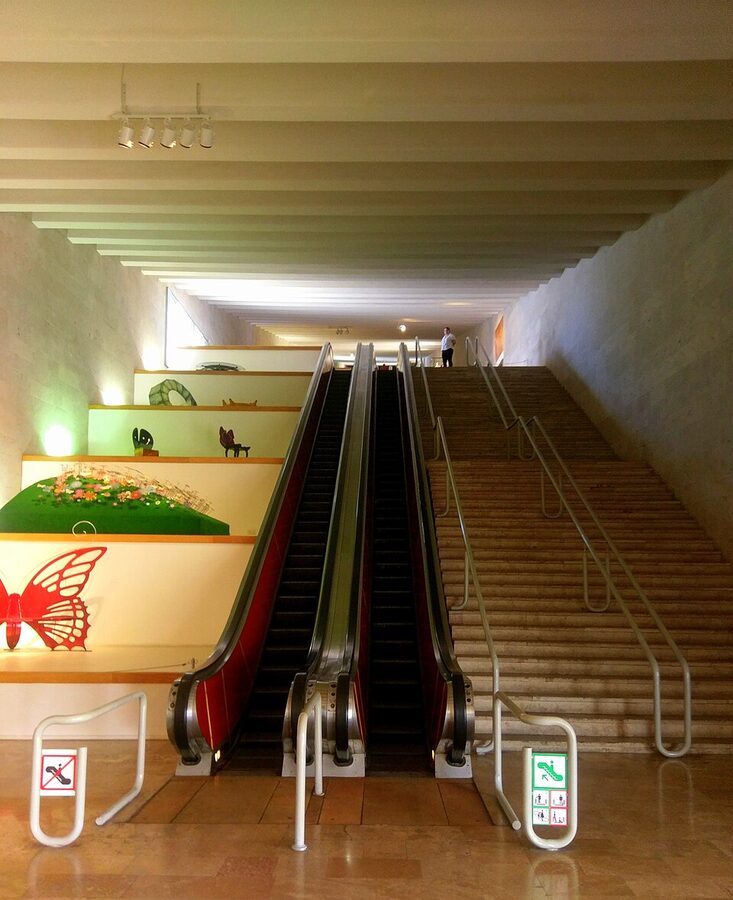
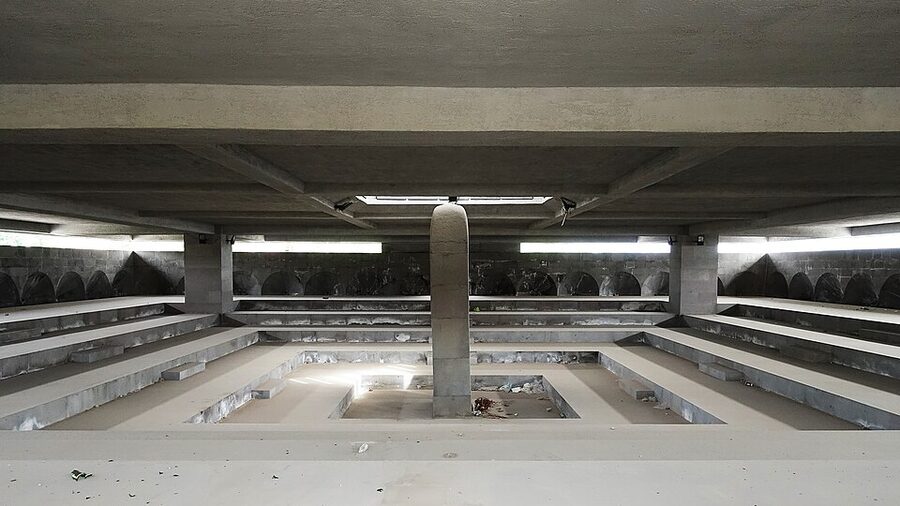
Inside the structure, behind the Cafesjian facade you see from Tamanyan Street, is a long sloped escalator that climbs through the building in five stages and lets you out near the top. The escalator runs daily 08:00 to 20:00 and is free.
What it feels like to ride it
The corridor is dim, with small spotlights on a series of contemporary glass works and large abstract sculptures placed on each landing. There is no music. The escalator is slow, by escalator standards. It gives you time to actually look at what is in front of you, which is the only reason a museum of contemporary art could plausibly turn its main vertical-circulation device into a gallery. Each level has an exit door. You can step off at terrace one, two, three, four, or five and continue outdoors.
Cafesjian’s collection
Most of what you see indoors is from Cafesjian’s personal collection of about 5,000 works. He had a particular obsession with studio glass: the kind of wall-mounted, light-catching pieces that look almost industrial up close. Names to look for if you care: Czech glass artists Stanislav Libensky and Jaroslava Brychtova, whose Open Window sits in the Sasuntsi Davit Garden Gallery; Czech sculptors Jaromir Rybak and Pavel Trnka; Americans Jon Kuhn and Herb Babcock; Slovak-American Jan Zorichak; and Swedish glass artist Bertil Vallien. The Khanjyan Gallery is Armenian, holding work by the Soviet-era painter Grigor Khanjyan. The Eagle Gallery is mixed Armenian and international.
If glass and post-war abstraction is not your thing, you can still get a lot from the place. The architecture rewards walking around regardless. But if you do not look at any of the indoor work, you are not seeing the Cafesjian Center; you are seeing a very nice staircase.
Plensa, Chadwick, and the upstairs garden
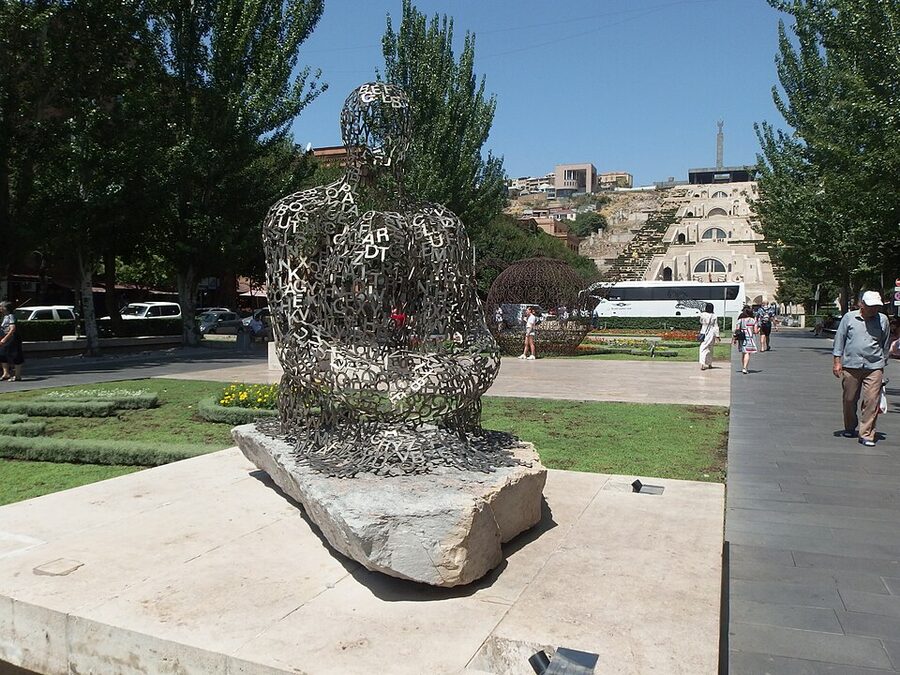
Outside on the upper terraces, beyond the Botero garden, you find work by Catalan sculptor Jaume Plensa, including Shadows I, a stylised seated figure made up of cut metal letters that read as silhouette from a distance and as alphabet up close. Lynn Chadwick’s stylised winged figures show up here too, in the same dark patinated bronze he is known for in collections at Tate Britain.
What you can see from the top
This is the part most visitors come for, and it deserves a section because the named landmarks in the view reward knowing what they are.
South: the Opera, Mashtots Avenue, Ararat
Looking south from the fifth terrace, the closest building is the Yerevan Opera Theatre, also a Tamanyan design, also from his 1920s plan. The long boulevard running diagonally to your right is Mesrop Mashtots Avenue, the city’s main shopping spine. Behind everything, when the haze lifts, is Ararat. Lesser Ararat to the left, Greater Ararat (5,165 m) to the right. The shape is unmistakable when it shows up; on a hazy summer afternoon you might see only the snowline ghost of the upper thousand metres. Locals have a word for the days Ararat is “out”, and they ring each other up.
West: Sports & Concerts Complex and the Genocide Memorial
Look west and the most distinctive shape on the skyline is the Karen Demirchyan Sports and Concerts Complex, a concrete late-Soviet hangar that was finished in 1983, half-burned in 1985, rebuilt, and renamed after the assassinated prime minister. Behind it, on the next ridge, is the spire-like stele of the Tsitsernakaberd Armenian Genocide Memorial. From the Cascade you see only the top of the stele over a long park. The Memorial itself is a half-day visit on its own and not the kind of thing to combine casually with sightseeing. When you go, plan it as the morning, not as a stop on a list.
East and centre: the cathedral and the rooflines
To the east, scanning across the central districts, the largest dome you can find is Saint Gregory the Illuminator Cathedral, consecrated in 2001 to mark 1700 years since Armenia adopted Christianity in 301 AD. It does not pretend to be old (the architecture is contemporary) but it is the largest cathedral in the country and easy to spot once you know what shape to look for.
What Ararat looks like when it doesn’t show up
Plan for the possibility. Ararat is fifty kilometres south, across the Turkish border, and it is famously unreliable: clear morning skies turn hazy by lunch in summer, and winter haze can hold for days. If you really want it, set an alarm for an hour before sunrise in late September or early October and walk up before any of the cafes open. That is the highest-probability slot. If it is not there, you still get the city from above, and the city alone is worth the climb.
When to go, and at what hour
The Cascade is open-air and never closes for the night. That gives you more options than at most attractions, and it pays to think about which one suits you.
Spring and autumn beat summer and winter
April-May and September-October are the best months. The plantings are in, the heat is bearable, the air is more often clear, and the cafe tables along the Tamanyan Street side are full but not crushed. July and August work but the climb is hot, the haze hides Ararat more than it shows it, and the white tuff radiates heat off the terraces in late afternoon. December-March can be beautiful, particularly in fresh snow, but the upper terraces ice over and the climb gets genuinely slippery.
Sunrise vs sunset vs after dark
Sunrise is the best slot for Ararat photography and the worst slot for everything else. Nothing is open, no cafes, no escalator. If your priority is the mountain, set a 5:30 alarm and accept the trade. Sunset is the popular slot, and rightly so: the sky over the city goes through twenty minutes of warm colour, the buildings light up, and the mood of the place softens. After 21:00 the Cascade itself is lit, the fountains run, and the cafes on the side streets are at full volume. I personally prefer the hour from 18:30 to 19:30 in May: late enough that the light is good, early enough that the steps are not crowded.
Time to budget
One quick visit, going up the escalator, looking from the top, coming down: 45 minutes. A proper visit including the sculpture garden, climbing at least the lower outdoor terraces, and looking at the escalator art on the way: 90 minutes to two hours. A serious visit including the Friday-Sunday exhibition halls, lingering on multiple terraces, and a coffee on Tamanyan: half a day. Most people give it 30 minutes and feel they have seen it. They have not.
The practical bits
Travel logistics, eating nearby, what to combine the Cascade with on the same day.
Getting there
The Cascade is in the centre, a 10 to 15 minute walk from Republic Square or 25 minutes from the train station. The closest metro stop is Yeritasardakan (one stop from Republic Square on the single line), about 650 metres away. Marshal Baghramyan is roughly a kilometre. By taxi, use the GG or Yandex apps. A ride from Republic Square should run you around 700 dram, from the airport around 3,500 to 4,500 dram depending on time of day. A city bus to the “Kaskad” stop costs 100 dram, paid in cash to the driver or via the city’s IC-card system if you have one. If you are coming back into Yerevan after a day trip from Garni or Echmiadzin, the Cascade is a good late-afternoon stop because the marshrutkas drop you within a short walk of the bottom.
Money: free vs paid
Most of what you do at the Cascade is free. The outdoor garden and stairs are free and never close. The interior escalator is free. The escalator-corridor art galleries are free. As of late 2025 the main exhibition halls are also free, with occasional special exhibitions priced at 1,000 dram (around $2.50). If you decide to attend a concert or evening event, those carry separate ticket prices that vary by performer. Cafes around the base run 1,800-3,500 dram for a coffee or a drink, which is on the high end for Yerevan; they are paying for the location.
Where to actually eat
The cafes lining Tamanyan Street and the small alleys around Saryan Street are convenient and pretty and overpriced for what you get. They are tourist-trap-adjacent rather than full tourist trap. The food is fine, the bills are 30-40% higher than they should be. If you have time and you care, walk five blocks south to Saryan Street, which is the local wine-bar street and has better-value food and a stronger atmosphere. In Vino on Saryan is the easiest entry point into Armenian wine; it is loud, well-stocked, and the staff will let you taste before you commit. Tavern Yerevan on Amiryan is the standard recommendation for traditional Armenian khorovats and dolma. It is touristy but the food is solid. Lahmajun Gaidz near the Opera does the cheapest decent lahmajun in the centre, around 600-800 dram per round.
If your priority is Armenian food properly done, the better choices sit in the streets either side of the Cascade rather than directly at the foot of it. Our guide to traditional Armenian food goes deeper into what to order.
What to combine the Cascade with
The Cascade pairs naturally with the Saryan park and the Saryan House Museum, which is a five-minute walk away on Saryan Street and is the best small museum in the centre. Give it 90 minutes. The Matenadaran ancient manuscripts museum is a 10-minute walk uphill from the foot of the Cascade and is one of the few places in Yerevan that actually justifies the word “must”; budget two hours. The Yerevan Opera sits directly in the line of sight from the top of the Cascade and is a possible evening pair-up if there is a performance running. Republic Square is fifteen minutes south on foot and works well for late-afternoon people-watching, especially on a summer Saturday when the dancing fountains run.
If you only have two days in town, our Yerevan in 48 hours guide builds the Cascade in as a late-afternoon stop on day one. That is genuinely the right way to fit it. For getting around the country between sights, the Armenia transport guide covers the marshrutka network, the metro, and the day-trip taxi rates.
What’s good and what isn’t
I love the Cascade. It is one of the best things to do in Yerevan, free, central, generous to anyone who will give it more than thirty minutes. It is also, by the standards of the same project finished, an unfinished Soviet-American-Armenian hybrid with a top section that has been a construction zone for twenty years and counting, a museum schedule that is hard for short visitors (Friday-Sunday only for the main halls), and a sculpture rotation that means you cannot guarantee any specific piece will be there on any specific day.
The construction at the top has been there long enough that locals stopped expecting it to finish on schedule years ago. The 2024 vote felt to a lot of Yerevantsis like a procedural step, not a starting gun. The cafes at the base, as already mentioned, are pricier than they should be. Weekend afternoons in summer can crowd the lower terraces enough that climbing past one of the photo-op spots takes some patience.
None of that changes the recommendation. It is still one of the best public spaces in the Caucasus. It is the most successful piece of Soviet-era urban planning in any of the post-Soviet capitals I have spent time in. It is the place I take any first-time visitor to Yerevan, in the late afternoon, and I have yet to see one of them not understand the city better afterwards.
One thing to take away
If you only do one thing differently after reading this: walk through the sculpture garden before you ride the escalator. Ten minutes there. Look at the cat. Look at the lion up close. Read the Tamanyan plaque. Then climb at least the first three terraces on foot. The Cascade is built to unfold from the bottom up, and if you take the escalator straight to the top you have skipped the whole reason it works. The view at the top is the destination. Everything else is the point.


.jpg)


