
The cabin pulls away from Halidzor station and within ten seconds the floor below you is gone. Not a slope. Not a hillside. Gone, the way it goes when an aeroplane lifts. There’s a beat where your stomach realises before your eyes do, and then the cable tightens and you’re suspended over the Vorotan gorge with maybe six hundred metres of air between you and the river. The other passengers stop talking for about half a minute. Then a small child says something in Russian and laughs, and the spell breaks, and you remember that this is a cable car, not a magic trick.
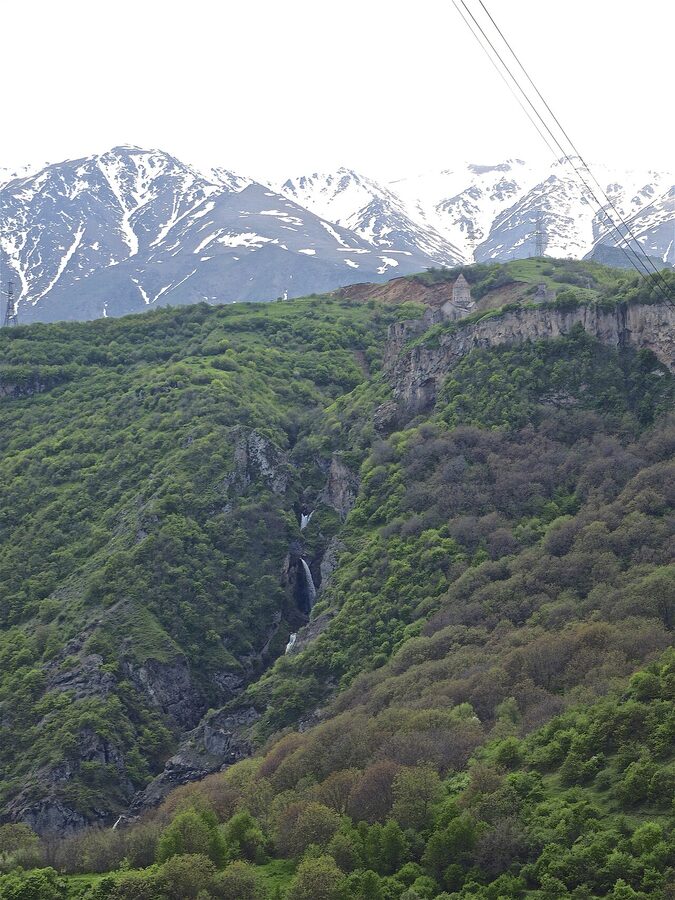
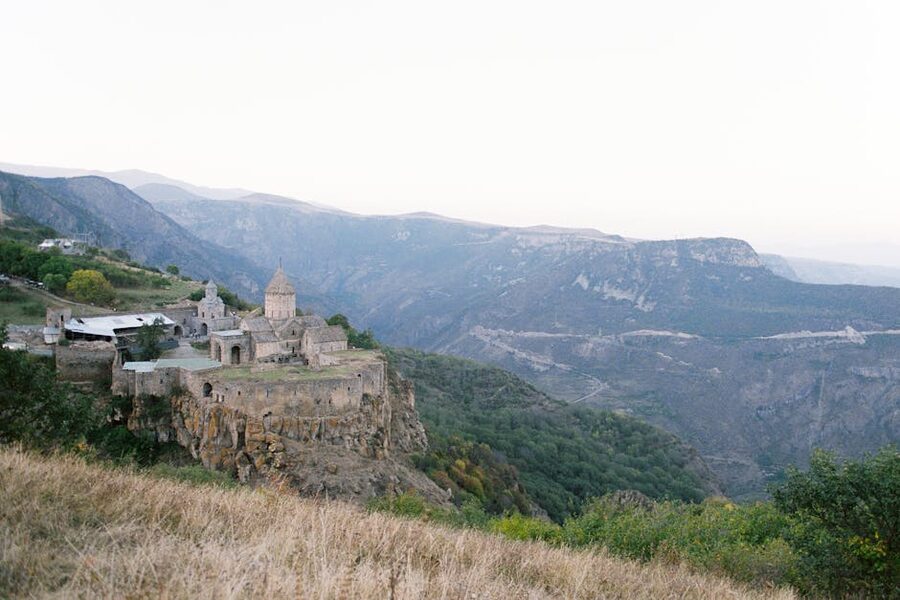
That first half-minute is what people remember about Tatev. The monastery sits on a basalt plateau on the far side of the canyon, 9th century, founded by Bishop Hovhannes with the financial backing of the princes of Syunik in 895. You can drive there along the H45 and it takes about 45 minutes from the cable car station, all hairpins. Or you can take the Wings of Tatev, which the Guinness Book of Records lists as the world’s longest reversible double-track aerial tramway at 5,752 metres. The cable car ride takes 12 minutes. The drive takes 50. The cable car costs more. The cable car wins.
This guide is for people who want the trip to actually be good rather than just done. I’ll cover how to get to Halidzor station, what the cable car ride is actually like, what to do at Tatev once you’re across, the Devil’s Bridge and Harsnadzor watchtower stops most day-trippers miss, where to stay if you don’t want to sit on a minibus for nine hours, and which tour operators are worth the money. If you’re still picking which Armenia destinations to fit into a one-week itinerary, the other big four are Lake Sevan, Dilijan National Park, Mount Aragats, and the day-trip cluster around Garni, Geghard, and Khor Virap.
In This Article
- Where Tatev actually is, and why that matters
- The Yerevan-day-trip math
- Why Goris changes the trip
- Getting to Halidzor for the cable car
- Group day tour from Yerevan
- Private driver from Yerevan
- Public transport via Goris
- Self-drive
- The cable car ride itself
- Tickets and prices
- Operating hours and the Monday rule
- What you actually see on the way over
- The monastery itself
- Saints Paul and Peter (Surb Poghos-Petros)
- Saint Gregory the Illuminator and Holy Mother of God
- The Gavazan column
- The library, the refectory, the oil press
- The view from the back wall
- Beyond the monastery: Devil’s Bridge and Harsnadzor
- How to get to Devil’s Bridge
- Harsnadzor watchtower
- Hiking down from the monastery to Halidzor
- Eating and sleeping at Tatev itself
- Tatevatun
- Tatev Info Cafe
- Saro Restaurant (Tatev Authentic Food)
- Sleeping in Tatev village
- The standard itinerary stops on the way
- Khor Virap
- Areni and Hin Areni Winery
- Noravank
- Shaki Waterfall
- Khndzoresk
- When to come
- May to June
- July to August
- September to October
- November to April
- Practical bits, ranked by how often I get asked them
- Is there an entrance fee for the monastery?
- Is there an audio guide?
- What should I wear?
- What about money?
- Phone signal?
- Souvenirs worth buying
- The verdict on day tours vs overnighting
- One thing I’d do differently
- Booking the trip
Where Tatev actually is, and why that matters
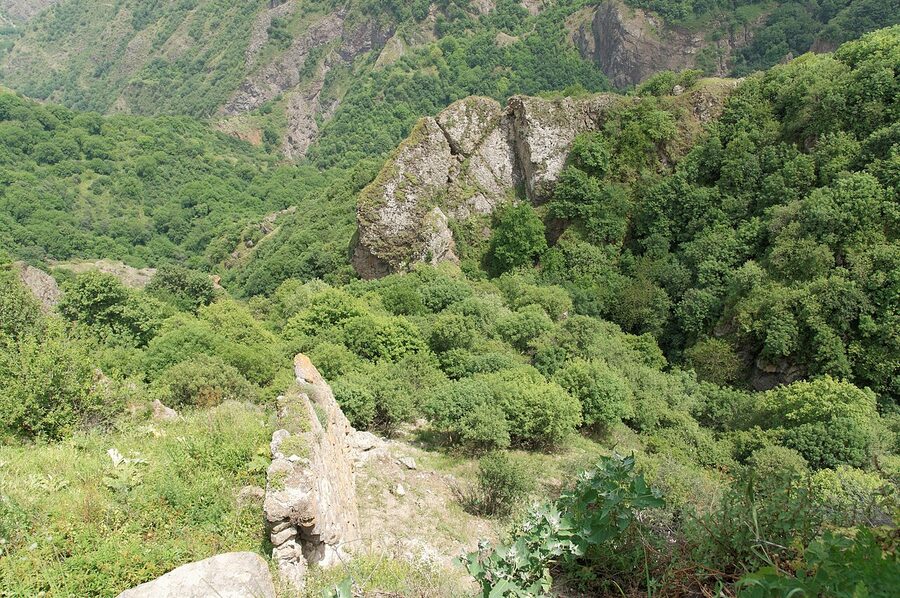
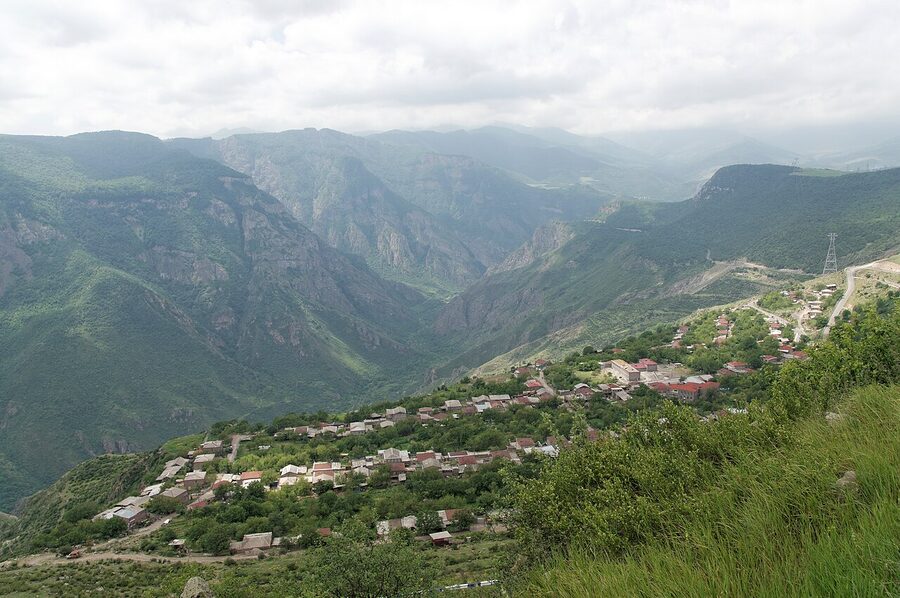
Tatev is in Syunik, Armenia’s southernmost province, 253 kilometres south of Yerevan by road. Halidzor village, where the Wings of Tatev station sits, is 240 kilometres from Yerevan, or roughly four to four and a half hours of driving if you don’t stop. The monastery itself is on the far side of the gorge, 5.7 km away by air and 39 km by road. Most people do the cable car. A small percentage drive in via the H45 just because they want to. A handful hike one way and ride back, which is the version with the strongest opinions attached.
The closest town is Goris, about 35 km north-east of Tatev. Goris has guesthouses, restaurants, a planned-grid old town, and the Soviet-era amenities of a small Armenian regional capital. If you’re driving from Yerevan you’ll see Goris first, then Halidzor, then the cable car, then the gorge.
The Yerevan-day-trip math
Four and a half hours down. Four and a half hours back. An hour or so at Halidzor for the cable car queue and the ride. About an hour and a half at the monastery if you’re moving. Add the standard one-tour stops at Areni winery and Khor Virap and you’re looking at 13 to 14 hours door to door. That’s the price of seeing Tatev without an overnight, and it’s steep. The drive is real driving, the road quality varies, and you will spend most of the day looking at a window.
If your Armenia trip is five days or longer, do not do this as a day trip. Sleep in Goris. The next section explains why.
Why Goris changes the trip
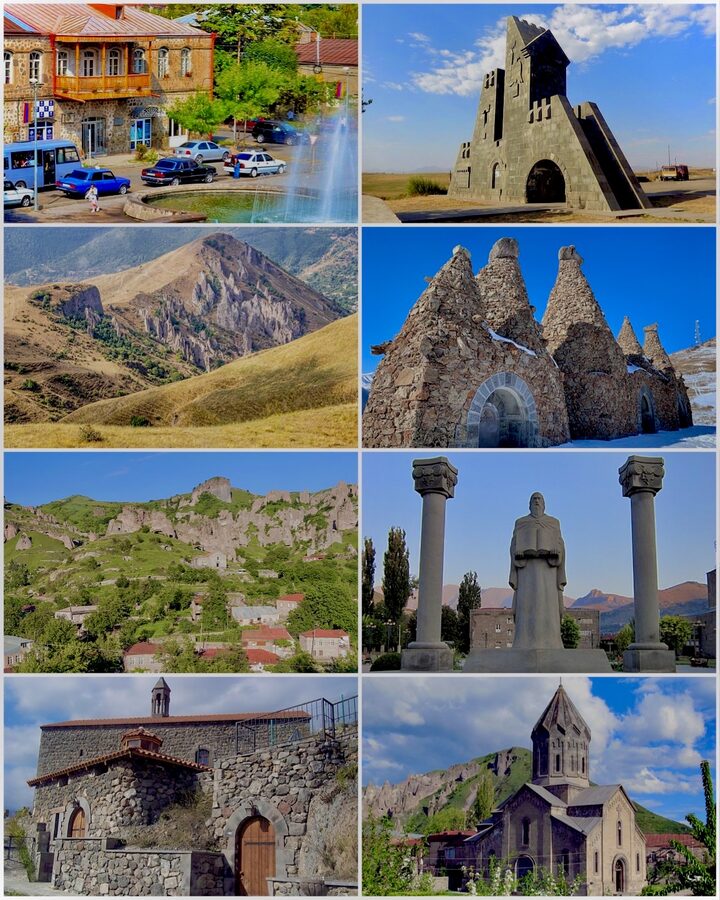
From Goris, Tatev is a half-day trip rather than a marathon. You drive an hour to Halidzor, you take the cable car, you eat lunch at one of the cafes near the monastery, you ride back, and you’re home in time for a proper Armenian dinner with the kind of guesthouse breakfast leftovers that they’ll insist on giving you anyway. You also get to see Khndzoresk, the abandoned cave village with the swing bridge, which most day-trip itineraries either skip or rush.
The Goris guesthouses run between 10,000 and 25,000 dram per night for a double, breakfast usually included. Mirhav Hotel is the upmarket option around 25,000-30,000 dram. Narek B&B and Aregak B&B are the budget reliables, both well under 15,000 dram. Family-run, you’ll have a long conversation about your country with somebody’s grandmother, and the breakfast will involve apricot jam they made themselves.
Getting to Halidzor for the cable car
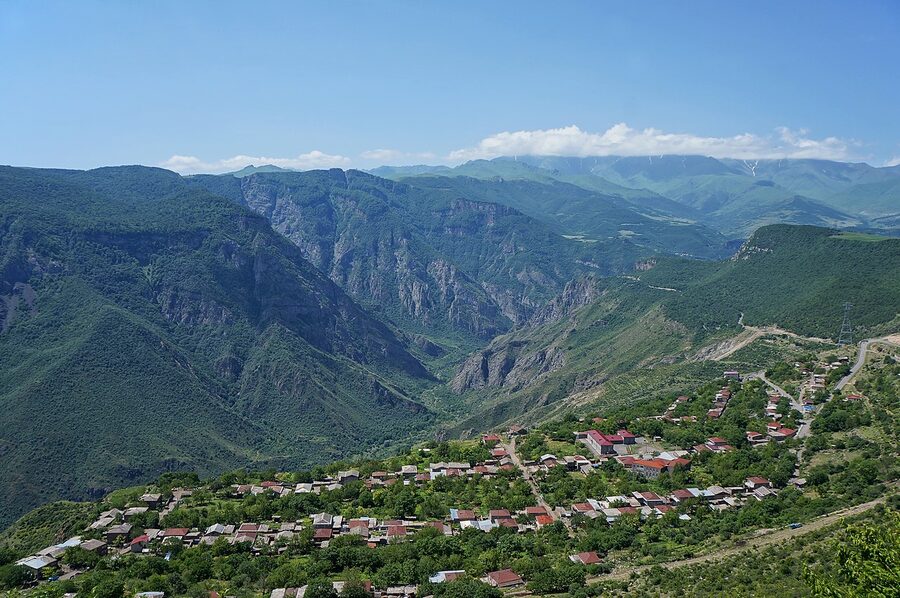
There are four ways to get to the Halidzor station, and the right one depends entirely on how much time you have and how much you mind a long bus.
Group day tour from Yerevan
The most common option, and the one most people end up on. A 13-14 hour day trip in a small minibus, departures Tuesday through Sunday (no Mondays because the cable car is closed), groups of 8-15, English-speaking guide, lunch usually a meat-or-vegetarian set menu at one of the village restaurants. Tour pricing sits in a tight band: AMD 16,000-25,000 (around USD 40-60) per person for the small-group versions, depending on which add-on stops the operator includes. The price almost always includes the round-trip cable car ticket, which on its own would run you AMD 7,000 in high season. The maths makes the group tour the cheapest way to see Tatev as a Yerevan day trip.
The standard itinerary stops at Khor Virap (for the Mount Ararat view), then Noravank or Areni winery, then lunch, then Halidzor and the cable car, then Tatev for about 90 minutes, then back to Yerevan with a stop at Devil’s Bridge or Shaki Waterfall depending on the operator. You return to the city around 22:00, sometimes later, and you will be tired in a way that takes a day to recover from.
For booking the named operators, the platforms with verified inventory in the top of search results are Viator, GetYourGuide, and Klook. The product mix is similar across all three; price differences are usually under USD 10 per seat. Pick whichever you have a loyalty programme with, or whichever has more recent reviews on the specific date you want to travel.
Private driver from Yerevan
About AMD 60,000-90,000 (USD 150-225) for the whole car for a day, four or five passengers maximum. Worth it if you’re a group of three or more, want to set your own pace, or strongly want to skip stops the group tours include. Local Rent and GoTrip both list private drivers; you can also arrange one through a Yerevan guesthouse, often cheaper than the booking platforms. The driver waits while you ride the cable car and explore.
The downside: no guide. The H45 from Yerevan to Goris is a real road and the driver is going to be doing actual mountain driving rather than narrating; if you want context for what you’re seeing, bring an offline copy of the Wikipedia entries for Tatev, Noravank, and the Vorotan Canyon. It’s a much better day with reading.
Public transport via Goris
For the budget version, take a marshrutka from Yerevan’s Southern Bus Terminal (right outside Sasuntsi David metro station) to Goris. There are scheduled services at 09:00 and 15:00, the trip takes 4-4.5 hours, and a ticket is around AMD 2,500-3,000 in cash, paid at the station. There’s also a marshrutka from Kilikia Bus Station bound for Stepanakert that’ll drop you in Goris if you ask the driver in advance. Triple-confirm the drop-off point before boarding; this is a vehicle that does not stop on demand.
From Goris, take a taxi or arrange a guesthouse driver to Halidzor, about AMD 2,500-3,500 one-way, AMD 12,000-15,000 if you want them to wait for you and drive you back. The Goris guesthouses all do this trip; ask at breakfast. Yandex and GG Taxi work in Goris but coverage drops once you’re outside the town, so you’ll want to negotiate a return time before the driver leaves.
Self-drive
You can rent a car in Yerevan and drive yourself. Rental sits around AMD 25,000-40,000 per day for a small Hyundai or Renault. The Yerevan-Goris stretch is mostly two-lane mountain road, in good repair as far as Yeghegnadzor, decent past it, and full of cargo trucks doing the Iran route once you’re south of Sisian. The hairpin descent from Goris into the Vorotan valley and up to Halidzor is genuinely steep. If you’re an experienced mountain driver, fine. If not, get a driver. The road from Halidzor up to the village of Tatev (if you skip the cable car and drive across) is a serpentine even more committed people skip.
The cable car ride itself
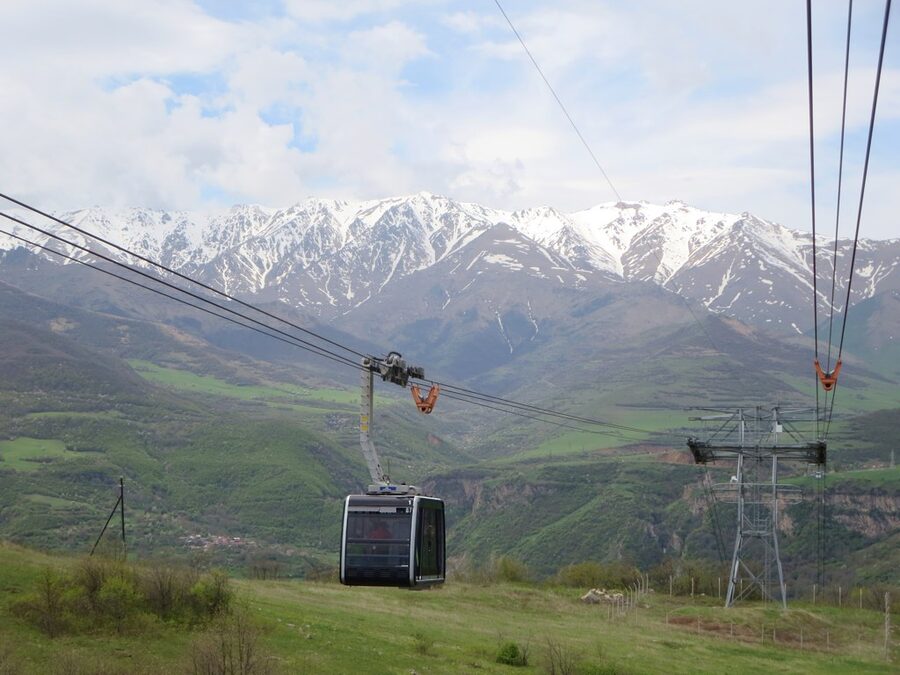
The cable car was built by the Austro-Swiss firm Doppelmayr/Garaventa, opened on 16 October 2010, and entered the Guinness Book of Records seven days later as the world’s longest reversible aerial tramway. It cost about USD 22 million. The line is 5,752 metres long. The cabin reaches a maximum height of 320 metres above the gorge floor at the deepest point. The full crossing takes 12 minutes. All revenues go back into the Tatev Revival programme: restoration of the monastery and economic support to local villages, rather than to a private operator.
Tickets and prices
Prices and hours come straight off the official Wings of Tatev site. The high-season tariff (March through November) is AMD 7,000 (about USD 18) for a return, AMD 5,500 for one-way. In low season (December through February) it’s AMD 5,000 return, AMD 3,500 one-way. Children under 7 ride free; locals get a discounted resident rate that’s irrelevant to most readers here.
You can buy tickets in person at the Halidzor station or online via tatever.am, though the online system has had outages in 2024-2026. If you’re on a tour the ticket is included in your fare. If you’re on a private trip in summer, especially on a weekend, buy the morning ticket and arrive early; afternoon queues can be 45 minutes during August school holidays.
Operating hours and the Monday rule
The Wings of Tatev runs Tuesday through Sunday, 10:00-19:00 in high season (May through August), 11:00-18:00 in shoulder and low season (September through April). Monday is the maintenance day and the cable car does not run, ever. People still turn up on Mondays and stand at the locked gate. Don’t be one of them.
The cable car also stops in high winds. Anything over about 75 km/h shuts the line. This happens a handful of times a year, mostly in late autumn and winter. If the weather looks marginal on your travel day, call the support line on +374 60 46 33 33 before driving out from Goris. If the cable car is closed, you can still drive to Tatev along the H45 from Halidzor (the road is open year-round), but it’s a 50-minute mountain drive each way and it’ll add two hours to your day.
What you actually see on the way over
Two minutes out of Halidzor the cabin crests the rim of the gorge and the Vorotan opens up underneath you in a way maps don’t prepare you for. The river is a brown-green ribbon at the bottom, snaking through what looks like a folded relief model. To your left, Iranian-plate cargo trucks are climbing the H45 toward the border. To your right, the basalt towers above the Devil’s Bridge. You can sometimes see the Harsnadzor watchtower (the small stone rotunda on the ridge) sticking out of the trees on the south slope.
About six minutes in, the monastery itself swings into view. It comes from below, an unfair angle for a building that was specifically designed to look impressive from the village. The bell tower comes first, then the Saints Paul and Peter church dome, then the curtain wall and the gatehouse. The cable car operator narrates over a slightly muffled tannoy in Armenian, English and Russian, and there’s a soundtrack involving panpipe-flavoured ambient music that does not at all match the view but somehow doesn’t ruin it either.
Sit on the right-hand side of the cabin going across (left-hand side coming back). That’s the side facing the monastery. The other side faces the canyon and is also fine, but Tatev is the headline.
The monastery itself
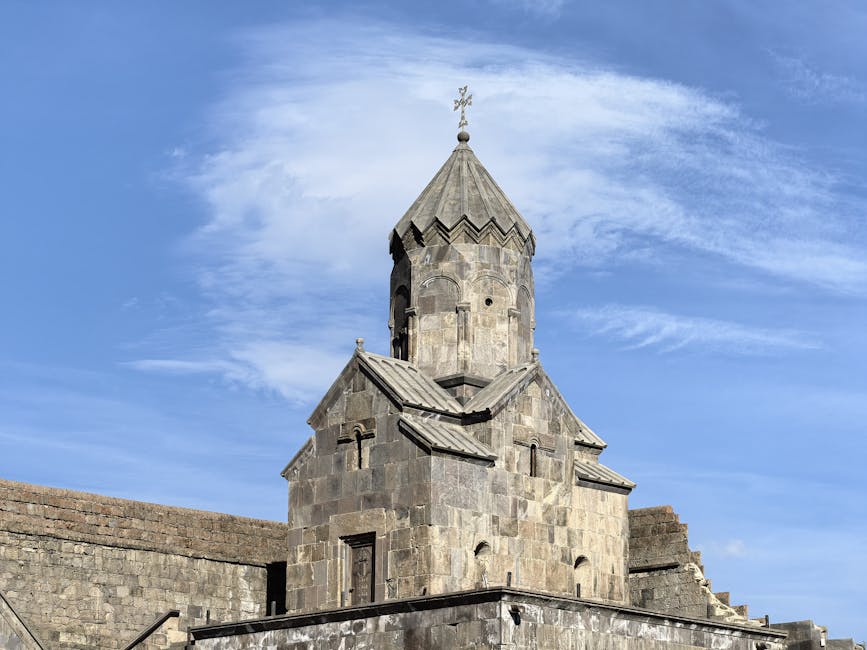
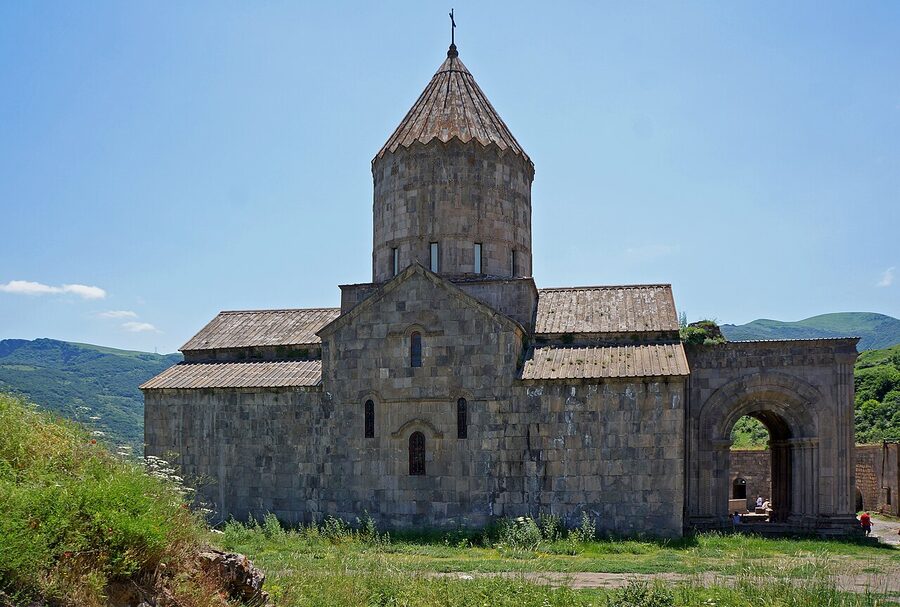
Tatev was a working bishopric, a working university, and a working monastery for most of its history, in roughly that order of importance. In the 14th and 15th centuries the University of Tatev under Grigor Tatevatsi was one of the leading centres of medieval Armenian thought, with around 1,000 monks and scholars based in and around the complex. After Tatevatsi died in 1409 and a Turkic raid in 1434 destroyed key buildings, the university wound down. The monastery limped on through invasions and the 1931 earthquake, which collapsed the dome of Saints Paul and Peter and the bell tower. The Tatev Revival programme (the same one that built the cable car) has been restoring it since 2008.
The complex is bigger than it looks. There are three churches, two refectories, a library, a mausoleum, an old oil press building, a school, residential cells for monks, and a curtain wall with a gatehouse. Allow at least 90 minutes if you want to see all of it without rushing. Two hours is better.
Saints Paul and Peter (Surb Poghos-Petros)
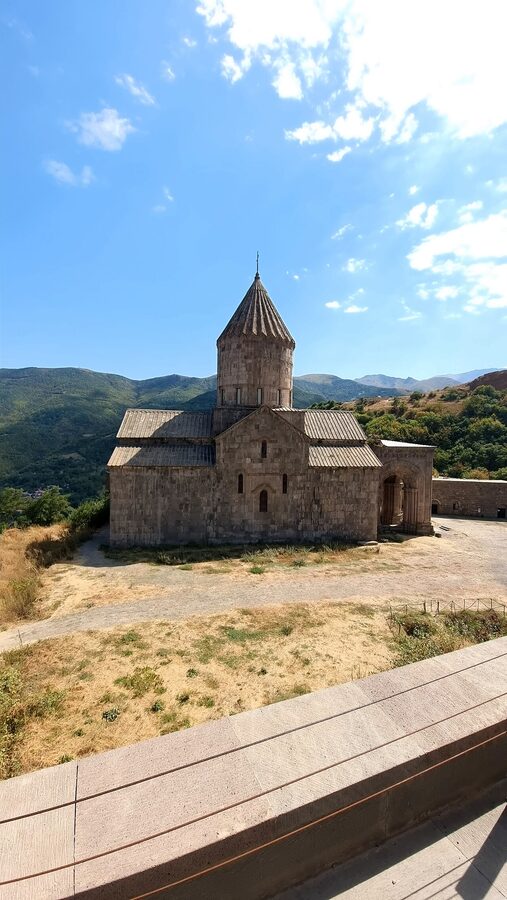
The main church, finished in 906 and consecrated to Saints Paul and Peter. From the outside it’s a classic Armenian centrally-domed cross-in-square, the kind you’ll have seen at Geghard and Echmiadzin. Up close the masonry is fascinating. Tuff blocks of slightly different colours, fitted dry, the joins so tight you couldn’t slide a coin between them.
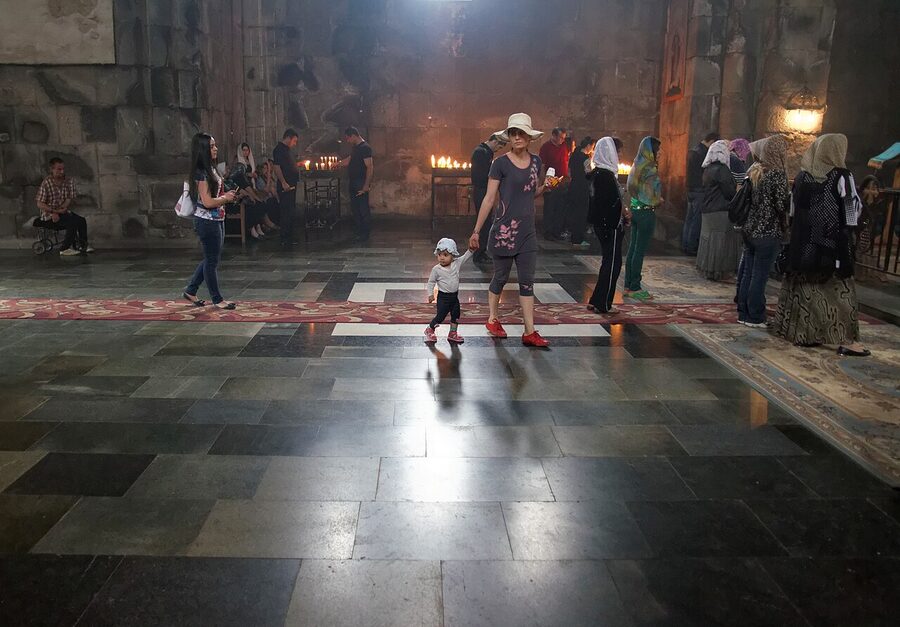
Inside, the wall paintings are mostly gone. There’s a 19th-century reference somewhere about full fresco cycles dating from 930, but the 1931 earthquake and the subsequent decades of neglect did most of the damage and the Soviet-era restoration didn’t prioritise paint conservation. What remains are fragments behind protective glass and a sense of how dim and incense-saturated the church would have been when it was the heart of a working university.
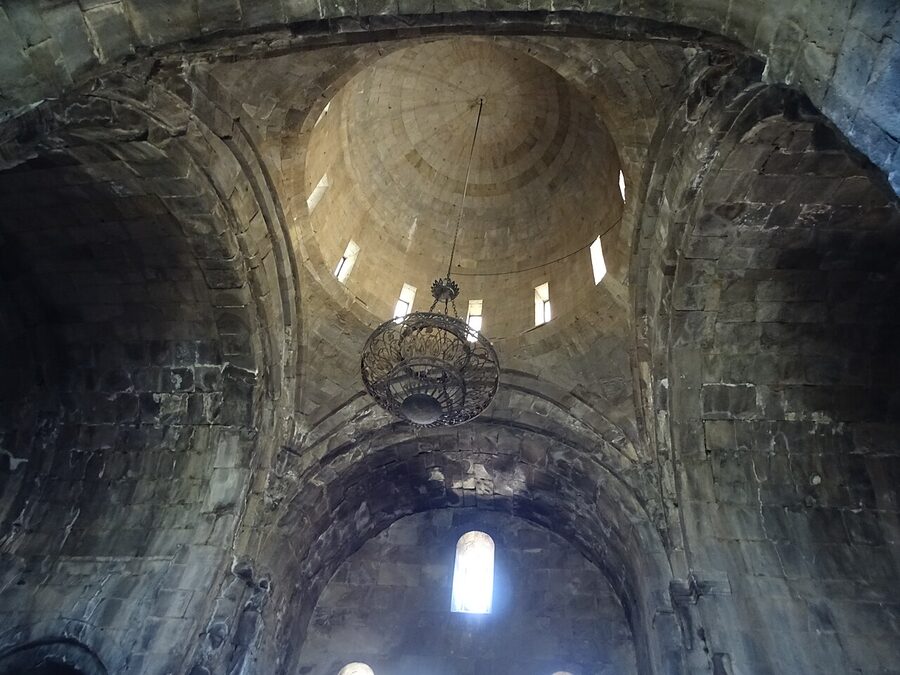
If you’re here on a Sunday, the 11:00 liturgy is open to visitors. You stand at the back, you don’t take photos during the service, and the chant inside the cleaned-out stone is one of the more memorable things you’ll experience in Armenia. It’s also the one time you really feel the building doing what it was built for.
Saint Gregory the Illuminator and Holy Mother of God
Two smaller churches inside the wall. Saint Gregory (Surb Grigor Lusavorich) is to the east of the main church, a single-nave 9th-10th century building with a more austere feel than Surb Poghos-Petros. Holy Mother of God (Surb Astvatsatsin) is to the south, smaller still, and is sometimes used for private prayer rather than tourist visits. If a door is closed at Tatev, leave it closed; the monks who still live here use these rooms.
The Gavazan column
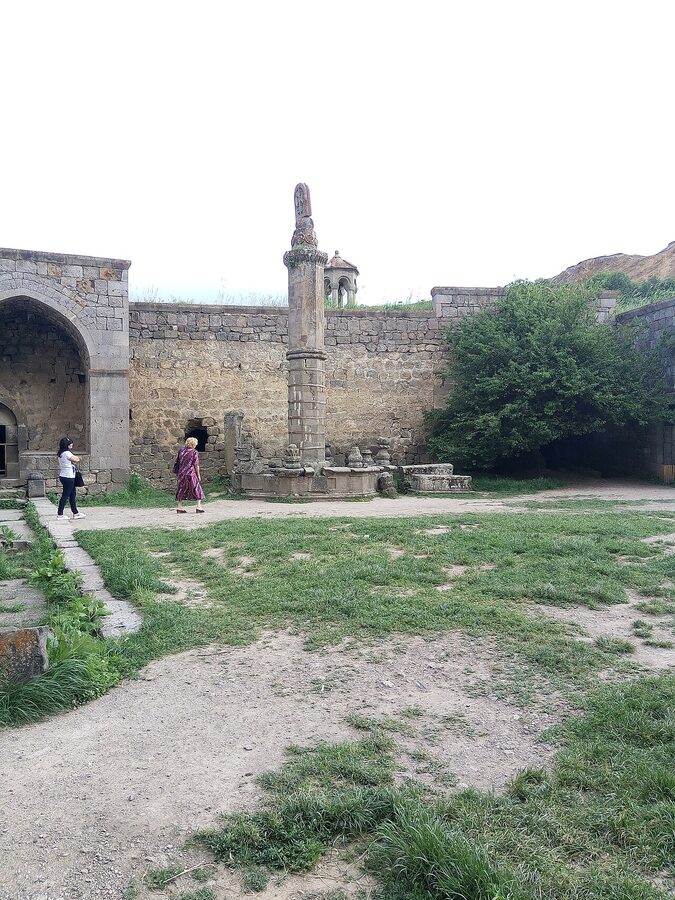
This is the thing nobody warns you about. In the courtyard near Surb Poghos-Petros stands an octagonal stone pillar, eight metres tall, called the Gavazan, which means “walking stick” in Armenian. It was built in 904. It’s articulated at the base on a kind of stone hinge, so it sways slightly when the ground vibrates. Medieval chronicles describe it warning the monastery of approaching cavalry by tilting at the right moment. Modern engineers think the swaying acted as a seismic indicator, an early-warning system for earthquakes, and probably also as a load-shedding device that prevented the column from collapsing during tremors. It’s 1,100 years old and it’s still standing because of how it’s designed to move.
You won’t see it move. You can push on it (please don’t) and you wouldn’t feel it shift. But standing next to a piece of 10th-century engineering that solved a structural problem we’re only now solving with base isolators is the reason a lot of architects come to Tatev specifically. Don’t walk past it without reading the small bilingual plaque next to it, which gives the construction date and the source citation in the History of Syunik chronicle.
The library, the refectory, the oil press
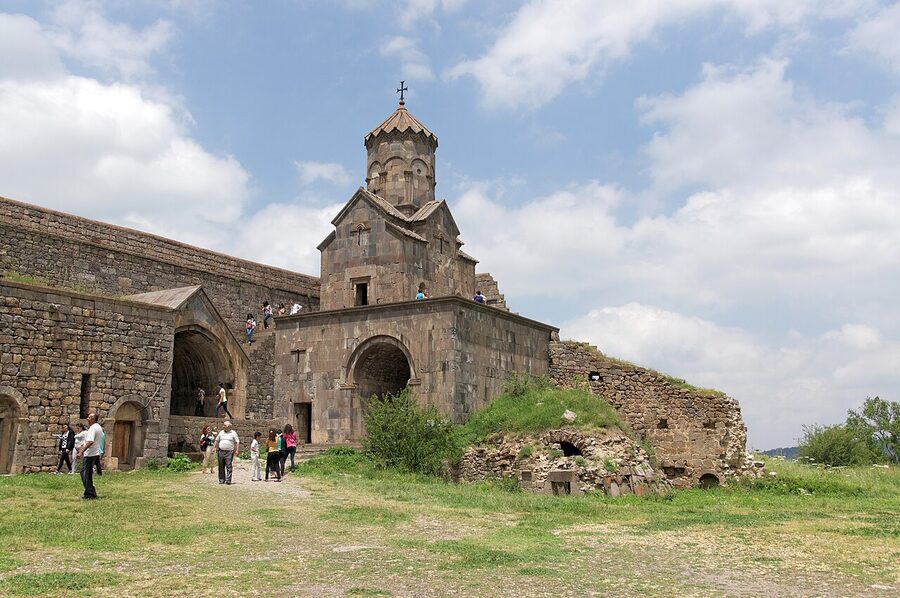
The library at Tatev once held one of the largest manuscript collections in medieval Armenia. Most of those manuscripts are now at the Matenadaran in Yerevan; what’s here are reading rooms, scriptorium spaces, and a small permanent display of replicas with bilingual labels. The refectory next door is a long vaulted hall used for monastery meals and on feast days for visiting laypeople; it’s open if no service is in progress.
The Dzit Han, or oil press, is technically outside the main complex (you walk down the lane on the south side), and it’s worth the ten minutes. The press itself is 17th century, stone wheels and beams reconstructed in working condition, and the building also doubles as a rotating photo exhibition space about Syunik villages and the Tatev Revival programme. Free entry.
The view from the back wall
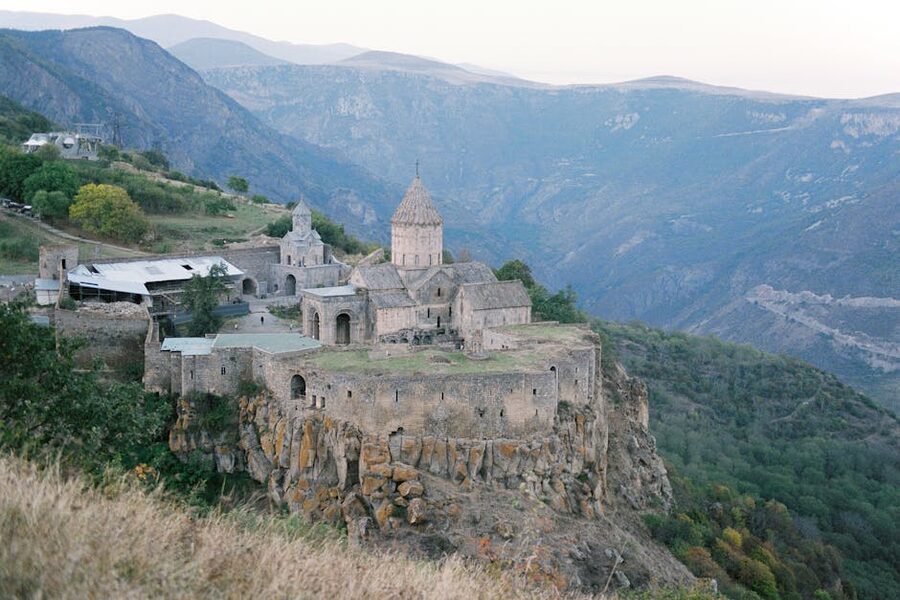
Walk through the courtyard, past Surb Poghos-Petros, and out to the southern edge of the plateau. The wall is low and the drop is real (the gorge is 600 metres deep at this point), and the view is the one you’ll have seen on every Armenia tourism poster. The basalt plateau juts out into the Vorotan canyon like a peninsula, the cable car runs across the gorge to your right, and the Harsnadzor watchtower is a small dot on the far ridge. Stay here for ten minutes. It’s the bit of the visit you’ll remember a year later.
Beyond the monastery: Devil’s Bridge and Harsnadzor
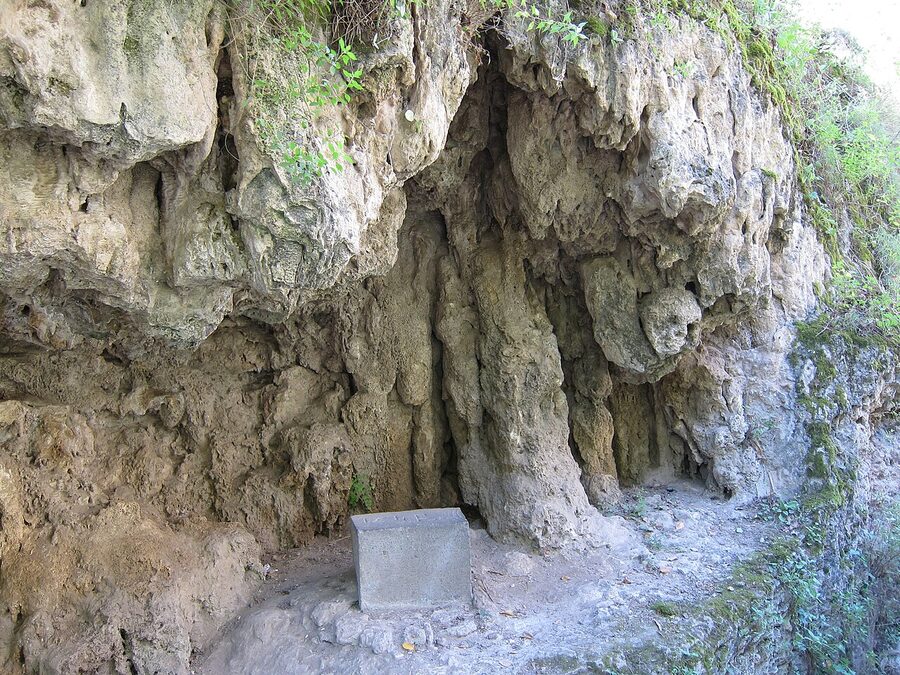
The Devil’s Bridge, Satani Kamurdj in Armenian, is a natural travertine arch over the Vorotan, formed by mineral-laden hot springs that built up calcium carbonate deposits over thousands of years. The bridge itself is about 30 metres long and 60 metres wide, and you can walk across the top of it without realising it’s there because the road runs over it. The interesting bit is underneath: ochre and rust-coloured mineral pools, hanging stalactites, and small grottos where the springs surface at around 30°C. People do bathe in them; the pools are shallow and the water has a sulphurous smell.
How to get to Devil’s Bridge
The Wings of Tatev operates a shuttle service from Halidzor station to Devil’s Bridge and the Harsnadzor watchpost for AMD 1,000 per person, including the round trip. It’s a 1 hour 15 minute add-on and most group tours do not include it. You can almost always tag onto a shuttle if your group’s lunch break is long enough. Otherwise, ask your taxi driver to detour to Devil’s Bridge on the way back to Goris; it adds 20-30 minutes to the drive and AMD 1,500-2,500 to the fare. If you’ve got a private driver for the day, this stop is the one you’ll be glad you made.
Harsnadzor watchtower
Above the gorge on the south side stands the Harsnadzor watchtower, a small stone rotunda from sometime around the 17th century. It was a signal post: when raiders approached up the Vorotan, the bell rang here and the bell at Tatev rang in response, and the Zangezur villages had warning. The chains that held up the bell are still inside; the bell itself has been gone for a long time. The walk up to the rotunda is about 30 minutes from the road, on a path that is steep but not technical. The view from the top covers Tatev plateau, the cable car line, and the upper Vorotan. Bring water; there is none at the top.
Hiking down from the monastery to Halidzor
Buy a one-way cable car ticket up, then walk back. The trail descends from the monastery through the village of Tatev, past the Great Hermitage of Tatev (a smaller monastic complex used as a retreat), past Devil’s Bridge, past Harsnadzor (you can detour up to the watchtower), and back to Halidzor. Total distance is about 10-12 km and the walk takes 4-5 hours including stops. It’s a hilly walk on a road and a partly-marked trail, not a technical hike, but bring water (4 litres per person in summer is not too much) and food because there’s nothing en route. People do this in trail runners; they shouldn’t in flip-flops.
Eating and sleeping at Tatev itself
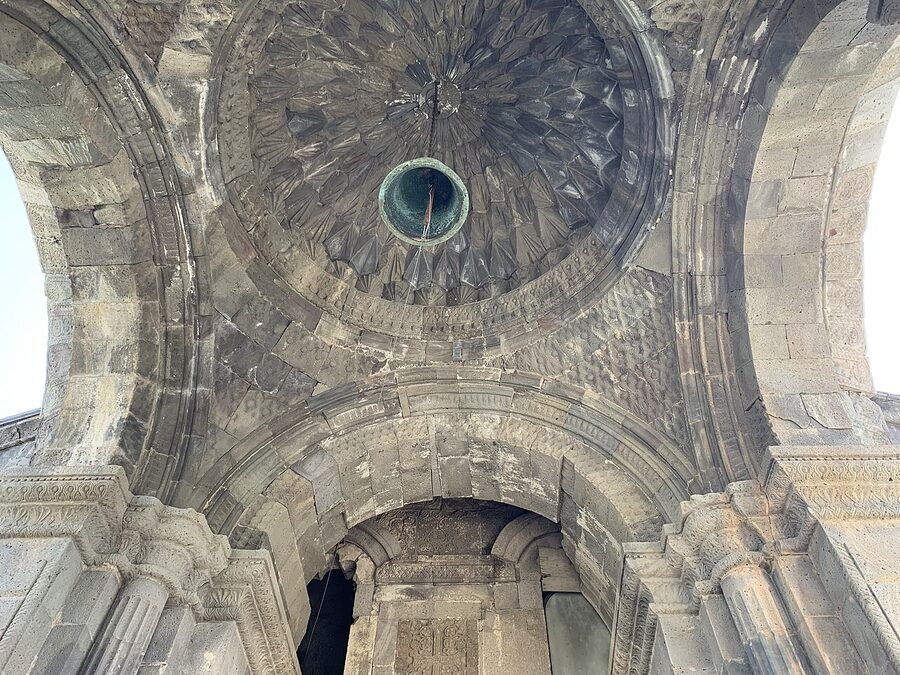
Most people eat lunch on the Tatev side of the cable car. There are two main restaurants near the monastery and a handful of food stalls; you eat well at any of them, and you eat the same set of dishes everywhere because the village runs on a small number of family-owned places.
Tatevatun
The official cable-car-affiliated restaurant, run as part of the Tatev Revival programme. Set lunch menus at AMD 5,000 per person: tjvjik (beef liver in onion sauce), bean soup, mountain sorrel salad, lavash, cheese, water and tea. Vegetarian version with ishli kufta or red bean salad and Armenian yogurt soup (spas) at the same price. The food is fine, the location is convenient, and it’s usually where the group tours stop, which means it can fill up between 13:00 and 14:30 in summer.
Tatev Info Cafe
Across the road from the cable car parking, smaller, family-run, and noticeably better if you have any vegetarian or vegan members in your group. The menu changes by season; sorrel soup, red bean stew, beet salad, and pickled wild mountain greens (jajik) are reliably good. Mains around AMD 2,500-3,500. They also do real coffee, which on the Tatev plateau is not a given.
Saro Restaurant (Tatev Authentic Food)
A smaller family place down the road, signposted on Google Maps as “Tatev Authentic Food.” Excellent khorovats (Armenian barbecue), home-made apricot vodka if Saro’s in the mood to bring it out, and mains around AMD 3,000-4,500. The atmosphere is rougher than Tatevatun (it’s somebody’s actual front yard with tables), and the food is better. If you’re not on a group tour, this is the one to pick.
Sleeping in Tatev village
If you want to wake up at the monastery before the cable car opens (which is the kind of thing that turns a Tatev visit into a lifelong memory), the village has about a dozen homestays. Aida B&B and Arman’s in Halidzor are the two most consistently mentioned, both family-run, both around AMD 12,000-18,000 per night for a double with breakfast. Bookable on Booking.com but check the place is actually open in the season you want; some close November-March.
The standard itinerary stops on the way
If you’re coming from Yerevan, the four-and-a-half-hour drive south is too long to do without breaks. Most tours stop at two or three of the following.
Khor Virap
Forty minutes south of Yerevan; the closest spot in Armenia for an unobstructed view of Mount Ararat across the closed Turkish border. The monastery is small but the setting is iconic, and the morning light (before about 11:00) gives the cleanest view of the mountain before clouds build up around the summit. Most Tatev tours stop here for 30-45 minutes. If you want a longer dive into the place, see our Khor Virap travel guide.
Areni and Hin Areni Winery
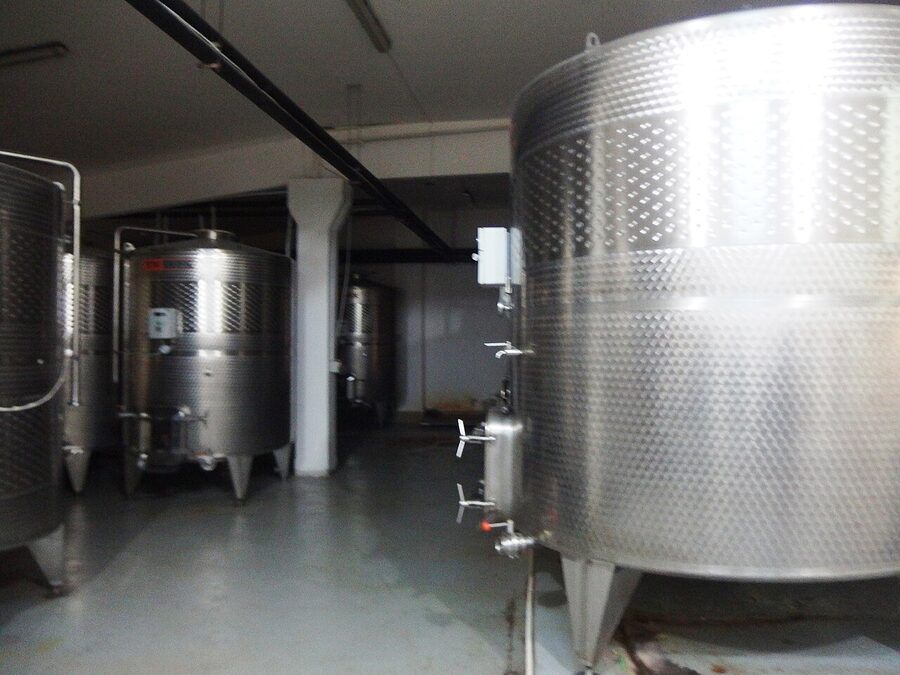
About halfway between Yerevan and Tatev, in Vayots Dzor province. The village of Areni gives its name to the dominant Armenian red grape, and the Areni-1 cave just outside the village is the site of the world’s oldest known winery, dating to about 4,100 BC. Hin Areni and a couple of other small wineries do tastings; the typical tour stop is 30-40 minutes for two or three pours and a vineyard view. The wines are good (the reds are tannic and a bit rustic, the rosés are clean), the prices for retail are competitive, and the dolma at the cafes around the winery is some of the best in southern Armenia.
Noravank
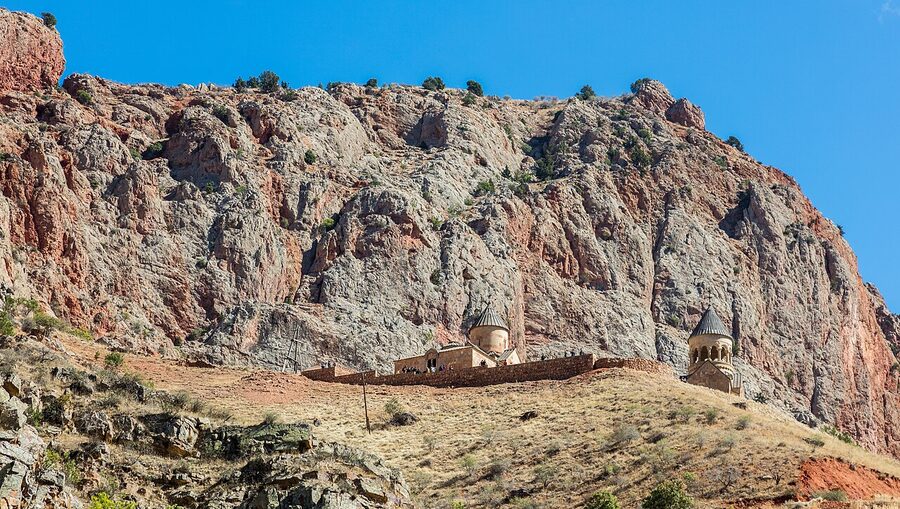
A 13th-century monastery in a side canyon five kilometres off the main road, known for the Burtelashen church with its narrow exterior staircase running up the front wall. The carved tympanum over the upper door (God the Father holding the head of Adam, with the dove of the Holy Spirit) is one of the more striking pieces of medieval sculpture in Armenia. Forty-five minutes here is usually enough; longer if you want to climb the staircase, which is steep, narrow, and worth doing.
Shaki Waterfall
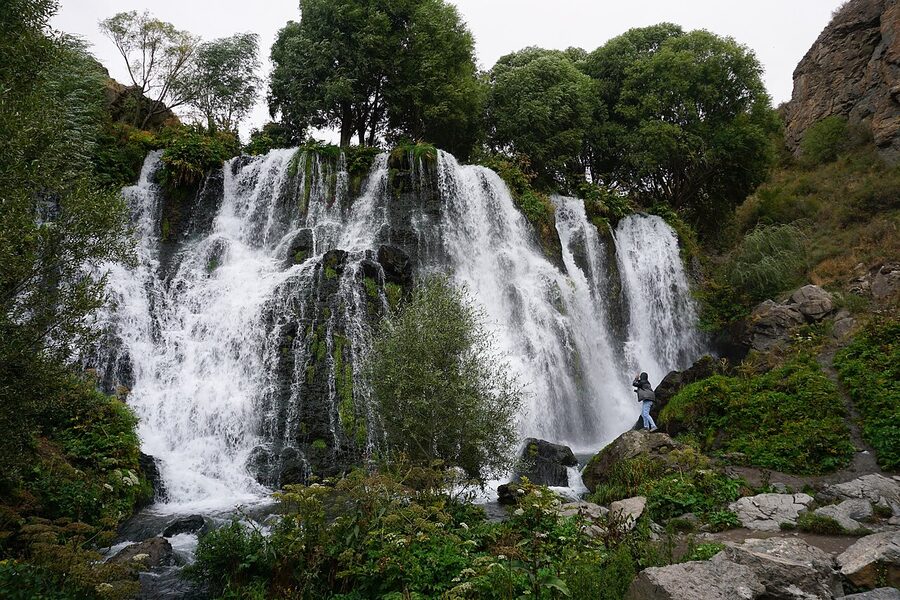
An 18-metre waterfall just off the main road south of Sisian, included on some Tatev tours and skipped on others. Best in May and June when the snowmelt is feeding it; by late August it’s thinner. There’s a viewing platform 50 metres from the parking lot and a short trail down to the base. Fifteen minutes is enough.
Khndzoresk
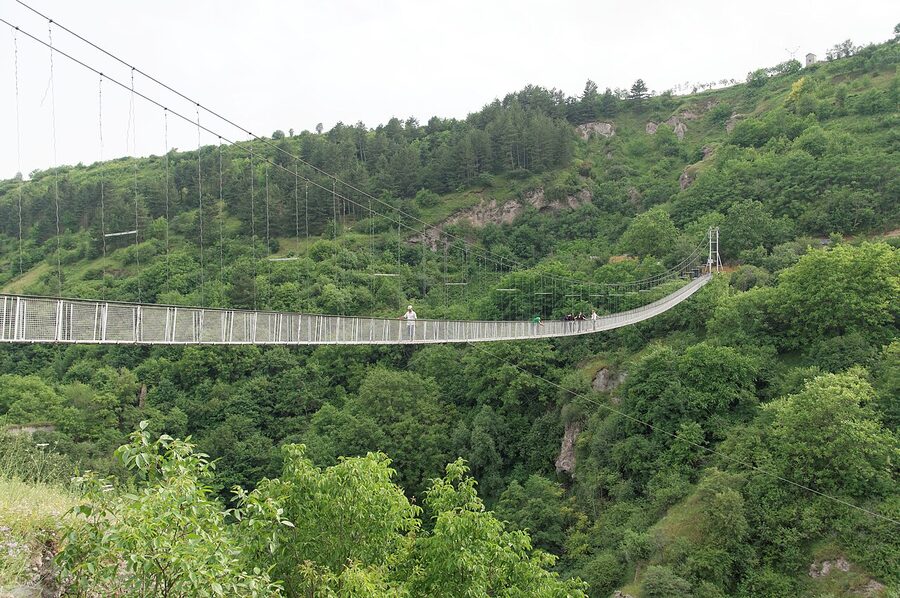
Twenty minutes east of Goris, the abandoned cave village of Khndzoresk sits in a gorge full of natural rock dwellings that locals lived in until the 1950s, when Soviet authorities resettled the population to a new village on the rim. The 160-metre suspension bridge that crosses the gorge between the two halves of the old village was built in 2012 and is the photogenic bit; the caves themselves are a 30-minute scramble down from the parking lot. If you’re overnighting in Goris, this is the half-day trip to do on either the morning before or the morning after Tatev.
When to come
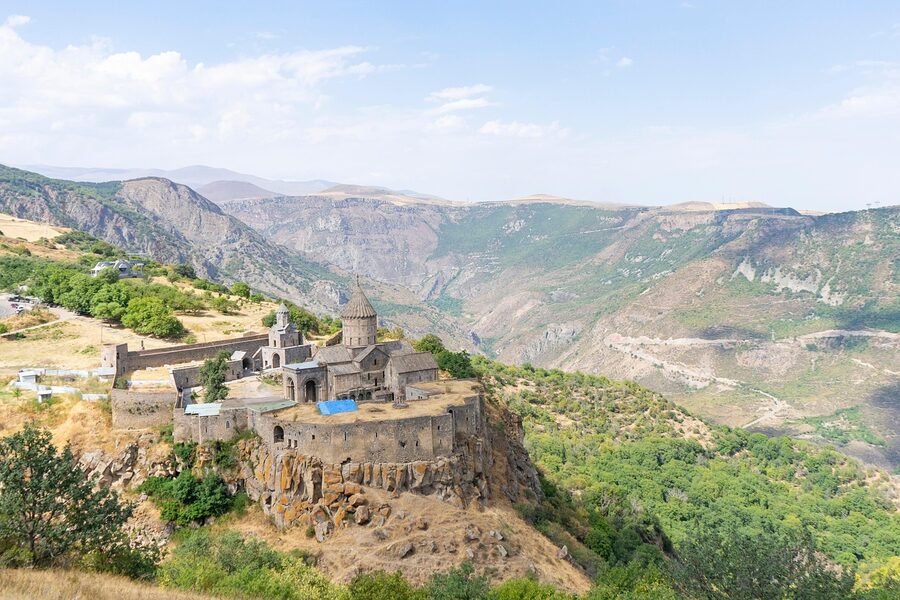
The cable car runs all year, but the trip looks and feels different in different seasons.
May to June
The best window. The grass on the Tatev plateau is green, the apricot blossom is on in the Vorotan villages, and the temperatures sit at a manageable 18-25°C. Days are long. The cable car has occasional wind closures in May but they’re short. This is also when the local guesthouses are most likely to have rooms because the package-tour rush hasn’t fully started.
July to August
Hot at lunch (28-32°C on the plateau, hotter in Goris in the gorge below), busy at the cable car, and the queue at Halidzor in the early afternoon can be 30-45 minutes. Go in the morning, eat lunch on the Tatev side, ride back at 17:00 when most of the day-trippers have already left. The main downside in summer is the heat haze: the canyon view from the back wall of the monastery is clearer in spring or autumn.
September to October
The other peak window. Cooler than summer, blue skies most days, the Vorotan villages have apricot drying frames out, and the autumn colours in the gorge come in late October. Hours roll back to the 11:00-18:00 schedule from late September.
November to April
Quieter, cheaper, and unpredictable. The cable car runs but wind closures are common from late November through February. Goris stays accessible (the Yerevan-Sisian road is gritted year-round), but a winter visit means accepting that one of your two travel days might lose the cable car. The upside is the empty monastery and the snow on the basalt plateau, which is genuinely spectacular if it cooperates.
Practical bits, ranked by how often I get asked them
Is there an entrance fee for the monastery?
No. Tatev itself is free to enter. You pay only for the cable car (or for the road to the village if you’re driving) and for any audio guide.
Is there an audio guide?
Yes. The Wings of Tatev rents a portable audio device for AMD 2,000 against an AMD 30,000 deposit (or your ID card). Languages are English, Armenian, German, Russian and French. The audio covers the cable car ride, the monastery complex, the Devil’s Bridge, and the Harsnadzor watchtower. It’s decent. If you’re on a group tour you don’t need it; the guide’s narration covers the same ground.
What should I wear?
Trousers or a long skirt, sleeves to the elbow at minimum, and a head covering for women if you’re going inside the church during a service. There are loose wraps available at the monastery entrance if you turn up underdressed. The walk between the cable car and the monastery is on uneven flagstones; trainers, hiking sandals, or sturdy walking shoes are right. Heels are wrong.
What about money?
Bring cash. The cable car ticket counter takes cards but the on-site cafes, souvenir stalls, and most of the village restaurants are cash-only. AMD 30,000-40,000 in cash per person covers the cable car, lunch, the audio guide, the shuttle to Devil’s Bridge, and a few souvenirs with margin to spare. There’s an ATM in Goris but not in Halidzor or Tatev village, so draw cash before you leave town.
Phone signal?
Patchy. Beeline and Ucom have coverage at Halidzor station and at the monastery; coverage drops in the cable car and is non-existent inside the gorge. If you need to coordinate a pickup, agree the time and place before you cross. Wi-Fi is available at Tatevatun and Tatev Info Cafe but not free at all of them; ask at the counter.
Souvenirs worth buying
Apricot honey from the Tatev village stalls (about AMD 3,000-4,000 for a 500g jar) is the genuine thing. Bees from the apricot orchards on the south slope of the plateau, and it tastes like apricots in a way that supermarket honey doesn’t. Walnuts in syrup (the Armenian dessert called rojak) is the other reliable buy. Skip the mass-produced Tatev branded fridge magnets and the polyester scarves. The local woven textiles in some of the stalls are real, made in the village; the polyester ones are imports and you can usually tell by feel.
The verdict on day tours vs overnighting
If you have five or more days in Armenia, sleep in Goris and do Tatev as a half-day trip. You’ll see the monastery in better light, you’ll have time at Devil’s Bridge, and you’ll get to do Khndzoresk on the same trip. The accommodation in Goris is cheaper and better than what you’d get in central Yerevan for a comparable night.
If you have three or four days, take the day tour. It’s long, it’s tiring, and you won’t see Devil’s Bridge or the watchtower properly, but you will see Tatev, you’ll see the cable car ride that everyone talks about, and you’ll have ridden through one of the more spectacular stretches of countryside in the Caucasus. Skipping it because the day is long is a trip-defining mistake.
If you have two days, skip Tatev and pick a closer monastery cluster. The combined Garni-Geghard-Khor Virap day from Yerevan is rich enough on its own, and you won’t spend nine hours in a minibus to do it. There’s no shame in not seeing every famous thing on a short trip.
One thing I’d do differently
On my second visit I bought a one-way cable car ticket up and walked back. It’s the version of this trip I’d recommend to anyone who’s reasonably fit, has half a day of slack in their itinerary, and brought trainers. You leave the monastery as the afternoon group tours are arriving, you walk down through the village past the kitchen gardens, you cross Devil’s Bridge on foot rather than from a shuttle bus window, and you climb up to the watchtower with the gorge opening up in front of you. It takes about four hours from the back wall of the monastery to the Halidzor station, with stops. You’ll arrive sweaty, tired, slightly sunburned, and convinced that this was actually the better half of the trip.
The cable car ride is the famous bit. The walk is the one you’ll talk about.
Booking the trip
If you’re coming as a day tour from Yerevan, the three platforms with verified inventory in the top of search results are Viator, GetYourGuide, and Klook. For the cable car alone, tickets are bookable directly through tatever.am, the official site, when their online booking is up; if it’s down, just turn up at the Halidzor counter.
The monastery is open dawn to dusk every day. The cable car is closed Mondays. Mount Ararat will be cloud-covered after about 11:00 in summer and 13:00 in spring. There’s no part of this trip that goes well if you’re in a hurry.
.jpg)


.jpg)


.jpg)


.jpg)


